• Skip to primary navigation
  • Skip to main content
  • Skip to primary sidebar

Appliance. net

Appliance news, reviews, ratings, forums, reports and buyers guides.
Locate repairs and parts. for home and kitchen appliances.

  • About Appliance.Net
    • BestPrice Family
    • Contact
    • Become a Featured Dealer
    • Retailer & Repair Services Advertising
  • Shopping
  • Appliance Forum
  • Manufacturers
    • Manufacturers 800 Numbers
    • Aga
    • Bosch
    • Caldera
    • Dacor – The Life of the Kitchen
    • General Electric – GE
    • Jenn Air
    • Sears – Kenmore
    • Thermadore
  • Sections
    • Features
    • News
    • Recalls
    • Kitchen
      • Dishwasher
      • Ranges Ovens and Cooktops
      • Refrigerators and Freezers
      • Microwave Oven
    • Household
      • Consumer Electronics
      • Heating and Cooling
      • Vacuum Cleaners
    • Laundry
      • Washing Machine
      • Dryers
    • Safety
You are here: Home / Archives for Features

Features

Jenn-Air’s Newest Refrigerator Line

June 17, 2009 By NightOwl

Jenn-Air, is introducing a new collection of high performance built-in refrigerators; available configurations in the new fully-integrated flush built-in refrigerator collection include 36-inch bottom-freezer and popular side-by-side door models along with an industry-first 42-inch French door bottom-freezer model offering the widest interior space available in any flush refrigerator currently on the market.

Created with the design-conscious consumer in mind, the thinner exterior door provides a flush fit with custom cabinetry for a seamless exterior, while the interior features greater usable cubic space than similar flush refrigerators. High performance vacuum insulation panels help maintain energy and keep food fresher, longer. The articulated hinge is equipped with a multi-pivot arm mechanism for smooth opening and closing. This hinge allows the refrigerator door to swing beyond a 90 degree angle.

All refrigerators in the new line feature Advanced Climate Control Technology which allows customized drawer storage at lower temperatures than the refrigerator for highly perishable foods through independently controlled Advanced Climate Control bins. Four settings provide more precise control of different temperatures including deli, produce, meat and Quick Chill. The Quick Chill setting lowers the bin temperature below liquid freezing point for a period of one hour, ideal for quickly chilling white wine, sparkling water or other beverages. . An industry exclusive removable water filter conveniently located at the base grill is easily accessible and features PUR® filtering technology.

Launching this spring, style options include the sleek Euro-Style Stainless and the commercial look of Pro-Style® Stainless. Beginning this fall, the warm hued tones of Oiled Bronze and the contemporary Floating Glass in both black and white will be added to the collection and all finishes will be available with updated style options. For consumers who may redecorate frequently, the exterior panels of the refrigerators are designed as separate pieces and can be easily switched out with a different style panel without having to replace the refrigerator. The overlay model accepts custom panels and handles, allowing the refrigerator to blend seamlessly with existing cabinetry. The refrigerators are available in 36-inch bottom-freezer, 42-inch French door bottom-freezer, and 42-inch and 48-inch side by side non-dispensing configurations.
Filed Under: Features, Kitchen, News, Refrigerators and Freezers Tagged With: bottom freezer, french door refrigerator, integrated refrigerator, Jenn-Air, Jenn-air refrigerator

Haier Acquires 20% of Fisher Paykel

June 15, 2009 By NightOwl

Haier Group announced it is participating in Fisher & Paykel Appliances’ (FPA) recapitalization plan. The plan includes the issue of new shares, share placement from existing shareholders and a top-up placement. At the plan’s completion, Haier will hold a 20% stake in FPA and becomes a new cornerstone shareholder of the home appliances manufacturer from New Zealand.

Haier and FPA also signed a Cooperation Agreement for the benefit of both companies that includes the sharing of market, design and technology resources, corporate and product planning, coordination of both companies’s manufacturing resources, optimization of sourcing and cooperation of after sales services globally.

Under the Agreement, Haier will have exclusive marketing and distribution rights of Fisher & Paykel Appliances-branded products in China, and Fisher & Paykel Appliances will have exclusive marketing and distribution rights of Haier-branded products in Australia and New Zealand.

Filed Under: Features, Household, News Tagged With: fisher and paykel, fisher paykel applianes, fisher paykel recapitalization, fisher pykel, Haier, Haier appliances

The Dishwasher of the Future – Washing With Air

June 12, 2009 By NightOwl

One of the big questions facing those of us who are trying to conserve water, is whether to wash dishes by hand or use the dishwasher. In most cases, the dishwasher uses less water, but for those folks who are still concerned, Hwang Jin Wook’s modern dishwasher prototype should intrigue you.

Hwang Jin Wook’s modern dishwasher concept developed for Electrolux uses air to clean the dishes by blowing away food bits. High-pressure air is used to clean the dishes. Steam is used to degrease the dishes and Ultraviolet rays are used to sterilize the dishes. Very little water is used to create steam but the water is recycled so essential water is never wasted.

It sounds like a great idea, but there is a small problem – the dishwasher cleans only two dishes at a time. This is a problem for most of us since a meal usually involves at least a pot or two and some utensils. Although now the unit is designed with single, young users in mind, expanding it to include family use will have a much greater impact on water conservation.

This is a great idea, can it be refined for mainstream use? We’ll wait and see.

You can read more here.

Filed Under: Dishwasher, Features, Kitchen, News Tagged With: dishwashers, dishwsher innovations, electrolux, electrolux dishwashers, save water, water saving dishwashers

Time to Replace That Old Refrigerator

June 10, 2009 By NightOwl

Is your refrigerator more than ten years old? If so, replacing it can save you some serious money. The problem is can it save you enough to warrant shelling out the money for a new unit? A new refrigerator isn’t cheap, but an older one accounts for anywhere from 5-8 percent of your household energy.

The nonprofit advocacy group Alliance to Save Energy estimates that if the older refrigerators were replaced, Americans would save $866 million a year in utility costs. In general, a new efficient refrigerator uses about half the energy of its 10-year-old cousin, federal statistics show.

If you plan now, you might be prepared when the new federal stimulus bill funneling $300 million into rebates for energy-efficient appliances, is enacted. But be ready to act because with 112 million households in the country, that $300 million won’t go far.

How to know when to buy? Uncle Sam’s efficiency program, Energy Star, has a refrigerator calculator on its Web site: www.energystar .gov. All refrigerators manufactured in the United States must meet minimum efficiency standards, but Energy Star-certified models are at least 20 percent more efficient.

If you’re thinking of buying a new refrigerator, here are some tips from EnergyStar:

• Start with the calculator at www.energystar.gov.

• When shopping, factor in the appliance’s yellow “EnergyGuide” label listing the energy use and approximate annual operating cost.

• Go smaller. Larger models cost more to operate, and a full refrigerator is more efficient than a half-empty one.

• Models with top freezers are the most efficient, using 10 percent to 25 percent less energy than side-by-side models.

• Consider doing without the ice-maker and dispenser. These increase energy use by 14 percent to 20 percent.

To get the most out of any refrigerator:

• Position it away from heat – an oven or dishwasher. Leave room at the back and sides for air circulation.

• Keep the air intake and condenser coils clean.

Filed Under: choosing a Kitchen Appliance, Features, Kitchen, Refrigerators and Freezers, _ Tips Tagged With: buying energy efficient appliances, energy efficient appliances, energy efficient refrigerator, energy efficient refrigerators, energy guide, energy star, refrigerator, refrigerators

Win an LG HE Washer and Dryer Pair

June 8, 2009 By NightOwl

The LG True Steam washer dryer pair is the prize available to contestants who enter to win through the LG or Benjamin Moore Paints websites.

From what we can find, the washer includes these Key Features:

* TrueSteam™ Technology
* Ultra Capacity (4.5 cu.ft.)
* TrueBalance™ Anti-Vibration System
* Wash/Rinse Optimizer™
* Trilingual LCD Display
* 1300 RPM Spin Speed
* 9 Washing Programs

Hey, it’s a chance for a free washer and dryer – Go ahead, give it a try.

Filed Under: contests, Dryers, Features, Laundry, Washing Machine Tagged With: appliance contest, LG, LG contest, LG dryer, LG washer, LG washer and dryer

Get Cleaner Dishes Out of Your Dishwasher

June 5, 2009 By NightOwl

We’re always scouring the web for the best appliance tips. Recently The New York Times offered this advice:

    Simply scrape your dishes, don’t pre-wash. The detergent goes after the food.

    Use just enough detergent. This is determined by how dirty they are, not how many dishes are in the load.

    Powdered detergent works better than liquid or tablets.

    Load properly, glasses on top, pots and pans on the bottom and don’t let items nest together. You can check your manual for the best way to load your particular dishwasher. Also, don’t impede the free movement of the sprayer arm.

    Streaks and spots are caused by water droplets and are not permanent. A rinse aid will help prevent them.

My favorite tip: Open the dishwasher immediately after the cycle ends. The dishes are at their hottest and will dry very quickly, leaving shiny dishes with no spots.

Filed Under: Dishwasher, Features, Kitchen Tagged With: Dishwasher, dishwasher loading tips, dishwasher tips, loading the dishwasher, spotty dishes

GE Stainless Upgrade, Plus Kitchen and Vacation Sweepstakes

June 3, 2009 By NightOwl

For a limited time, GE is offering an upgrade on selected models of their refrigerators, dishwashers, ovens, and microwaves. You can choose a stainless finish for the same price as white, bisque or black. You can find all the details HERE.

GE is also offering a Grand Prize trip to your choice of Bilbao, Spain, Brussels, Belgium, Los Angeles, CA,
Louisville, KY, New York, NY, or Seattle, WA.

First prize:

A full Kitchen suite of stainless steel appliances, including a refrigerator, range, microwave and dishwasher.

Eighteen Second place prizes of a stainless steel appliance of your choice will also be awarded.

As always with these contests, no purchase is necessary. See HERE for entry.

Filed Under: contests, Dishwasher, Features, Kitchen, News Tagged With: free stainless upgrade, GE, GE contest, GE stainless steel, GE stainless upgrade, GE sweepstakes, stainless steel, stainless steel offer, stainless steel upgrade, vacation contest

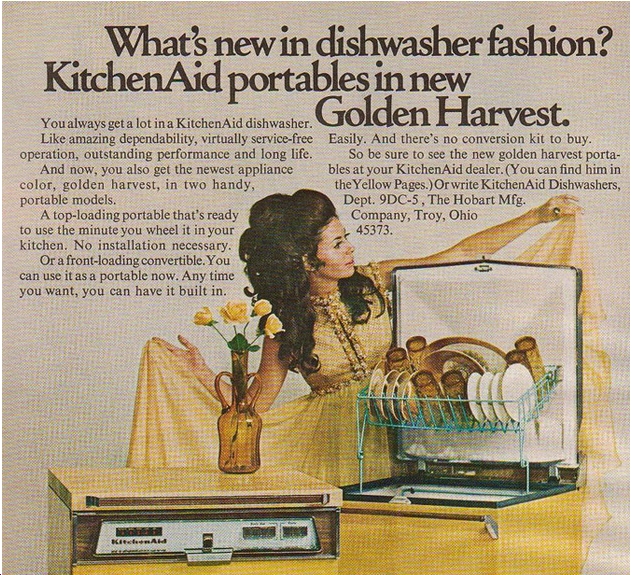
70’s Appliances – Do You Remember Harvest Gold?

June 1, 2009 By NightOwl

Today stainless is still popular in kitchen remodeling, but it is slowly losing its standing to oiled bronze. Thirty years from now we will all look back at these kitchens and fondly remember them the same way we are chuckling at the kitchens of the 1970’s.

Although my mother chose the ever-so-popular Avocado Green appliances, another favorite of the era was Harvest Gold. This ad not only shows the wonder of the modern dishwasher, but also how important it was to dress appropriately for the job. Especially since this was one of the new portable dishwashers that she would be pushing around the kitchen.

Notice the stylish brown tinted glassware? My parents had something similar that I thought was the height of elegance.

Filed Under: Dishwasher, Features, Humor, Kitchen, Laundry, Recalls, Safety, Small Appliances, _ Tips Tagged With: 1970's appliances, 1970's dishwashers, 70's appliances, dishwashers, harvest gold appliances, old dishwashers

Put it on Ice – Using Your Freezer to Save Money

May 29, 2009 By NightOwl

Every house has one – the freezer that is attached to your fridge. The problem is most of us don’t use it to its full advantage. Check out the contents of your freezer. Most likely it contains a frozen pizza or two, some ice cubes, ice cream and maybe some mystery meat and leftovers you thought you’d reheat someday.

Well, Mark Bittman at the New York Times has some very helpful suggestions for putting your freezer to work for you.

In terms of reducing waste, the most important step you can take is to freeze things the moment you realize you’re not going to cook them in time. If you get a last-minute dinner invitation, you might freeze that fish you bought; if you take the kids strawberry picking, get the excess in there as quickly as you can; if you have a superharvest of vegetables (or a good score at the farmer’s market), blanch them and freeze them.

After all, few foods improve in the refrigerator. They don’t improve in your freezer, either, but they degrade more slowly, especially if you keep the temperature at 0 degrees or below. While you’re freezing, remember that your enemy is freezer burn, a freeze-drying on surfaces exposed to air that imparts unpleasant flavors and dry, fibrous textures. To help maintain quality, avoid freezer burn by double- or even triple-wrapping food, filling containers to the top and squeezing the air out of containers (zippered bags are good for this).

One more thing, easy to overlook and impossible to overrate: Label. It is incredible how much things grow to resemble another in the freezer. Use a permanent marker, write exactly what it is (“fish” or “stew” isn’t as helpful as “monkfish” or “lamb/veg stew”), and date it.

STORAGE

In addition to produce and meats, there are some less obvious ingredients whose life can be extended by freezing. Most of them can be used straight from the freezer: Fresh noodles; flours or meals; grains; nuts (which taste kind of good frozen); whole coffee beans (supposedly not as good after you freeze them, but most of us can’t tell the difference); banana leaves (nice for plating or wrapping, but they come in huge packages); and more, detailed below.

LEFTOVERS

Make extra of any dish, with leftovers in mind, then freeze in smaller portions that can be taken to work, sent to school or reheated for a solitary dinner. Freeze in individual containers, topping up with water, cooking liquid or oil to prevent freezer burn, or freeze in sturdy zippered bags, then squeeze out as much air as possible. Defrost in the fridge, in cold water, or in a microwave, or not at all — many items can be reheated straight from frozen. (Yes, I’m talking about homemade TV dinners.)

BEANS AND GRAINS

I’m tempted to say that you should never cook beans or grains without making more than you need. Freezing them (covered with water or cooking liquid, leaving room for expansion) works that well, and saves loads of time.

STOCK

For home cooks, the biggest problem with stock is having it around when you need it. So make as much as you can manage — three gallons, say. To save space, you can reduce the stock so that it’s extra concentrated, and reconstitute it with water to taste when you’re ready. Refrigerate and skim the fat, if you like, then freeze in containers of varying sizes, or in ice cube trays.

STOCK-MAKING MATERIAL

Scraps of poultry (most of the chicken parts we don’t eat are good for stock), meat (again, especially the less-used, bonier parts) or fish (heads and skeletons in particular), vegetable trimmings, bones and more. Keep separate bags for each, adding to them when you can. Remember, though, that stock is not garbage soup: Carrot and potato peels, cabbage cores, and the like can be used, but in moderation. Animal organs are best avoided (fish gills and guts must be removed, and offal in general makes bitter stock).

BREAD, BREAD DOUGH, BREAD CRUMBS

Freeze dough in well-wrapped balls; defrost until it regains springiness. (It will never rise quite as high as unfrozen dough, but it works nearly perfectly for pizza or focaccia, and well enough for other uses.) Good crusty bread, wrapped in aluminum foil, can turn lighter dishes into meals — just defrost in the foil at 350 degrees or so for 10 minutes, then crisp up, unwrapped, at slightly higher temperatures. (I’m talking about crusty bread; sliced bread can be defrosted on the counter or in a toaster.) And stale bread can be made into crumbs in a blender or food processor, stored in a container, and added to at will.

PASTRY AND PASTRY DOUGH

Most cake and cookies freeze pretty well, carefully wrapped. Or make a frozen log of “refrigerator” cookies to slice and bake later. Same with biscuits: make a whole batch or double batch of biscuit batter, bake just enough for dinner, and freeze the rest.

TOMATOES AND TOMATO SAUCE

Tomato sauce is best frozen in zippered bags with the air squeezed out. If you have ripe tomatoes, core, quarter, and throw them in a bag; as they thaw the skins will slip off, a bonus. (The frozen chunks separate easily so you can just break off a couple for soups, stews, salsas, sauces and so on.) You can also freeze unused portions of canned tomatoes, preferably in their juice.

BACON

Or pancetta, prosciutto, smoked ham hocks, prosciutto bones, etc. Wrap tightly in plastic and cut off pieces as you need them. (Or cut before freezing — you might need a butcher to do this in the case of big bones.)

FRESH HERBS

If you have extra herbs, your four best options are: Make pesto by puréeing the herb with oil and whatever other seasonings you like; make “pesto,” a purée of herb and water, with or without other seasonings; make compound butter; chop herbs, and freeze in ice cube trays covered with water.

FISH

When I’m in a good fish market I buy too much and later wonder what I was thinking. Fortunately, squid, shrimp and the meat of lobster, clams and mussels all freeze well. Even fillets, steaks, and cleaned whole fish — wrapped carefully in plastic — will keep most of their quality in the freezer for a couple of weeks, and there’s no reason they should spend any longer there. Another note: If you’re buying fish that has been frozen to begin with, ask for still-frozen rather than thawed fish, then store it in the freezer or thaw in the refrigerator.

FRUIT

Easier than making jam: Freeze berries or stone-fruit halves spread out on trays, then bag or put into containers, so they don’t all freeze together in a block. Or cook down a bit and store in their juice. Or purée and freeze.

VEGETABLES

If you find yourself with too much corn, greens, carrots, peas or snow peas, broccoli, cauliflower, string beans, put them up. Blanch them for a minute before spreading them on a tray, the same way you freeze fruit. Tomatoes (as noted above) and bell peppers are the exception; they freeze well raw.

BANANAS

When my kids were young these were a staple. Peel and individually wrap overripe bananas in plastic; freeze. Use within a few weeks for banana bread or smoothies.

TORTILLAS

Wrap two corn tortillas at a time in wax paper, then in a plastic bag; freeze flat. When you’re ready, stick the wax paper packages right into the microwave for a minute to warm. The same technique works well for cooked waffles and pancakes. Where do you think General Mills got the idea?

EGG WHITES

If you make a lot of ice cream, custard, or other recipes that call for a lot of egg yolks, you will have extra whites. Freeze them in batches of two or three for making meringues, macaroons or angel food cake.

Parmesan rinds

Most cheese freezes well, but there’s not much reason to do it. Parmesan rinds, however, add a great deal to risotto and soups (and can be eaten; they’re delightfully chewy and a little rubbery). Freeze them in zippered bags.

CHICKEN OR DUCK LIVERS, FAT, ETC.

As noted above, they don’t make good stock, but they have other uses. Three livers or so and a small handful of fat makes a nice little batch of chopped liver, for example.

WINE

That last quarter of a bottle? Freeze it, then use it for cooking wine as needed. See stock for best methods.

CITRUS

If you have a surplus of citrus — perhaps someone sent you a case of oranges from Florida or you found lemons for a dollar a pound and went overboard — squeeze them. The juice freezes fairly well. Lemons, limes and oranges also can be frozen whole. When a recipe calls for juice, defrost what you need in the microwave.

BURRITOS

It’s a bit of a project, but you can mass-produce breakfast or other burritos, wrap them individually (first in wax paper, then in plastic), and microwave in a couple of minutes.

This burrito idea can be expanded to include any cooking you do, make a bit extra, or take those leftovers and turn them into one serving frozen meals for future lazy days. No more store brought frozen dinners for you – now you can have a favorite, homemade meal anytime, just look in the freezer.

Filed Under: Cooking, Features, Kitchen, Refrigerators and Freezers Tagged With: 36" refrigerator, Cooking, economical cooking, freezer, money saving freezer, saving money

Washing Machine Shaking the House? This Might Help

May 27, 2009 By NightOwl

We have come across an intriguing product: Shake Away Plus, from Kellett Enterprizes. These pads claim to reduce the noise and vibrations that many front loading washing machines have. Some washers have even been known to “dance” across the laundry room.

Here is the Shakeaway claim:

    Shake Away Plus Vibration Isolation Pads will reduce the hassle of your front load washer vibrating.The package contains 4 KE Shake Away™ PLUS pads .
    They will effectively reduce the transfer of vibration from your washing machine or dryer to the floor surface with it’s five layer design.

    Each pad measures 2-1/2” x 2-1/2” x 1” thick.

The four pads retail for just under $30.00 plus shipping.

Filed Under: Dryers, Features, Laundry, Parts/Repairs, Washing Machine Tagged With: Shake Away, ShakeAway, vibration pads, vibration reduction, Washing Machine, washing machine vibration

  • « Go to Previous Page
  • Go to page 1
  • Interim pages omitted …
  • Go to page 24
  • Go to page 25
  • Go to page 26
  • Go to page 27
  • Go to page 28
  • Interim pages omitted …
  • Go to page 53
  • Go to Next Page »

Primary Sidebar

[footer_backtotop]

© 2006-2019 Appliance.net · Log in