• Skip to primary navigation
  • Skip to main content
  • Skip to primary sidebar

Appliance. net

Appliance news, reviews, ratings, forums, reports and buyers guides.
Locate repairs and parts. for home and kitchen appliances.

  • About Appliance.Net
    • BestPrice Family
    • Contact
    • Become a Featured Dealer
    • Retailer & Repair Services Advertising
  • Shopping
  • Appliance Forum
  • Manufacturers
    • Manufacturers 800 Numbers
    • Aga
    • Bosch
    • Caldera
    • Dacor – The Life of the Kitchen
    • General Electric – GE
    • Jenn Air
    • Sears – Kenmore
    • Thermadore
  • Sections
    • Features
    • News
    • Recalls
    • Kitchen
      • Dishwasher
      • Ranges Ovens and Cooktops
      • Refrigerators and Freezers
      • Microwave Oven
    • Household
      • Consumer Electronics
      • Heating and Cooling
      • Vacuum Cleaners
    • Laundry
      • Washing Machine
      • Dryers
    • Safety
You are here: Home / Archives for Kitchen

Kitchen

Energy Standards for Refrigerators Upgraded

December 6, 2010 By NightOwl

Advocacy groups and appliance manufacturers hailed a 25 percent increase in energy efficiency for most new refrigerators, starting in 2014, thanks to new efficiency standards that the U.S. Department of Energy (DOE) announced today, continuing a 40‐year trend of improving energy efficiency for this essential home appliance.

The groups said the new standards are the first step in the department’s implementation of the
recommendations they proposed to DOE in July for new minimum efficiency standards, tax credits and ENERGY STAR incentives for smart appliances affecting six major categories of home appliances.

According to the proposed rule, a typical new 20‐cubic‐foot refrigerator with the freezer on top would use about 390 kilowatt hours (kwh) per year, down from about 900 kwh/year in 1990 and about 1,700 kwh/year in the early 1970s. On a national basis, the new standards would, over 30 years, save 4.5 quads of energy, or roughly enough to meet the total energy needs of one‐fifth of all U.S. households for a year. Over the same period, the standards will save consumers about $18.5 billion. DOE will finalize the standards by year’s end, and they take effect in 2014.

“This big step forward for refrigerator efficiency proves that the well of innovation leading to energy savings is very, very deep,” said David B. Goldstein, energy program director for the Natural Resource Defense Council and winner of a MacArthur Prize for his work on refrigerator efficiency. “These standards pave the way for manufacturer investments in a next generation of products that demonstrate ever‐increasing energy and cost savings.”

Based on the July agreement, home appliance manufacturers and efficiency, environmental and consumer advocates have agreed to jointly pursue with Congress and the administration new standards for six categories of home appliances (refrigerators, freezers, clothes washers, clothes dryers, dishwashers and room air conditioners), a recommendation that ENERGY STAR qualification criteria incorporate credit for Smart Grid capability and a package of targeted tax credits aimed at fostering the market for super‐efficient appliances.

As part of the new refrigerator standards, ice maker energy consumption also will be reflected in product energy‐use ratings, giving consumers a better way to gauge actual energy use when making a choice among refrigerators.

“Even though refrigerators have become much more energy efficient, they still account for about 10 percent of household electricity use,” observed Alliance to Save Energy Vice President for Programs Jeffrey Harris. “With the new standards, consumers will not only save energy, they’ll also have a better picture of total energy use, because the ratings will include automatic ice makers.”

Several prior refrigerator standards, including those put in place in 1993 and 2001, are also the result of joint industry/advocate agreements.

A table showing the percent energy savings achieved by the proposed standards relative to current standards for select categories and the complete press release can be seen at AHAM.org

Filed Under: choosing a Kitchen Appliance, Features, Kitchen, News, Refrigerators and Freezers Tagged With: AHAM, AHAM.org, DOE, DOE energy standards, energy efficient refrigerator, energy star refrigerator, refrigerators

Rating the Latest Appliances – JD Powers Results

December 4, 2010 By NightOwl

The 2010 Laundry Appliance Satisfaction Study and 2010 Kitchen Appliance Satisfaction Study from J.D. Power and Associates found that awareness of Energy Star certified appliances has increased among U.S. owners of new appliances since 2009 and so has the percentage who purchased an Energy Star appliance.

According to appliancemagazine.com, 86% of 2010 dishwasher buyers reported buying an Energy Star certified appliance, for an increase of 5% from 2009 and a 9% increase from 2008.

Satisfaction with appliance performance is strongly influenced by the owner’s perception of the appliance’s water and/or energy efficiency, the study found. Customers who report that their appliance is Energy Star certified are more likely to be more satisfied with their appliance than customers who do not indicate that their appliance is certified.

The Laundry Appliance Satisfaction Study measured customer satisfaction with clothes washers and dryers based on performance in six factors:


• ease of use
• features (such as the number of settings available and appliance capacity)
• performance and reliability (including energy efficiency, noise level, and how well the appliance functions)
• styling and feel
• warranty
• price

CLOTHES WASHERS: Samsung ranked highest for the second year in a row when it came to satisfying clothes washer owners, with a score of 832 on a 1000-point scale. Samsung performed particularly well in four of six factors:

• performance and reliability
• ease of use
• features
• styling

Other brands that broke the 800-point mark in the clothes washer rankings included:

• Kenmore Elite (817 points)
• Electrolux (816)
• LG (811)
• Maytag Epic (802)

CLOTHES DRYERS: Samsung scored 833 and was No. 1 in the clothes dryer rankings – the third consecutive year it’s been in the top spot. J.D. Power reported that Samsung did particularly well in four of the six factors:

• performance and reliability
• ease of use
• styling
• features

Only two other brands scored more than 800 points in the study:

• LG (814 points)
• Kenmore Elite (809)

Kitchen Appliances Study
Customer satisfaction was measured based on performance in six factors:

• performance and reliability (including how well the appliance functions, noise level, and energy efficiency)
• features (such as the number of settings available and appliance capacity)
• ease of use
• styling and feel
• price
• warranty

REFRIGERATORS: Samsung – for the sixth year in a row – ranked highest in satisfying refrigerator owners with a score of 803. Samsung performed particularly well in:

• ease of use
• performance and reliability
• features.

Samsung was followed by LG (781 points) and Kenmore Elite (776 points).

DISHWASHERS: Miele ranked highest in customer satisfaction in dishwashers with a score of 806 and performed particularly well in four of the six factors:

• performance and reliability
• styling and feel
• features
• warranty

Bosch also cracked the 800-point mark, scoring 801 points.

COOKTOPS/RANGES/OVENS:
Wolf ranked No. 1 in cooking appliances with a score of 812, and performed particularly well in five of six factors:

• ease of use
• performance and reliability
• styling and feel
• features
• warranty

Samsung ran a close second in this category, with a score of 809, and was the only other appliance brand to top the 800-point threshold.

The Studies

The 2010 Laundry Appliance Satisfaction Study was based on responses from more than 5100 consumers who purchased clothes washers and more than 5100 consumers who purchased clothes dryers from a retail store or received one through other means (such as a new-home builder or a gift) during the past 24 months. The study was fielded between March and April 2010.

Filed Under: choosing a Kitchen Appliance, Dishwasher, Dryers, Features, Gas Range, Kitchen, Laundry, News, Oven, Refrigerators and Freezers, Reviews, Washing Machine Tagged With: appliance ratings, cook-top, cooktop, customer satisfaction, Dishwasher, dryer, energy efficient dryer, energy efficient washer, energy star, energy star dishwasher, energy star refrigerator, JD powers rarings, JD powers survey, Miele dishwasher, range, washer, Washing Machine

Tipping Stoves – A Real Danger to Children

December 3, 2010 By NightOwl

The U.S. Consumer Product Safety Commission has launched an investigation into the recent death of a toddler crushed by a stove. This horrific accident is not as unusual as we would like to believe.

Since 1980, there have been 34 deaths. In just the past five years, there have been more than 1,600 appliance-related injuries having to do with instability and tip-over.

My News3 put four year old Clementina Gonzales to the test. She was easily able to move the stove off a wall, and she only weighs 40 pounds.

The stove we tested was not mounted to the wall, which was likely the case in the incident over the weekend when a stove toppled over onto a 17 month old boy, killing him. Police say it happened when the boy’s father stepped away to pack a travel bag. He was only gone a few minutes.

Appliance specialist Richard Rodriguez showed us how an L-shaped bracket can prevent a stove from tipping over.

“On every gas or electric range, this is called the anti-dip tip device. Like it says, it keeps the range from tipping over. They’ll put this in backwards toward the wall and then they’ll slide the range in, onto it, and screw it down.”

Since 1991, industry standards have required that stoves come with the brackets. Instructions on how to install them are on the first page of most owner’s manuals. So far, there are no federal regulations requiring the brackets.

Clementina’s father says he did not get a bracket with his stove.

“…we just purchased it not too long ago and pretty much just hooked up the gas line to it and scooted it into place and that’s it,” said Joe Gonzalez.

Big hardware stores like Home Depot and Lowe’s do not sell these brackets separately, but we did locate some with a Google search. You might be able to find one at an appliance part store. You may also contact your stove manufacturer and order one directly.

The Consumer Product Safety Commission just published an evaluation on stove stability. It found static weight between 40 and 50 pounds at the edge of an oven door was enough to tip all ranges tested forward.

The bottom line is that a slide-in range is a danger without being bracketed into the wall. I would suggest that those brackets be bolted into the wall stud.

A quick check behind the range will tell you if you have the brackets already installed:

A simple, inexpensive, lifesaving addition to installation.

Filed Under: Features, Gas Range, Kitchen, News, Oven, Safety Tagged With: oven installation, oven safety, range installation, range safety, range tipping

Underwear in Your Dishwasher – Versatility Only Goes So Far

December 1, 2010 By NightOwl

Washing baseball caps in the dishwasher is old news; I’m quite familiar with the idea of sanitizing kitchen sponges there too, and we’ve written here before about cooking lasagna in the dishwasher, but washing your underwear?

Alexia Elejalde-Ruiz of the Chicago Tribune writes of her adventures with her dishwasher:

One recent evening, I ran a variety of non-kitchen items through a dishwasher cycle, including flip-flops, baseball caps, hairbrushes, makeup brushes, dish sponges and, the test of honor, underwear. The computer keyboard was a risk I was unwilling to take.

I also, separately, made dinner in the dishwasher, the goal being a simple meal of poached salmon, steamed asparagus and baked potato. I avoided the dishwasher lasagna Florentine, for which there is a recipe online, and which sounds like a disaster waiting to happen.

The results, although not tragic, were unremarkable.

The baseball caps, two of which I placed on the bottom rack and two on the top, emerged after a normal wash cycle smelling far better than they had going in (thanks to the lemon-scented detergent), with no damage to fabric or shape. Some stains appeared to have faded, but were they immaculate? No. And they were soaking wet.

The plastic flip-flops, long smudged with dirt, still looked filthy when the cycle was over but were undamaged. The plastic hairbrush (hair removed) and an eyeshadow brush caked in Halloween makeup definitely looked cleaner, but not thoroughly. Perhaps the best outcome was for the dish sponges, which went in disgusting and came out looking and smelling almost new.
The two pairs of cotton underwear I draped over the prongs on the top rack had seen better days, poor things. My sopping wet skivvies, which had drooped down through the rack’s cracks like Dali’s melting clocks, were cleaner, but not perfectly, and the fabric looked as if it had been stretched out.

Perhaps the meal would be more triumphant.

Following a recipe for dishwasher salmon from Bob Blumer, author of “The Surreal Gourmet,” I greased the shiny side of a 12-inch square of heavy-duty aluminum foil with olive oil and placed two salmon fillets on top. I drizzled the salmon with freshly squeezed lime juice, added salt and pepper, then wrapped the aluminum foil tightly around the fillets, and wrapped another layer of foil around that. I prepared the asparagus the same way.

I had already run the potatoes through the dishwasher to clean them (a good time-saving trick). I wrapped them in aluminum foil, as well, hoping another cycle would soften them more. With everything on the top rack, I ran a normal cycle, high heat, no soap.

Dinner was meh. The salmon, while cooked, was a little rubbery and not flavorful. The potatoes weren’t cooked nearly enough. The asparagus, however, was steamed perfectly, to a crisp al dente, far better than the mushy spears I often end up with when I throw them in a pot.

Still, the meal was a colossal waste of water. Unless every other appliance in your kitchen has failed, leave your cooking to the stove.

Dish sponges, baseball caps, gardening tools and hard plastic toys are probably the best candidates for a dishwasher cleaning — the high heat sanitizes the items.

As for underwear, when times are desperate or it’s just too cold outside, I’d rather just hand-wash in Woolite — as my mom used to do.

Filed Under: Cooking, Dishwasher, Features, Humor, Kitchen Tagged With: caps in the dishwasher, cooking in the dishwasher, Dishwasher, fish in the dishwasher, varied uses for dishwasher, washing underwear in the dishwasher

Government Appliance Rebate Not Working Perfectly?

November 29, 2010 By NightOwl

The appliance business in Washington state did not see the benefits some might have expected from the government’s appliance rebate program. The Tri-City Herald reports:

About 38,000 people around the state got checks from $75 to $750 for buying Energy Star-rated appliances and properly recycling the old ones said Rebecca Stillings with the state Department of Commerce.

But all the money had been applied for by Friday, November fifth she said.

The owner of one Tri-City business was glad to hear that.

“That’s good news for us,” said Steve O’Neill, owner of Master’s Appliance & Refrigeration in Pasco. “We saw a lot less used appliances coming through our shop.”

O’Neill’s store sells new and used appliances, and the rebate program meant fewer used appliances available for resale or to salvage for parts. (The rebate program requires the older be recycled.)

“It really only helped the people who could afford the newer, high-end ones,” O’Neill said. “If you had to buy used, it just drove up the price.”

O’Neill said he used to bring in a truckload of used appliances a day to refurbish or use as parts to rebuild other machines for resell in the store he’s owned for 10 years.

Now, it’s down to two or three truckloads a week.

Because the store sells new and used appliances, O’Neill saw both sides of the program.

“What we lost on the used stuff, we didn’t make up on the new ones we sold,” he said.

At Garrison’s Home Appliance Center in Kennewick, owner Henry Garrison said some customers obviously knew about the rebate program.

“I had some people and they only wanted the ones they can get some money back on,” he said.

The program wasn’t much of a hit at Bunch-Finnigan Appliances in Kennewick. Dan Bunch said most customers weren’t aware of the program, and weren’t interested when they heard about it.

“The requirements and regulations are too strict, and it’s complex,” Bunch said.

Bunch said he didn’t notice an increase in business during the rebate program.

Filed Under: Dishwasher, Dryers, Features, Gas Range, Household, Kitchen, News, Parts/Repairs, Refrigerators and Freezers, Shopping, Washing Machine Tagged With: appliance rebate program, cash for appliances, Federal Appliance Rebates

Recall: Haier America and Black and Decker Chest Freezers Due to Fire Hazard

November 4, 2010 By NightOwl

Name of Product: Chest Freezers

Units: About 67,500

Importer: Haier America Trading LLC, New York, N.Y.

Hazard
: A capacitor in the freezer’s circuitry can overheat, posing a fire hazard.

Incidents/Injuries
: Haier America and CPSC have received reports of 18 incidents, including four reports of fires with minor property damage, consisting of smoke damage, damage to a wall, and food spoilage. There have been no reports of injuries.

Description: This recall involves the Black & Decker® Model BFE53 and Haier® Model ESNCM053E 5.3 cubic foot capacity white chest freezers. “Black & Decker” is printed at the front upper-right corner or “Haier” is printed on the front upper-left corner of the freezer. “Black & Decker” or “Haier,” the model number, the unit’s serial number and other information are printed on a rating label at the top center of the back of the freezer. Only Model BFE53 and Model ESNCM053E freezers with serial numbers beginning as follows are included in this recall:

Beginning of Serial Number
on Rating Label
1001
1002
1003
1004
1005
1006
1007

Sold at: Black & Decker Model BFE53 was sold exclusively at Wal-Mart nationwide from January 2010 through September 2010, for about $150. Haier Model ESNCM053E was sold through Amazon.com and other retailers from May 2010 through October 2010 for between $220 to $290.

Manufactured in: China

Remedy: Consumers should immediately unplug their freezer and contact the company to schedule an appointment for a free repair to the freezer.

Consumer Contact: For additional information, call the company toll-free at (877) 878-7579 between 7 a.m. and 10 p.m. ET Monday through Friday, from 8 a.m. to 9 p.m. ET Saturdays and from 8 a.m. to 8 p.m. ET Sundays or visit the firm’s website at www.chestfreezerrecall.com

CPSC is still interested in receiving incident or injury reports that are either directly related to this product recall or involve a different hazard with the same product. Please tell them about it by visiting https://www.cpsc.gov/cgibin/incident.aspx

Filed Under: Features, Household, Kitchen, News, Recalls, Refrigerators and Freezers, Safety Tagged With: Black & Decker, black and decker, Black and Decker chest freezer recall, Black and Decker freezer recall, Black and Decker recall, chest freezer, chest freezer recall, freezer recall, haier freezer recall, Haier recall

Recall: GE Dishwashers Due to Fire Hazard

October 28, 2010 By NightOwl

Name of Product: GE Profile™ and GE Monogram® Dishwashers

Units: About 174,000

Manufacturer: GE Appliances & Lighting, of Louisville, Ky.

Hazard: Water condensation can drip onto the electronic control board, causing a short circuit and resulting in an overheated connector. This poses a fire hazard to consumers.

Incidents/Injuries: GE has received five reports of fires, four of which caused minor damage to the kitchen countertops where the dishwashers were installed and one caused minor damage to adjacent cabinets and smoke damage to the home. No injuries have been reported.

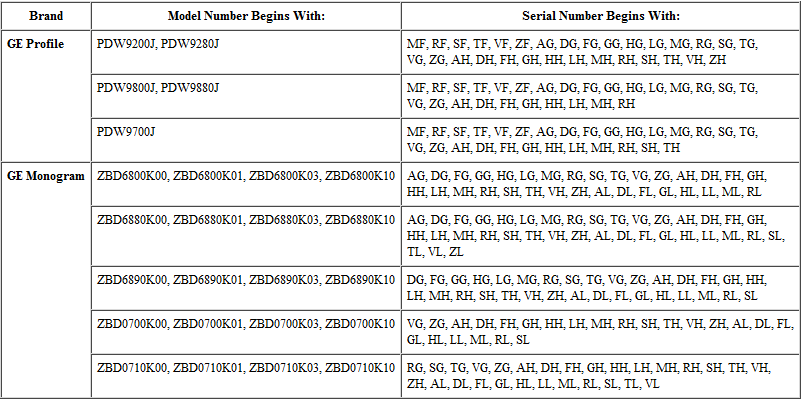
Description: This recall involves the GE Profile dishwashers manufactured between July 2003 and December 2005 and GE Monogram dishwashers manufactured between January 2004 and December 2006. They were sold in white, black, bisque, stainless steel and with custom panels. The recalled model and serial numbers listed below are located on the inside on the front left side of the dishwasher tubs.


(Click to Enlarge)

Sold at: Retail stores nationwide, appliance dealers and authorized builder distributors from July 2003 through December 2006 for between $750 and $1,400.

Manufactured in: United States

Remedy: Consumers should immediately stop using the recalled dishwashers, disconnect the electric supply by shutting off the fuse or circuit breaker controlling it and inform all users of the dishwasher about the risk of fire. Contact GE for a free in-home repair or to receive a GE rebate of $200 for the purchase of a new GE Profile dishwasher and a GE rebate of $400 for purchase of a new GE Monogram dishwasher.

Consumer Contact: For additional information, contact GE toll-free at (877) 275-6840 from 8 a.m. to 5 p.m. ET Monday through Friday or visit the company’s website at www.geappliances.com/recall

Filed Under: Dishwasher, Features, Kitchen, News, Recalls, Safety Tagged With: dishwasher recall, GE dishwasher recall, GE recall

Recall: Frigidaire and Electrolux ICON Electric Smoothtop Cooktops and Slide-In Ranges Due to Fire Hazard

October 25, 2010 By NightOwl

Name of Product: Frigidaire and Electrolux ICON Smoothtop Electric Cooktops and Frigidaire Slide-in Ranges with rotary knobs and digital displays

Units: About 122,000

Manufacturer: Electrolux Home Products Inc., of Charlotte, N.C.

Hazard: Liquids can pool under the control knob and cause the surface heating element to turn on unexpectedly, heat to temperatures other than expected and then not turn off, posing a risk of fire and burn hazards to consumers.

Incidents/Injuries: Electrolux has received 70 reports of incidents, including three reports of fires that resulted in property damage. Three minor burn injuries were reported.

Description: This recall involves Frigidaire and Electrolux ICON smoothtop electric cooktops and Frigidaire slide-in ranges with rotary knobs and digital displays. Model and serial numbers for the slide-in ranges can be found inside the oven door on the left side of the unit or on the underside surface on cooktop models. The following model and serial numbers are included in this recall:

Frigidaire Serial Number Range and Models

Serial Number Range: NF501XXXXX through NF952XXXXX
Model Numbers GLEC30S9EB
GLEC36S9EB
GLEC30S9EQ
GLEC36S9EQ
GLEC30S9ES GLEC36S9ES
GLES389EB
GLES389EQ
GLES389ES
GLES389FB GLES389FQ
GLES389FS
LEEC30S9FE
LEEC36S9FE
LES389FE PLEC30S9EC
PLEC36S9EC
PLES389EC
PLES399EC

Electrolux ICON Serial Number Range and Models

Serial Number Range: NF501XXXXX through NF045XXXXX
Model Numbers E30EC65ESS E36EC65ESS

Sold at: Mass merchandise and independent retail stores from January 2005 through August 2010 for between $500 and $2,500.

Manufactured in: Canada

Remedy: Consumers should immediately stop using and unplug the recalled ranges or power off cooktops at the circuit breaker. Contact Electrolux for information on how to obtain a free repair kit.

Consumer Contact: For additional information, contact Electrolux at (888) 281-5310 between 8 a.m. and 10 p.m. ET Monday through Saturday or visit the firm’s website at www.smoothtoprangerecall.com (Frigidaire) or www.cooktoprecall.com (Electrolux).

CPSC is still interested in receiving incident or injury reports that are either directly related to this product recall or involve a different hazard with the same product. Please tell them about it by visiting https://www.cpsc.gov/cgibin/incident.aspx

Filed Under: Features, Household, Kitchen, News, Ranges Ovens and Cooktops, Recalls, Safety Tagged With: cook top recall, cooktop recall, electric cooktop recall, Frigidaire and Electrolux ICON Electric Smoothtop Cooktops and Slide-In Ranges, Frigidaire and Electrolux ICON Electric Smoothtop Cooktops and Slide-In Ranges recall, ICON Smoothtop Electric Cooktops recall, recall, Smoothtop Electric Cooktops, smoothtop range recall

Appliance Lifespans

October 23, 2010 By NightOwl

We’ve said it before, here, but we’ll say it again, below we list some approximate lifespans for household appliances.

Average appliance life span in years

Compactors: 6

Dishwashers: 10

Disposers, food waste: 9

Dryers, electric: 12

Dryers, gas: 12

Freezers: 11

Microwave ovens: 9

Ranges, electric: 16

Ranges, gas: 17

Range/oven hoods: 11

Refrigerators: 12

Washers: 11

Water heaters, electric: 13

Water heaters, gas: 11

Air-conditioners, room: 9

Air-conditioners, central: 11

Boilers, gas: 20

Dehumidifiers: 7

Furnaces, gas: 15

Furnaces, oil: 17

Heat pumps: 12

Courtesy of heraldnet.com

Filed Under: Dishwasher, Dryers, Features, Gas Range, Household, Kitchen, Laundry, Microwave Oven, Parts/Repairs, Refrigerators and Freezers, Small Appliances, Washing Machine Tagged With: appliance lifespan, appliances, dryer, dryer lifespan, household appliances, kitchen appliance lifespan, kitchen appliances, laundry appliances, washer, washer lifespan

Paying for Your Next New Appliance

October 21, 2010 By NightOwl

Household appliances are generally so reliable, having one break down takes us by surprise. The hassle of shopping for a new appliance is trouble enough without worrying about paying for it too. Plan ahead, because the dryer is not going to sound out announcements before it conks-out.

Repair or Replace?

The first decision to be made is if you really need a new appliance, or if repairs are in order. If the repair costs half the price of a new appliance, seriously consider buying new, says Mark Kotkin at Consumer Reports. According to the magazine’s research, any major household appliance more than eight years old should be considered for replacement rather than repair. The magazine also suggest you skip the repair and buy new if your appliance costs less than $150.

Budgeting

“I’ve seen a lot of people’s budgets over the years, and it seems like household maintenance is one category that people miss,” says Matt Bell of MattAboutMoney.com. People who know the age of their appliances and their expected life spans can budget better for replacements. Or they could maintain a more general emergency fund for when bad things happen. Either cash stash will help you avoid finance charges on a credit card you can’t pay off right away, said Bell.

Home Warranty

A home warranty is a service contract for an existing home that covers major operating systems, such as a furnace or a dishwasher. The homeowner buys a repair contract, often for $300 to $500 a year, and pays a service charge for each call. If many of your major appliances are near the ends of their useful lives, a home warranty might be worthwhile. But warranties are complicated, covering some types of breakdowns and not others. Pre-existing conditions and malfunctions that stem from poor maintenance or installation can be excluded. Some companies will cover all or part of an appliance’s replacement cost. Choose this option carefully.

Filed Under: choosing a Kitchen Appliance, Dishwasher, Dryers, Features, Gas Range, Household, Kitchen, Laundry, Microwave Oven, Oven, Parts/Repairs, Ranges Ovens and Cooktops, Refrigerators and Freezers, Shopping, Vacuum Cleaners, Washing Machine, _ Tips Tagged With: appliance, appliance costs, appliance repair, appliances, appliances lifespan, home warranty, kitchen appliances

  • « Go to Previous Page
  • Go to page 1
  • Interim pages omitted …
  • Go to page 4
  • Go to page 5
  • Go to page 6
  • Go to page 7
  • Go to page 8
  • Interim pages omitted …
  • Go to page 41
  • Go to Next Page »

Primary Sidebar

[footer_backtotop]

© 2006-2019 Appliance.net · Log in