• Skip to primary navigation
  • Skip to main content
  • Skip to primary sidebar

Appliance. net

Appliance news, reviews, ratings, forums, reports and buyers guides.
Locate repairs and parts. for home and kitchen appliances.

  • About Appliance.Net
    • BestPrice Family
    • Contact
    • Become a Featured Dealer
    • Retailer & Repair Services Advertising
  • Shopping
  • Appliance Forum
  • Manufacturers
    • Manufacturers 800 Numbers
    • Aga
    • Bosch
    • Caldera
    • Dacor – The Life of the Kitchen
    • General Electric – GE
    • Jenn Air
    • Sears – Kenmore
    • Thermadore
  • Sections
    • Features
    • News
    • Recalls
    • Kitchen
      • Dishwasher
      • Ranges Ovens and Cooktops
      • Refrigerators and Freezers
      • Microwave Oven
    • Household
      • Consumer Electronics
      • Heating and Cooling
      • Vacuum Cleaners
    • Laundry
      • Washing Machine
      • Dryers
    • Safety
You are here: Home / Archives for Features

Features

International Online Toaster Museum

August 4, 2008 By Appliance

BoingBoing Gadgets reports:

The International Central Service’s Online Toaster Museum shows in nearly infinite nuanced zoological detail just what happens when a piece of technology reaches evolutionary perfection: innovation switches to design. I could spend hours flicking through this collection, trying to decide upon my appliance-void kitchen’s optimal toaster as a reflection of its own inherent soul.

I’m fessing up my inner geek but I think stuff like this is gorgeous.
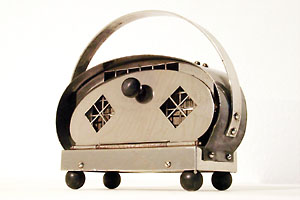
SIEMENS SCHUCKERT nickel plated toaster

http://www.toastermuseum.com/

Filed Under: Features, Humor, Kitchen Tagged With: guggenheim museum, international online toaster museum, international toaster museum, toaster, toaster museum

KitchenAid Introduces 72″, Counter-depth, French Door Refrigerator

August 1, 2008 By NightOwl

KitchenAid has introduced a new 72-inch counter-depth model that offers extra space on the inside and a built-in look on the outside.  This latest configuration joins a line that includes freestanding, counter-depth and 42-inch built-in French Door refrigerators. 

“Based on our research, we found that the currently available 69-inch model refrigerators don’t fully utilize the 72-inches of available height space found in many of today’s newly constructed homes,” said Debbie O’Connor, Senior Manager of Brand Experience for KitchenAid.  “Our newest French door model offers those who have this space an even better option to choose from in this increasingly popular refrigerator style.  Not only does our latest 72-inch model maximize space with more room inside the refrigerator, it also offers a seamless, built-in look at a gentler price.”   


The French Door Bottom Mount has a narrow door swing, making it easy to maneuver in the kitchen even when multiple cooks are working in the same space.  Its narrow door swing also allows for design flexibility in kitchen designs where a full door swing would be too tight.  Its wide refrigerator shelves have no interior divisions, allowing significantly greater space for wider items, such as cookie sheets, baking pans and serving trays.  In addition, the freezer on the bottom requires less bending, with more frequently accessed refrigerator items located higher and closer at hand.   


Premium features found on the latest KitchenAid® French door model include a single-hand interior water dispenser that is strategically located to prevent interference with usable refrigerator space.  A FreshChill™ Temperature Management System features a thermostat in the refrigerator and an evaporator fan that help regulates temperatures to maintain optimal storage and freshness.


The new 72-inch Counter-depth French Door Bottom Mount refrigerator models will be available in stainless steel, black and white.  Manufacturer’s suggested retail prices will range from $$2,799 to $3,099.   

Filed Under: Features, Kitchen, Refrigerators and Freezers Tagged With: counter depth refrigerator, french door refrigerator, kitchenaid, kitchenaid french door refrigerator, kitchenaid refrigerator

How Your Automatic Ice Maker Makes Ice

July 30, 2008 By NightOwl

A tall glass of iced tea or lemonade seems to symbolize summer, and it seems we are all adding ice to our drinks. I remember those old fashioned metal ice cube trays with a lever that was lifted to release the cubes. Those were followed by plastic trays that we twisted to get to the ice. Now I have noticed that it is nearly impossible to find a new refrigerator without an automatic ice maker built into it. If you’ve ever listened to your freezer making ice and wondered exactly how the system works, howstuffworks.com has the answer for you. We’ll share the gist of for you:

An ice maker works like those plastic trays, but the process of pouring water and extracting cubes is fully automated. A home ice maker is an ice-cube assembly line.

Most ice makers use an electric motor, an electrically operated water valve and an electrical heating unit. To provide power to all these elements, you have to hook the icemaker up to the electrical circuit powering your refrigerator. You also have to hook the icemaker up to the plumbing line in your house, to provide fresh water for the ice cubes. The power line and the water-intake tube both run through a hole in the back of the freezer.

When everything is hooked up, the ice maker begins its cycle. The cycle is usually controlled by a simple electrical circuit and a series of switches.

  • At the beginning of the cycle, a timed switch in the circuit briefly sends current to a solenoid water valve. In most designs, the water valve is actually positioned behind the refrigerator, but it is connected to the central circuit via electrical wires. When the circuit sends current down these wires, the charge moves a solenoid (a type of electromagnet), which opens the valve.
  • The valve is only open for about seven seconds; it lets in just enough water to fill the ice mold. The ice mold is a plastic well, with several connected cavities. Typically, these cavities have a curved, half-circle shape. Each of the cavity walls has a small notch in it so each ice cube will be attached to the cube next to it.
  • Once the mold is filled, the machine waits for the water in the mold to freeze. The cooling unit in the refrigerator does the actual work of freezing the water, not the ice maker itself. The ice maker has a built-in thermostat, which monitors the temperature level of the water in the molds. When the temperature dips to a particular level — say, 9 degrees Fahrenheit (-13 degrees Celsius) — the thermostat closes a switch in the electrical circuit.
  • Closing this switch lets electrical current flow through a heating coil underneath the ice maker. As the coil heats up, it warms the bottom of the ice mold, loosening the ice cubes from the mold surface.
  • The electrical circuit then activates the ice maker’s motor. The motor spins a gear, which rotates another gear attached to a long plastic shaft. The shaft has a series of ejector blades extending out from it. As the blades revolve, they scoop the ice cubes up and out of the mold, pushing them to the front of the ice maker. Since the cubes are connected to one another, they move as a single unit.
  • At the front of the ice maker, there are plastic notches in the housing that match up with the ejector blades. The blades pass through these notches, and the cubes are pushed out to a collection bin underneath the ice maker.
  • The revolving shaft has a notched plastic cam at its base. Just before the cubes are pushed out of the ice maker, the cam catches hold of the shut-off arm, lifting it up. After the cubes are ejected, the arm falls down again. When the arm reaches its lowest resting position, it throws a switch in the circuit, which activates the water valve to begin another cycle. If the arm can’t reach its lowest position, because there are stacked-up ice cubes in the way, the cycle is interrupted. This keeps the ice maker from filling your entire freezer with ice; it will only make more cubes when there is room in the collection bin.

It’s quite a system, and one we should appreciate on a 100 degree day.

Filed Under: Features, Kitchen, Refrigerators and Freezers Tagged With: freezer, ice, ice cubes, ice maker, icemaker, making ice

Laundry Tips From Whirlpool

July 28, 2008 By NightOwl

If you want good advice, go to the experts. I know I’m not alone in my opinion that laundry takes up way too much of my time. Whirlpool, a leading manufacturer of washers and dryers offers their advice on getting your clothes clean with the least amount of hassle.

  • As your laundry accumulates, pre-sort it into designated baskets for lights, darks and whites. This way, a load will be ready to throw in the washer whenever you have a minute to spare.
  • While sorting, don’t forget to close zippers, clasp hooks and check pockets to prevent snags and avoid washing tissues, money, lipstick, etc.
  • Streamline the laundry process by incorporating storage solutions and flat working surfaces into your laundry room. This will keep laundry where it belongs and eliminate the need to treat, sort and fold in other rooms of the house.
  • Wash small loads as needed between laundry days. Today’s high efficiency washing machines use substantially less water and energy than a conventional top-loading washer. Which means you can do small loads when you have time, rather than waiting for the basket to fill up.
  • Don’t overload the washer or dryer. Clothes come out cleaner and less wrinkled when given room to move freely.

Filed Under: Dryers, Features, Laundry, Washing Machine, _ Tips Tagged With: whirlpool, whirlpool appliances, whirlpool laundry, whirlpool washers and dryers

Save Energy and Save Money or Not?

July 25, 2008 By NightOwl

Energy costs are going up and we’re surrounded by warnings of global warming.  What’s a conscien-tious consumer to do?  Buy an energy efficient appliance of course.

From washing machines that use steam instead of hot water, to refrigerators that use low-energy compressors, to low-power computer screens, electronics companies are furiously developing energy-efficient products and heavily promoting lines already on the market that use less electricity than competitors’ brands.

Homemakers are increasingly buying front-load washing machines, which use gravity to move water instead of agitators as in top loaders.

And now, new washers from LG Electronics and Whirlpool offer an option to use steam instead of hot water, cutting water and power use by more than 70 percent compared with some top-load models.

LG expects 4 out of 10 front-load washers it sells in North America to use steam technology by the end of this year, compared with 2 out of 10  currently.

Their biggest appliance plant in South Korea makes mostly front loaders, while recently built plants like one in Russia have stopped manufacturing top loaders altogether.

Among refrigerators, which consume 30 percent of overall power in a typical home, traditional compressors are giving way to linear compressors that use up to 40 percent less power and make less noise.

In the computing industry, power-saving has long been a key priority as bigger and hungrier gadgets challenge battery life.  PC makers from Apple to the Lenovo Group are replacing screens lit by conventional cold cathode fluorescent lamps with light emitting diode (LED) displays.  “LED saves up to 40 percent of the power used in traditional backlights,” said Jeff Kim, an analyst at Hyundai Securities. “Next year they will be commonly found in notebook screens, and will be increasingly used in TV panels from 2010.”

But too often, these energy-efficient products carry a hefty price premium to reflect the cost of developing new technologies, which in turn hampers faster adoption.  For instance, Whirlpool’s washing machines with steam are sold at $1,300 to $1,500, compared with a traditional machine priced at $700.  Still, makers argue that the lifetime savings from green products could amount to the price of the appliance itself.

Sometimes a little incentive helps.

The Japanese electronics retailer Bic Camera is running a campaign in which buyers of eco-friendly products get extra credit points that can be used for future purchases. “That’s a little nudge to help people buy products that are more efficient, even if they are slightly more expensive,” said Naoko Ito, a Bic Camera spokeswoman. “Consumer interest is high.”

Filed Under: choosing a Kitchen Appliance, Consumer Electronics, Features, Kitchen, Laundry, Refrigerators and Freezers Tagged With: energy efficient appliances, energy saving appliances

Assistive Kitchen Robot Takes Stanford’s Dishes to the Wash

July 22, 2008 By Appliance

BoingBoing Gadgets reports:

The “Assistive Kitchen” robot picks up the dishes and takes them to the wash, thanks in large part to RFID sensors built into the plates and utensils in Stanford’s test kitchen. The team building the robot is also trying to teach it to surf the web to pick up new tricks, as well as self-optimize its routines to minimize the amount of running around it would have to do to pick up the dishes. (Pick up all the plates missing from the cabinet before returning to the dishwasher, for instance.)

Robot B21 today — Rosie tomorrow.

Robot chef gets a boost from wireless kitchen [New Scientist] (Thanks, Zoe!)

Hal 2000 as a dishwasher

Filed Under: Dishwasher, Features, Kitchen Tagged With: assistive robot, Dishwasher, hal 2000, jetsons rosie, Kitchen, kitchen robot, robot dishwasher, stanford

Whirlpool’s New SpeedCook Oven

July 21, 2008 By NightOwl

Whirlpool’s New SpeedCook combines a microwave with a true convection oven and range hood.  The  SpeedCook appliance is a True Convection oven, a g2Max® SpeedCook oven, a  microwave and a steamer all in one. 

 Typically, microwave ovens operate on HIGH power only. For example, to achieve a 50% power level (“medium”) in a typical microwave oven, the microwave oven operates 50% of the time at HIGH power and 50% of the time OFF.  In contrast,  this microwave system delivers the selected power level continuously. This constant stream of microwave power helps to minimize overcooking of foods and messy food spatters.

The microwave system features the 6th SENSE™ cooking system. A humidity sensor in the microwave oven cavity detects moisture and humidity emitted from food as it heats. The sensor adjusts cooking times to various types and amounts of food. Sensor cooking takes the guesswork out of microwave cooking.

A 1,000-watt halogen bulb with a 500-watt quartz bulb to serve as the grill element for various cooking functions.  This allows browning which is not usually possible in a microwave.

The oven’s convection system is composed of a convection element, which heats in conjunction with the convection fan for true convection cooking. The system is embedded in the wall of the microwave oven cavity, behind the protective screen.

On the outside, a glass LCD screen makes programming simple and easily visible. You can choose from a handy 30-second cook option and many resets to cook different sorts of food. There are also speed cook, “keep warm,” and childproof options on the oven.  Other options include the option to turn off the turntable and instructions for using the oven to proof a loaf of bread.

This sounds like a real multipurpose appliance.  It retails starting at $919.

Filed Under: choosing a Kitchen Appliance, Cooking, Features, Kitchen, Microwave Oven, Ranges Ovens and Cooktops Tagged With: microwave convection hood, microwave convection oven, Microwave Oven, Speedcook, SpeedCook microwave, whirlpool, Whirlpool microwave oven, whirlpool speedCook

Food Safety and Your Refrigerator

July 18, 2008 By NightOwl

We all know how important it is to eat plenty of fruits and vegetables everyday.   One of the easiest ways to do that is to keep the fridge produce drawers stocked with your family’s favorites .  The problem arises with how most people maintain those drawers.  The details of how a refrigerator is cleaned and its temperature, along with how food is prepared and stored were discussed by a panel of experts meeting in New Orleans this June.

Vegetable bins in home refrigerators contain the highest percentage of bacteria,” said Sandria Godwin, a food scientist with Tennessee State University and part of a four-member panel that presented its findings on consumer refrigeration trends.

“You don’t have to go to a party or a restaurant to get food poisoning,” she said. “We are all looking for someone to blame when it comes to food safety, but there are things we can do to reduce the risk, especially for high-risk groups such as the elderly, infants and children.”

Poor refrigerator cleaning, mixing unwashed vegetables with uncovered raw meats in the storage bins, failing to install a refrigerator thermometer, and not maintaining the recommended refrigerator temperature of 40 degrees are all food spoilers and bacteria multipliers.

While less scientific than some of the other findings, uncertain economic times have also forced consumers to view raising the temperature in the refrigerator as a way to save on their energy bill, panelists said. It has also made consumers less likely to throw away food that is past its recommended self date.

Consumers with a higher income are less likely to keep their refrigerator clean, Godwin said. She cited busy lifestyles and time constraints as the cause.

We have a big challenge because it’s hard to change behaviors,” said Danielle Schor, senior vice president of food safety with the nonprofit International Food Information Council in Washington, D.C.

“People think food-borne illness is something you just get over,” Schor said. “It’s not a stomach ache; it can cause a lot of damage, but people don’t always see the immediate consequence so they don’t realize the danger.”

The 68th Annual Meeting and Expo of The Institute of Food Technologists, has attracted about 15,000 food scientists and others in the food technology industry, including representatives from the academic, private, nonprofit and government sectors.

Filed Under: Cooking, Features, Kitchen, News, Refrigerators and Freezers, Safety Tagged With: food safety, fresh food storage, refrigerator safety, refrigerators

Dacor’s Newest Cooktop

July 17, 2008 By NightOwl

Dacor introduces its newest Renaiss-ance Gas Cooktops, available in 30 and 36 inches.  The SimmerSear burners give  up to 18,000 BTUs to simmer and sear at ultra-low and ultra-high temperatures.  These new gas cooktops also have Dual-Stacked sealed burners for simmering.

For an ultra cool look, and an added safety feature, the Illumina burner controls glow Dacor signature flame-blue when the burners are on.  Extra-wide continuous  grates provide plenty of room for oversized pots and pans.  And Dacor’s exclusive bead-blasted finish on the spill tray and sealed burners make cleaning up easier than ever.

Filed Under: Cooking, Features, Gas Range, Kitchen, News, Ranges Ovens and Cooktops Tagged With: Dacor, Dacor cooktop, Dacor Renaissance, gas cooktop

Are You Using LPG or Natural Gas?

July 14, 2008 By NightOwl

The last time you bought a new gas appliance- grill, dryer or range for example, you were likely asked what type of gas you used in your home.  Liquefied petroleum gas (LPG) or natural gas are both used to power those and other household appliances,but they have different properties and will be used differently in an appliance.

Liquefied petroleum gas (LPG),  is a product of crude oil distillation. It contains mostly propane, or C3H8. Propane has the nice property that, when you compress it, it condenses into a liquid. This means that it is much easier to store in a tank than natural gas, which does not easily compress.

Natural gas is just that — natural. If you sink a well in the right spot, natural gas flows out of the ground. It is mostly methane, or CH4.

Howstuffworks.com offers further explanation:

You can see the difference between natural gas and LPG most easily when you buy a gas stove. Normally, you are supplied with two sets of jets, one set for natural gas and one set for LPG. You install one jet in each burner. The jet is simply a little screw-in cap with a hole drilled into it. The difference is that the hole in the jet for natural gas is bigger — about twice as big — as the hole in the jet for LPG.

The reason for this difference is because LPG contains much more energy than natural gas. A cubic foot of natural gas contains something like 1,000 BTU (British Thermal Units) of energy. A cubic foot of propane contains perhaps 2,500 BTU. You can see that if you take a gas appliance set up for natural gas and then run it on LPG, the appliance is going to run more than twice as hot. In the case of a water heater , it is apparently hot enough to start a fire.

So, the seemingly simple question of what type of gas fuels your home, can be an important piece of fire safety information for protecting you and your family.

Filed Under: choosing a Kitchen Appliance, Dryers, Features, Gas Range, Household, Kitchen, Safety Tagged With: gas appliances, gas dryer, gas grill, gas oven, Gas Range, gas water heater, LPG, Natural Gas

  • « Go to Previous Page
  • Go to page 1
  • Interim pages omitted …
  • Go to page 36
  • Go to page 37
  • Go to page 38
  • Go to page 39
  • Go to page 40
  • Interim pages omitted …
  • Go to page 53
  • Go to Next Page »

Primary Sidebar

[footer_backtotop]

© 2006-2019 Appliance.net · Log in