• Skip to primary navigation
  • Skip to main content
  • Skip to primary sidebar

Appliance. net

Appliance news, reviews, ratings, forums, reports and buyers guides.
Locate repairs and parts. for home and kitchen appliances.

  • About Appliance.Net
    • BestPrice Family
    • Contact
    • Become a Featured Dealer
    • Retailer & Repair Services Advertising
  • Shopping
  • Appliance Forum
  • Manufacturers
    • Manufacturers 800 Numbers
    • Aga
    • Bosch
    • Caldera
    • Dacor – The Life of the Kitchen
    • General Electric – GE
    • Jenn Air
    • Sears – Kenmore
    • Thermadore
  • Sections
    • Features
    • News
    • Recalls
    • Kitchen
      • Dishwasher
      • Ranges Ovens and Cooktops
      • Refrigerators and Freezers
      • Microwave Oven
    • Household
      • Consumer Electronics
      • Heating and Cooling
      • Vacuum Cleaners
    • Laundry
      • Washing Machine
      • Dryers
    • Safety
You are here: Home / Archives for Dryers

Dryers

Paying for Your Next New Appliance

October 21, 2010 By NightOwl

Household appliances are generally so reliable, having one break down takes us by surprise. The hassle of shopping for a new appliance is trouble enough without worrying about paying for it too. Plan ahead, because the dryer is not going to sound out announcements before it conks-out.

Repair or Replace?

The first decision to be made is if you really need a new appliance, or if repairs are in order. If the repair costs half the price of a new appliance, seriously consider buying new, says Mark Kotkin at Consumer Reports. According to the magazine’s research, any major household appliance more than eight years old should be considered for replacement rather than repair. The magazine also suggest you skip the repair and buy new if your appliance costs less than $150.

Budgeting

“I’ve seen a lot of people’s budgets over the years, and it seems like household maintenance is one category that people miss,” says Matt Bell of MattAboutMoney.com. People who know the age of their appliances and their expected life spans can budget better for replacements. Or they could maintain a more general emergency fund for when bad things happen. Either cash stash will help you avoid finance charges on a credit card you can’t pay off right away, said Bell.

Home Warranty

A home warranty is a service contract for an existing home that covers major operating systems, such as a furnace or a dishwasher. The homeowner buys a repair contract, often for $300 to $500 a year, and pays a service charge for each call. If many of your major appliances are near the ends of their useful lives, a home warranty might be worthwhile. But warranties are complicated, covering some types of breakdowns and not others. Pre-existing conditions and malfunctions that stem from poor maintenance or installation can be excluded. Some companies will cover all or part of an appliance’s replacement cost. Choose this option carefully.
Filed Under: choosing a Kitchen Appliance, Dishwasher, Dryers, Features, Gas Range, Household, Kitchen, Laundry, Microwave Oven, Oven, Parts/Repairs, Ranges Ovens and Cooktops, Refrigerators and Freezers, Shopping, Vacuum Cleaners, Washing Machine, _ Tips Tagged With: appliance, appliance costs, appliance repair, appliances, appliances lifespan, home warranty, kitchen appliances

LG’s Smart Diagnosis

October 13, 2010 By NightOwl

LG has taken the technology they used in the Kenmore Connect system for Sears. and applied the self-diagnosis technology for clothes washers and dryers to their own LG brand.

The SmartDiagnosis system was developed by LG to help customer service representatives quickly and efficiently troubleshoot mechanical issues over the phone, limiting service calls and in-home visits.

Consumers calling the LG customer service center are instructed to press select buttons on the laundry unit, which in turn trigger a series of diagnostic tones. Each tone corresponds with a specific potential maintenance need and can be identified by trained service technicians over the phone, allowing them to evaluate the information and provide feedback based on the data that was received. The system is designed to eliminate a step in the troubleshooting process, because issues may be identifiable without a service technician visit. When service visit is required, the technician can come prepared with the correct parts so that the repair can be resolved in one visit.

Filed Under: Dryers, Features, Laundry, News, Washing Machine Tagged With: Kenmore Connect system, LG, LG appliances, LG dryer, LG washer, remote diagnosis, SmartDiagnosis, SmartDiagnosis system, talking washer and dryer

Samsung’s New 2010 Appliances

July 5, 2010 By NightOwl

Samsung’s new home appliance product line for 2010 includes a front-loading washer with a spacious 5.0 cu.ft. capacity and a new intense PowerFoam cleaning technology, a new Four-Door Refrigerator with a unique mid-drawer positioned at counter height that opens to the outside and has independent temperature control, a new line of side-by-side refrigerators highlighted by the best in class energy efficiency, and the first hybrid induction range.

The new washer,  offers a spacious 5.0 cu.ft. capacity to help get more wash done in less time. It also features the newly improved Vibration Reduction Technology Plus, which reduces rattling and noise, making it so  families hardly know they’re on and allowing them to put their laundry machines anywhere they prefer. Samsung hopes to eliminate the need for all those stain-treatment sticks with the new PowerFoam feature that pre-dissolves detergent into powerful foam for a more thorough washing. In addition, PureCycle alerts consumers with a gentle chime after 40 washes and allows consumers to clean their machine with the press of a button using hot water, not harsh chemicals. These are both available in colors stainless platinum or white, and prices range from $1,399-$1,549.

Samsung’s Four-Door Refrigerator  offers a counter-height FlexZone Drawer with Temperature Control and SmartDivider that is accessible to everyone in the family. The flexible mid-drawer opens separately from the exterior of the refrigerator, ensuring that no cold air is lost from the main refrigerator or freezer compartments. The drawer itself can be temperature-controlled to store different types of food including snacks, party platters, deli meats, or beverages, and the Smart Divider allows families to adjust how the drawer is organized. It’s proprietary Twin Cooling System Plus keeps food  fresh by eliminating odor transfer and maintaining optimal humidity levels in each compartment. It is available in stainless platinum, stainless steel, black and white for $2,699-$2,999.
Samsung’s new Energy Efficient Side-By-Side Refrigerators, are among the most energy efficient refrigerators on the market. Through a combination of  features such as a proprietary insulation system, electric temperature sensors, LED tower lighting, and Samsung’s Twin Cooling System, the new side-by-side refrigerators can use up to 30 percent less energy than Department of Energy minimum standards. It is available in black, white, stainless steel, stainless platinum for $999-$1,799.

Filed Under: choosing a Kitchen Appliance, Dryers, Features, Kitchen, Laundry, News, Refrigerators and Freezers, Washing Machine Tagged With: new samsung appliances, samsung, samsung appliances, samsung dryer, samsung refrigerator, Samsung SilverCare Washer, samsung VRT

Energy Star Credibility

June 10, 2010 By NightOwl

The U.S. Environmental Protection Agency and the U.S. Department of Energy recently outlined a new two-step process to strengthen the credibility of the Energy Star brand.

Step 1: Testing. More aggressive product testing will be required in the future in order to be Energy Star-certified.

DOE began tests at third-party test labs on six of the most common appliances categories:
• freezers
• refrigerator-freezers
• clothes washers
• dishwashers
• water heaters
• room air-conditioners.
DOE noted that these appliances account for at least 25% of a typical homeowner’s energy bill. It will test about 200 basic models in the coming months.

The agencies are also developing a new system to require all products seeking the Energy Star label to be tested in approved labs and require ongoing verification testing.

Step 2 Enforcement.

The agencies have taken action against 35 companies in the last 4 months to enforce compliance with Energy Star as well as with DOE’s minimum appliance efficiency standards. A news release details some of the enforcement actions taken in 2009-2010, including:

• July 2009: Subpoenas issued to AeroSys Inc. to obtain air-conditioner and heat pump documentation.
• Sept. 2009: AeroSys required to provide product samples for DOE testing to verify models met U.S. federal minimum energy efficiency standards.
• Dec. 2009: DOE and EPA took steps to remove Energy Star labels from 20 LG refrigerator-freezer models that had been shown, via testing by multiple independent labs, to consume more energy than allowed by Energy Star criteria.
• Jan. 2010: DOE signed a Consent Decree with Haier regarding actions to address four Haier freezer models, including two Energy Star models, that were consuming more energy than reported.
• March 2010: EPA terminated its Energy Star relationship with US Inc./US Refrigeration based on a history of logo misuse, unresponsiveness, and failure to comply with program guidelines.

Other actions addressed problems with lightbulb and showerhead manufacturers.

The agencies noted that Energy Star violations receive much media attention but account for a small percentage of total products in the program. A recent independent review found 98% compliance.

Filed Under: choosing a Kitchen Appliance, Dishwasher, Dryers, Features, Gas Range, Kitchen, Laundry, Microwave Oven, News, Ranges Ovens and Cooktops, Refrigerators and Freezers, Small Appliances, Washing Machine Tagged With: energy star, energy star appliances, Energy Star testing, energyStar

EnergyStar Ratings – Can They be Trusted?

May 17, 2010 By NightOwl

According to retailers, the Federal Appliance Rebate Program has increased appliance purchases nationwide.  The rebate is for energy efficient appliances which is great – only you might not be getting what that EnergyStar  label promises.

A recent report from the Government Accountability Office (GAO) suggests that some Energy Star products aren’t all they’re cracked up to be.

Responding to a request for investigation from Sen. Susan Collins (R., Maine), the GAO submitted 20 fictitious products between June 2009 and March 2010 for certification by Energy Star, a joint program of the Environmental Protection Agency (EPA) and the Department of Energy (DOE). Fifteen of the fakes–including a phony “room-air cleaner” that was little more than a space heater with a feather duster taped to it–received an Energy Star label.

Parade Magazine reports that in response, federal officials announced plans to strengthen the program. From now on, each application will be reviewed individually by an EPA staff member (as opposed to the automated approval process previously in place). By the end of the year, companies that want Energy Star certification for their products will be required to submit lab results from an independent testing agency rather than conduct their own evaluations.

Meanwhile, consumer advocates say we can still have faith in our Energy Star appliances: Most Energy Star brands on the market are about 10% more energy-efficient than their counterparts.

Sen. Collins applauds the reforms, calling them long overdue. “Energy Star wasn’t just slipping a bit,” she says. “It was in danger of falling off the quality cliff–putting taxpayers at risk of getting ripped off. Now that the EPA and DOE are moving to put more stringent oversight in place, I believe consumers will be better served and the integrity of the program will be restored.”

Filed Under: choosing a Kitchen Appliance, Dishwasher, Dryers, Features, Gas Range, Heating and Cooling, Household, Kitchen, Laundry, News, Oven, Ranges Ovens and Cooktops, Refrigerators and Freezers, Washing Machine Tagged With: appliance, appliance rebates, appliances, choosing appliances, energy star, energyStar, Federal Appliance Rebates, State Appliance Rebates

Just How Much Energy is That Appliance Using?

May 10, 2010 By NightOwl

My computer stays on through the week, only getting shut off on the weekend.  My answering machine and TV stay plugged in, their little red lights glowing in the night.  I do turn off the treadmill between uses and the DVD player too.

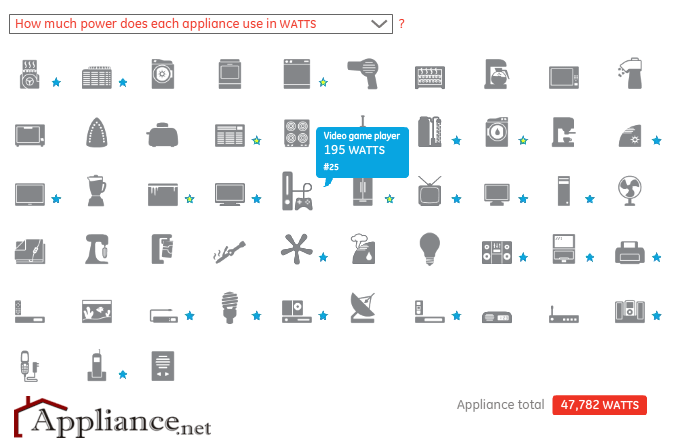
My energy habits are probably similar to many Americans.  If you’re wondering how much energy you’re wasting, or conversely, saving by turning appliances off, check out this energy calculator from GE:

This is a really cool tool that calculates  how much power each appliance consumes in watts or kilowatthours.  Alternatively, you can see how much each appliance costs to use in dollars, and how much it consumes in equivalent gallons of gas.

Some appliances are marked with a blue star indicating that an  EnergyStar model is available or click on the green star to see how much energy (and money) you’ll save with a new appliance.

Filed Under: choosing a Kitchen Appliance, Dishwasher, Dryers, Features, Gas Range, Heating and Cooling, Household, Kitchen, Laundry, Microwave Oven, Multimedia, Office, Oven, Personal Care, Ranges Ovens and Cooktops, Refrigerators and Freezers, Small Appliances, Vacuum Cleaners, Washing Machine Tagged With: appliance energy use, appliance use, energy star appliances, energy use, GE, kilowatthours, using kilowatthours

Approved Energy Efficient Appliance Rebate Programs

April 28, 2010 By NightOwl

If you are wondering which Department of Energy (DOE) rebates are available in your state, just check out this interactive map.  There is also a simple table listing the individual states along with the total rebate dollars available, websites and phone numbers.

DOE has approved the appliance rebate programs for the states and territories linked or listed on this page as of April 27, 2010. This list and map will be updated as additional program details are available.  This DOE site is the only official DOE-sponsored Web site – beware of other unofficial sites.

Filed Under: choosing a Kitchen Appliance, Dishwasher, Dryers, Features, Gas Range, Heating and Cooling, Household, Kitchen, Laundry, News, Oven, Ranges Ovens and Cooktops, Refrigerators and Freezers, Washing Machine Tagged With: appliance rebate programs, appliances, DOE appliance rebate programs, finding appliance rebate programs, map of appliance rebate programs, rebates, State Appliance Rebates

Appliance Rebates are Here – But Not for Long

April 23, 2010 By NightOwl

The federal appliance rebates are finally here, but if you want yours, you’d better act fast.

According to the Wall Street Journal,  in Florida  the $17.6 million allocated for the program lasted a day and half, as more than 72,000 claims were filed. In Illinois, the second half of its $12.4 million, made available on Friday, April 16th disappeared in 11 hours.

Nationwide, $300 million in rebate money has been allocated by the federal government to 56 states and territories to encourage residents to buy furnaces, clothes washers, refrigerators and other appliances with the government’s Energy Star label. Typically, rebates run about $75 for a clothes washer and several hundred dollars for home heating and cooling systems.

But in an experience reminiscent of last year’s popular “cash for clunkers” program, which paid consumers to trade in gas-guzzling automobiles, interest in the appliance programs has been so been intense that the state programs are often running dry in a matter of days.

For example, Melissa Woodall, a single mother of three in Miami, said she began scanning appliance ads a few weeks ago for a new stove. She noticed an article about the rebates and decided to replace her old, leaky dishwasher and refrigerator.

The day before qualified purchases were allowed, she visited Sears to pick out the appliances. On Friday, she arrived to the store at 6:30 a.m. and found 49 customers in line. Fortunately, the store had given her a printout the night before. All she had to do was pay and arrange delivery, which still took an hour and a half in the crowded store.

And the ordeal was not over, Ms. Woodall said — she still had to get the rebate itself. At 11 a.m., when online signups began, she and her sister went to the state’s rebate site. “The Web site was flooded. It kept crashing,” she said. It took her an hour and 15 minutes to get registered for the rebate.

It was worth it, Ms. Woodall said. She paid about $1,500 for the dishwasher and fridge and will be getting about $500 back.

Each state has structured its own program, sometimes excluding certain appliances like air-conditioners or requiring proof that old appliances were recycled before paying out the cash. The amount of money available varies widely, from more than $35 million in California, where the program was scheduled to start on Thursday in connection with Earth Day, to $100,000 in American Samoa.

The federal government created the appliance rebate program as part of the 2009 stimulus legislation, and retailers say it has increased sales.

The high interest is understandable. The rebate programs come on top of existing discounts on Energy Star appliances, recycling and take-back rebates for old units, and specials provided by individual retailers. In some cases, consumers may qualify for federal or state tax credits, too.

Filed Under: choosing a Kitchen Appliance, Dryers, Features, Household, Kitchen, Laundry, News, Refrigerators and Freezers, Washing Machine Tagged With: appliance rebate program, appliance rebate program California, appliance rebates, Appliance Rebates california, Appliance Rebates Florida, Appliance Rebates Illinois, Appliance Rebates Texas, Federal Appliance Rebates, State appliance rebate program

Avoiding the 10 Most Common Laundry Problems – From the Thor Appliance Company

April 5, 2010 By NightOwl

1. Detergent Overuse

As highlighted in a recent Wall Street Journal article, Americans continue to overuse laundry detergent. Detergent overuse not only shortens of the life of clothing, it can damage or even ruin a perfectly fine washing machine.

High levels of detergent can get trapped in fabric, making clothing appear dingy and faded. Inside your laundry machine, detergent residue gums up the inner workings of your washer, including the door gasket and drain system. In a washer dryer combo, suds from too much soap can accumulate in the condensing chamber, causing longer dry times.

The reason for detergent overuse is twofold. High efficiency washers of today use significantly less water (and therefore need less detergent) than the top loaders of an earlier era. While Americans are still getting used to new frontload machines, they continue to measure detergent based on top load washers. Making matters worse, modern detergents are much more concentrated, which means that a little goes a long way.

Today, accurately measuring out laundry detergent is more important than ever. Be sure to read the detergent box to determine the correct amount of soap for your load size and water temperature.

2. Overloading

Even with the expanded capacity of modern washers and dryers, overloading continues to be a common problem. Unlike old tub-style topload washers which use an agitator to stir clothing clean, new frontload machines clean by tumbling laundry. In order for frontload washers to work properly, there must be room for the laundry to tumble. These washers should be loaded to about 3/4 of full capacity to allow the clothing to fall away from the drum during the wash cycle. An overfilled washer will result in poor cleaning results and wrinkled laundry.

3. Forgetting to Empty the Lint Filter

Forgetting to empty the lint screen not only creates longer dry times, it can be a potential fire hazard. When emptied after each cycle, lint filters eliminate the collection of gooey lint in vent line ducting. However, screens that are not cleaned regularly can cause potentially hazardous lint accumulation within the dryer housing.

A perfect kindling for a fire, lint that comes in contact with a dryer’s heating element has the potential to ignite. While newer dryers are designed to be less susceptible to fires, no dry system is completely immune from years of lint built up.

Take the time to empty the lint screen after each cycle and be sure to inspect old dryers for lint accumulation behind the filter and where the vent line exits the back of the machine.

4. Forgetting to Remove Packing Bolts

Frontload washers use packing bolts to secure the machine’s suspension system during transportation. If the packing bolts are not removed before the washer is operated, the suspension system will not function and the machine will jump and vibrate. Be sure to refer to your user manual for directions on how to remove packing bolts. Also, remember to replace packing bolts if your washer is moved to a new location.

5. Not Using Fabric Softener

When most of us think of fabric softener, we think of soft fluffy towels or that snuggly little teddy bear. And while fabric softener can make your towels fluffy and your sweater softer, it also plays an important role in frontload washer operation.

As mentioned earlier, frontload washers tumble clothing during the wash cycle. In addition, they extract water by spinning laundry between rinses. The high speed spin of a frontload washer can cause clothing to stick to the side of the drum, keeping them from tumbling freely during the rinse cycle. A small dose of fabric softener will help laundry fall away from the drum and ensure that clothing is rinsed properly.

If you are averse to using a scented fabric softener, there are many mild and unscented softeners on the market today.

6. Mixing Fabrics and Colors

As life gets more hectic, we’re all more apt to cut corners when it comes to laundry. This often results in tossing every color and fabric type in the washer and selecting a warm water wash. Mixing colors and fabrics can not only discolor clothing (e.g. the pink sock that used to be white), it can break down delicate fabrics.

Be sure to read the washing instructions on each garment and take a few extra minutes to sort laundry into white, colors and delicates. Not only will your clothes last longer, you won’t have to be seen with that embarrassing pink sock.

7. Shrinkage

In a push for record breaking dry times, many appliance manufactures have turbo charged dry cycles with scorching heat and too often poor results. Excessive heat can ruin delicate clothing and significantly shrink cotton fabric. Hang drying garments in the spring and summer is a good way to save energy and avoid cotton shrinkage – and a quick five minute fluff in the dryer will release any wrinkles that may have developed while hang drying. In the cooler months, selecting a more moderate dry cycle will extend the life of clothing and keep shrinkage to a minimum.

8. Out of Balance Loads

Unless you live adjacent to a pile driving project, the sound of an out of balance washer is hard to mistake. While most modern washers have an automatic shut-off trigger that eliminates damage to the machine, the few seconds of earth shattering pounding is not something that can (or should) be ignored.

While reshuffling clothing will usually do the trick, larger blankets and bedding can be hard to balance, particularly if they’re too bulky to fit comfortably in your washing machine. The best way to avoid out of balance loads is to use an extra large washer at your neighborhood laundromat or have those bulky items professionally laundered.

9. Pens and Other Pocket Hazards

Long hailed as a nerdy fashion accessory, the pocket protector just might be the best defense against this next laundry mistake. That’s because one unsuspecting ballpoint pen left is a pocket can ruin an entire load of clothing.

If a single ink stain is tough to remove, image dozens on ink streaks scattered over an entire load of shirts and pants. The best way to avoid this disaster (other than the pocket protector idea) is to take the extra time to check each pocket for pens, gum, rocks or any other unfriendly item that may cause harm to your clothing or washer and dryer.

10. Leaky Hoses

A leaky or bursting washer hose can cause major water damage in a matter of minutes. Like any material, the rubber used in laundry hoses breaks down after years of use, particularly under high pressure. Thankfully there are a number of products on the market that can eliminate leaks before they become disasters.

There are many aftermarket multi-layered hoses that offer additional flood protection. One word of caution about aftermarket hoses; many European washing machines have custom hoses with a metric sized connection for the washer and a standard sized connection for the water input. In this case, you may need to stick with the stock hoses or search for a more customized hose option that blends metric and standard sizing.

Filed Under: Dryers, Features, Laundry, Washing Machine, _ Tips Tagged With: clothes washing tips, drying clothes, Laundry, laundry mistakes, laundry tips, Thor Appliance Company, washing clothes, washing machine tips

Bendix is Back

March 8, 2010 By NightOwl

Marking the return of one of America’s most historic brands, a new line of home appliances has been unveiled under the venerable Bendix name.  Bendix Home Appliances invented the first front-loading washer in 1937. A  predecessor to today’s high efficiency front-loading washing machines, by the 1950s, Bendix was the top selling washer in the United States. Other home appliances followed, including a line of Bendix televisions and refrigerators.

Beginning February 3, 2010 with a selection of highly efficient washers, dryers and washer dryer combinations, the new Bendix line will be available online at BendixAppliances.com and through select U.S. dealers and distributors. Large capacity washers and dryers are also slated for release in later 2010. “The line will initially focuses on smaller energy efficient laundry machines, particularly ventless stackable sets and combos,” said Michael Lee, principal at JMM Lee Properties, LLC, the owner of the Bendix trademark. The Bendix line will cater to retail consumers and wholesale building accounts alike.

The first selection of Bendix washers are undergoing ENERGY STAR certification, which will likely qualify the products for U.S. Government efficiency rebates slated to go into effect in spring 2010. In addition to pending ENERGY STAR certification, the ventless dry system used in Bendix washer dryer combinations and stand-alone dryers, use 2/3 less energy compared to standard household vented dryers. “Green building is now done for more than just bragging rights,” said Lee, “It’s a significant selling point and consumers know what questions to ask and what products are most efficient.”

Filed Under: choosing a Kitchen Appliance, Dryers, Features, Household, Laundry, News, Washing Machine Tagged With: Bendix, Bendix appliances, Bendix dryer, Bendix washer, Bendix washer and dryer, Thor appliances

  • « Go to Previous Page
  • Go to page 1
  • Go to page 2
  • Go to page 3
  • Go to page 4
  • Go to page 5
  • Interim pages omitted …
  • Go to page 11
  • Go to Next Page »

Primary Sidebar

[footer_backtotop]

© 2006-2019 Appliance.net · Log in