• Skip to primary navigation
  • Skip to main content
  • Skip to primary sidebar

Appliance. net

Appliance news, reviews, ratings, forums, reports and buyers guides.
Locate repairs and parts. for home and kitchen appliances.

  • About Appliance.Net
    • BestPrice Family
    • Contact
    • Become a Featured Dealer
    • Retailer & Repair Services Advertising
  • Shopping
  • Appliance Forum
  • Manufacturers
    • Manufacturers 800 Numbers
    • Aga
    • Bosch
    • Caldera
    • Dacor – The Life of the Kitchen
    • General Electric – GE
    • Jenn Air
    • Sears – Kenmore
    • Thermadore
  • Sections
    • Features
    • News
    • Recalls
    • Kitchen
      • Dishwasher
      • Ranges Ovens and Cooktops
      • Refrigerators and Freezers
      • Microwave Oven
    • Household
      • Consumer Electronics
      • Heating and Cooling
      • Vacuum Cleaners
    • Laundry
      • Washing Machine
      • Dryers
    • Safety
You are here: Home / Archives for Dishwasher

Dishwasher

Appliance Manufacturers are Aiming at Boomers

December 31, 2008 By NightOwl

What’s next?  The Baby Boom generation is everywhere.  As a child of the 60’s I’ve often had mixed emotions towards them – annoyance at how much attention they get combined with gratitude that they cause so many changes that I will benefit from in the future.  One of those changes is happening now in the appliance manufacturing business.  As boomers age, they are increasingly staying in their own homes and have the income to modify those homes accordingly.  Appliance manufacturers want to get a piece of that.  According to the Wall Street Journal, changes are being made.

In the kitchen, General Electric Co. is designing ovens with easier-to-open doors and automatic shut-off burners. A joint venture of Germany’s Bosch and Siemens AG has introduced a glass cook top for its premium Thermador brand designed to prevent boil-overs. Minnesota-based Truth Hardware reports booming sales for its remote-controlled window motors.

“This population is far more demanding and will refocus designers” on individual consumers, says Joe Coughlin, director of the Massachusetts Institute of Technology’s AgeLab, which studies design and engineering for an aging population.

Among appliance makers, Whirlpool Corp. has long tested products with potential customers who are deaf, blind or arthritic. The testing with arthritis patients helped prod the Benton Harbor, Mich., appliance maker to offer pedestals that raise the height of washing machines and clothes dryers for customers with back problems.

[Whirpool dryer with pedestal] Whirlpool

A pedestal beneath this Whirlpool dryer reduces stooping when removing laundry.

Whirlpool also offers washing machines with large knobs that make louder-than-usual noise when they’re set, for customers with limited vision or arthritis. “It’s not one of those little prissy knobs,” says spokeswoman Audrey Reed-Granger. One model introduced last year plays musical chimes to indicate washing temperature or other features.

At GE’s consumer and industrial headquarters in Louisville, Ky., designers use “empathy sessions” to help develop new refrigerators, stoves and dishwashers. Industrial-design intern Joanie Jochamowitz, 22, wraps her knuckles with athletic tape and wears blue rubber gloves to simulate arthritis. She shoves cotton balls in her ears to simulate hearing loss, dons special glasses to simulate macular degeneration and puts dried corn kernels in her loafers to simulate aches and pains. She grabs a walker. Then she tries to peel potatoes.

“I don’t want to get old,” she says, as she hobbles around the kitchen, fumbling with potato peelers and stove controls, and nearly spilling a pot of boiling water.

GE began the empathy sessions last year so its young designers could better appreciate how consumers use appliances. “When you’ve got designers that are 25 or 30 years old, it’s very hard for them to understand what someone in their 60s or 70s experiences,” says Kim Freeman, a spokeswoman for GE Appliances.

The company also arranges focus groups where consumers cook a meal in a GE model kitchen while staffers watch through cameras and one-way mirrors. And GE videotapes appliance users in their homes. The summaries from these tapes are used in brainstorming sessions about design changes.

“We note what they are doing. We see if those behaviors happen more than once and why,” says Marc Hottenroth, industrial design leader for GE’s Consumer and Industrial unit.

These efforts have prompted several changes in GE product designs, including brighter LED lighting that improves visibility inside new models, such as one with a French-door refrigerator atop a bottom freezer. This year, GE introduced a single-wall oven with two cooking spaces that can operate at different temperatures. Its research shows boomers cook and entertain more frequently and like the two-ovens-in-one concept. Some models can be raised off the ground for easier access. “You don’t have to reach in as far,” says Ms. Freeman. She says it prevents people from stooping awkwardly, losing their balance and burning themselves on the hot stove.

GE has new dishwashers and washing machines that allow users to put in an entire bottle of detergent a few times a year rather than a smaller amount for every load. The machines are designed to reduce confusion and make housework less of a chore, particularly for older consumers.

View Full Image

GE product-development

GE

At an ’empathy session,’ members of a GE product-development team tape their knuckles to simulate impaired dexterity.

Appliance manufacturers hope these design changes will buoy revenue. Sales and profits in the U.S. appliance industry are down this year because of the housing bust, the stock-market slide and the economic slowdown.  But for the long term, the appliance industry expects big returns because of baby boomers and hopes of a housing rebound.
Filed Under: choosing a Kitchen Appliance, Dishwasher, Dryers, Features, Household, Kitchen, Laundry, News, Oven, Ranges Ovens and Cooktops, Safety, Washing Machine Tagged With: age modified appliances, aging at home, appliances for handicapped, appliances with modifications, baby boomers, GE, GE appliances, whirlpool, whirlpool appliances

EnergyStar Standards for Dishwashers get Tougher

December 3, 2008 By NightOwl

We have a question on our forums here at appliance.net asking readers to post about their favorite appliance.  Surprisingly, no one mentioned their dishwasher.  Dishwashers save not only time, but energy and water as well. The Department of Energy (DOE) has not rated dishwashers for their water usage until now.  Currently, the EnergyStar rating is based on energy usage.  The change could save American families more than $25 million in energy and water bills in the first 6 months the criteria are in effect.

The criteria will go into effect in two phases. The first set of criteria will apply on August 11, 2009, and the second will apply on July 1, 2011. DOE estimates that by 2012, the new guidelines will save Americans 671 billion Btu and 1.13 billion gallons of water per year. With the new water saving requirement, consumers using ENERGY STAR dishwashers will save more than a gallon of water with each dishwashing cycle. Manufacturers are also eligible to receive tax credits for the production of dishwashers that meet the new ENERGY STAR dishwasher criteria under the Emergency Economic Stabilization Act of 2008.

In the first phase, ENERGY STAR qualified dishwashers will be required to be at least 48% more efficient than federal energy efficiency standards require, saving the nation over 71 million kWh of energy and more than 500 million gallons of water per year. Stricter federal energy efficiency standards take effect January 1, 2010. In the second phase, ENERGY STAR qualified dishwashers must be at least 13.5% more efficient than the 2010 federal energy efficiency standards, saving the Nation over 95 million kWh of energy and more than 830 million gallons of water per year. The ENERGY STAR criteria for dishwashers were last modified on January 1, 2007.

Filed Under: choosing a Kitchen Appliance, Dishwasher, Features, Kitchen, News Tagged With: Dishwasher, energy star, energy star dishwasher, energyStar, energyStar dishwasher

Fisher & Paykel Advances on American Market

November 25, 2008 By NightOwl

Fisher & Paykel recently revealed its new “DishDrawer Tall” which will be manufactured in Mexico specifically to fit plates big enough for the large meals popular with Americans.  F&P managing director John Bongard told analysts and media the new dishwashers, whose top drawer can fit 13 inch plates, would open up a new market for his company.

The new products will target the top end of the home appliance market, which F&P focuses on in the US. Bongard said the dishwashers, expected to hit stores in January, would sell for more than the US$1299 its existing, smaller dishwashers are sold for. F&P plans to introduce them in New Zealand and Australia later in 2009.

Bongard said F&P currently made around 45 percent of all its dishwasher sales in the US where the company generated 29.7 percent of its operating revenue in the March year. That made the US F&P’s second biggest market behind only Australia.

Meanwhile, Bongard said F&P had reined in marketing in the US over recent months as it would be like “throwing money against the wall” in such tough economic times. However, he said the use of F&P products by celebrities such as actress Tori Spelling – in her reality TV show – and talkshow host Oprah Winfrey had helped boost F&P’s profile.

When he briefed US analysts these days there were always three or four in the room who owned F&P products, Bongard added.

“Seven or eight years ago you had to spell the [company’s] second name for them.”

Filed Under: Dishwasher, Features, Kitchen, News Tagged With: F & P, Fisher & Paykel dishwashers, fisher paykel

Should You Fix the Old Appliance or Buy a New One?

November 7, 2008 By NightOwl

It’s a common question – when your appliance needs repairs is better to fix it or start looking for a new one?  Often fixing the broken appliance can take days or even weeks if the parts are not available.  A new one can often be purchased and installed within hours.  But is buying a new appliance the right choice?

“We surveyed 13-thousand of our subscribers, covering more than 20-thousand broken products, and plenty of them had complaints about the repairs they got,” said Celia Kuperszmid-Lehrman from Consumer Reports.

The biggest problems were with electric cooktops and wall ovens.

“The parts were very difficult to find and the repairs often took two weeks or more to get done,” said Kupersmid-Lehrman.

When it comes to dryers, washers, and other larger appliances, the survey showed people have much better luck using an independent shop once the warranty is up, rather than a factory-authorized service center.

But Consumer Reports says sometimes an appliance just isn’t worth fixing.

“You should replace it if the repair is going to cost more than half the price of a new model.” said Kupersmid-Lehrman.

Additionally, Consumer Reports says that it is not necessary to buy an extended warranty, as the cost for repairs, if needed will likely be about the same as the cost of the warranty.


Filed Under: Dishwasher, Dryers, Features, Gas Range, Kitchen, Laundry, Oven, Parts/Repairs, Ranges Ovens and Cooktops, Refrigerators and Freezers, Washing Machine Tagged With: appliance repair, consumer reports, repair or buy

Energy Star Might Not be Such a Star

November 3, 2008 By NightOwl

Most consumers who are shopping for a new, energy efficient appliance know to look for the Blue EnergyStar label.  The Energy Star label alerts shoppers to supposedly very energy efficient appliances.  Many appliances also have a yellow energy guide label.  That label tells shoppers specifically how much energy they can save by buying that particular appliance. 

Buying an efficient appliance really can help save money by saving energy.  Over the past five years, the nation has saved over $61 billion according to the Web site EnergyStar.gov.  That translates to a reduction of greenhouse gases equal to taking half the country’s vehicles off the roads for one year.

There’s a problem though, according to Business Week, consumer and environmental groups say it’s often too easy for companies to win the right to display the star. According to descriptions from the Department of Energy (DOE), which manages the Energy Star appliance program, the coveted logo should ideally appear on dishwashers, refrigerators, and other appliances that score in the top 25% for energy efficiency in their categories. But in 2007 some 60% of all dishwasher models on the market qualified, the DOE says. The year before, 92% of them hit the mark. “If the DOE gives Energy Star to everyone, eventually it’s worthless,” says David B. Goldstein, a director at the Natural Resources Defense Council.

NO INDEPENDENT AUDITS

This past summer the nonprofit Consumers Union complained that some companies were gaming the system. Its testing labs discovered that two refrigerators—one from Samsung and one from LG Electronics—displayed the logos but only measured up if their icemakers were switched off. When the icemakers were on, the machines exceeded the power consumption stated on their Energy Star labels by 65% and by more than 100%, respectively. “Consumers don’t buy a fridge with this sort or feature to leave it off,” says Steven Saltzman, a deputy editor at Consumer Reports. It turned out that when the refrigerator rule was revised in 2001 and 2004, the icemaking feature was rare for this type of model, and there was no requirement to turn it on during the tests. Spokespeople from both LG and Samsung say the companies are in full compliance with DOE standards.

Critics also gripe that there is no independent auditor for appliance testing. The DOE can spot-check products, but it mainly relies on companies to test rivals’ wares and to complain if something looks fishy. Such complaints are rare—and it’s not just consumers who suffer. Federal and state governments require the Energy Star for billions of dollars of purchases each year. Last month, Texas offered a statewide sales-tax-free day for Energy Star goods. If the mark loses credibility, that could weaken official efforts to improve efficiency.

Until this issue is resolved, read those yellow labels carefully, the fact that an appliance carries the Energy Star label no longer seems to mean that it meets the highest standards of efficiency.

Filed Under: choosing a Kitchen Appliance, Dishwasher, Dryers, Features, Kitchen, Laundry, News, Oven, Ranges Ovens and Cooktops, Refrigerators and Freezers, Washing Machine Tagged With: Department of Energy, energy efficiency, energy star, energyStar

GE to Launch New Line of Smart Appliances

October 8, 2008 By NightOwl

In the first Quarter of 2009, GE will introduce a suite of ”smart” appliances.  Energy Manage-ment Enabled Appliances. These GE appliances will be enabled to receive a signal from their local utility. The appliances will receive the control message and react based on the appliance internal programming. It requires no consumer interaction.

”Now that ENERGY STAR® appliances are recognized by 75% of American consumers, the next step is to reshape when energy is being used,” said Kevin Nolan, Vice President Technology for GE Consumer & Industrial. ”Peak hour energy demand is growing faster than total energy demand. It is imperative that we begin to shift some of the energy load from peak hours to other parts of the day – – helping to avoid the need to build new power plants to meet the demand,” he explained.

For example, the automatic defrost feature on GE refrigerators is initiated by the internal electronics based on the number of refrigerator door openings and other input signals. If the refrigerator can delay the defrost cycle from occurring during peak energy usage hours, consumers will save money by paying for the same amount of energy later in the day when the rates are lower.

In addition to ”smart” refrigerators, GE will enable ranges, laundry pairs, dishwashers and microwave ovens to receive and respond to communications from the utility company. Consumers will be notified of a rate change or of critical peak pricing by the display on their appliances letting them know when higher rates are in effect. Appliances will be programmed to avoid energy usage during that time but consumers may choose to override the program – giving them ultimate control.

Filed Under: Dishwasher, Dryers, Features, Gas Range, Household, Kitchen, Laundry, News, Refrigerators and Freezers, Washing Machine Tagged With: "smart" appliances, GE, GE appliances, GE dishwashers, GE refrigerators

Dishwasher Power Wars-Plus a Little Advice

September 15, 2008 By NightOwl

Here’s a fun story straight from the Wall Street Journal:

Marriage counselors say one of the biggest issues that couples fight over is money. But many of us know what’s really the most contentious battleground in the home: the dishwasher.

Except for the family dog, perhaps nothing in the house is louder or wetter, breaks more things, or causes more fights than the dishwasher. It’s just an appliance, but in many families the dishwasher becomes a stainless-steel-and-ceramic metaphor for marital power. Who loads it, how it gets loaded, how often should it be run, and when did it last get emptied – all these questions are like a fuse on a pack of TNT. One spark and there’s a conflagration.

I, of course, know that my method of loading the machine is best: Don’t rinse first, which wastes precious water and time. And silverware goes in tines and blades DOWN, thank you, so you don’t skewer yourself unloading later.

But others disagree. Tines UP, please, and always prewash.

A straw poll around the office reveals that many couples staunchly stick to the method they learned growing up. That means visiting family members who want to “help” in the kitchen can compound the problem. Woe to the well-meaning in-law who puts pot lids on the top instead of the bottom. Or worse, moves things around. Marriages have broken up over less.

One colleague says he always runs the machine immediately once it’s loaded, so no one goes in to rearrange. Another says he divides people into two categories: loaders and emptiers. He’s an emptier.

Dishwasher manufacturer Whirlpool offers some advice on its Web site: “It is not necessary to rinse the dishes before putting them into the dishwasher. The wash module removes food particles from the water.” And for silverware: “Mix items in each section of the basket with some pointing up and some down to avoid nesting. … Always load sharp items (knives, skewers, etc.) pointing down.”

But that’s not likely to end the dishwasher wars. Apologies to those of you who wash by hand (maybe you’re happier people!) but readers, do you find you fight over the dishwasher? And if so, how do you reach détente?

Filed Under: Dishwasher, Features, Humor, Kitchen Tagged With: Dishwasher, loading the dishwasher, Wall Street Journal

Dishwashers Save Time and Water

September 5, 2008 By NightOwl

It’s official, running a fully loaded dishwasher uses less water than washing dishes by hand. If you use an Energy Star rated dishwasher you will save even more. An replacing an older dishwasher with a newer Energy Star rated dishwasher can save you about $30 dollars a year in energy costs too.
According to Frigidairee appliances:
If you still wash your dishes by hand, you’re probably wasting more than just your valuable time. Over an average eleven-year lifespan, Energy Star qualified dishwashers can save 55,000 gallons of water (that’s a lifetime supply of drinking water for more than four people) or $465 in energy and water bills (that’s like getting a 15-year supply of dishwasher detergent).

Here are some additional savings that come with upgrading to an Energy Star dishwasher:

Save Time:
Using an Energy Star qualified dishwasher instead of handwashing will save nearly 10 days of your time each year. So stop scrubbing – just load and go!
Dishwashers today don’t require pre-rinsing of dishes before loading. Pre-rinsing doesn’t necessarily improve cleaning and wastes water. Just scrape off food and liquids – the dishwasher will do the rest.

Save Money:
Cut your energy and water bills by more than $40 per year compared to handwashing.
You can save $465 in energy and water bills over the life of an Energy Star dishwasher compared to washing dishes by hand.

Save Energy:
Use half as much energy as washing by hand.
Fill your dishwasher to full capacity to get maximize the energy used to run it. Most of the energy used by a dishwasher goes to heat water. Since you can’t decrease the amount of water used per cycle, fill your dishwasher to get the most from the energy used to run it.

Save Water:

Use nearly 5,000 gallons less water per year, compared to washing dishes by hand.
Run your dishwasher only on the cycle necessary for the task to conserve water

Reduce Noise:

Energy Star qualified dishwashers run 50% more quietly than 10-year old models.

Help the Environment:
Less energy means less pollution and greenhouse gases in the environment. Less water consumption helps protect our lakes, streams and oceans.
Stay away from the heat-dry, rinse-hold and pre-rinse features and try the air-dry option instead.

You can read more here about choosing a Frigidaire dishwasher.

Filed Under: choosing a Kitchen Appliance, Dishwasher, Features, Kitchen Tagged With: Dishwasher, energy star, energy star dishwasher, Frigidaire, Frigidaire dishwasher

Assistive Kitchen Robot Takes Stanford’s Dishes to the Wash

July 22, 2008 By Appliance

BoingBoing Gadgets reports:

The “Assistive Kitchen” robot picks up the dishes and takes them to the wash, thanks in large part to RFID sensors built into the plates and utensils in Stanford’s test kitchen. The team building the robot is also trying to teach it to surf the web to pick up new tricks, as well as self-optimize its routines to minimize the amount of running around it would have to do to pick up the dishes. (Pick up all the plates missing from the cabinet before returning to the dishwasher, for instance.)

Robot B21 today — Rosie tomorrow.

Robot chef gets a boost from wireless kitchen [New Scientist] (Thanks, Zoe!)

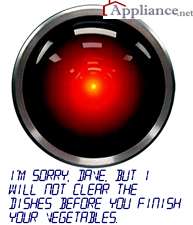
Hal 2000 as a dishwasher

Filed Under: Dishwasher, Features, Kitchen Tagged With: assistive robot, Dishwasher, hal 2000, jetsons rosie, Kitchen, kitchen robot, robot dishwasher, stanford

KitchenAid Introduces its Quietest Dishwasher Yet

July 9, 2008 By NightOwl

KitchenAid is now offering its quietest dishwasher ever. Featuring the new EQ™ Wash System and Whisper Quiet Ultima Sound Insulation System, this latest KitchenAid undercounter dishwasher is exceptionally quiet with a sound rating of only 48 dBA, or decibels, a level close to that of a quiet room (40 decibels) and well below a moderate rainfall (60 decibels).

The EQ™ Wash System provides optimal cleaning performance and noise reduction while also saving water and energy. The system features a true variable speed motor that helps to minimize operating noises by starting slowly and adjusting its operating capacity to deliver the power needed based on the wash cycle. Alternating wash zones focus the washing action while using less water and energy for high performance cleaning. A three-stage filtration system captures food particles as the water circulates within the dishwasher to maximize efficiency of its pump. For enhanced drying performance, the interior of the dishwasher is heated by a dedicated drying element.

“In addition to being our quietest, our latest dishwasher is 58% more efficient than

Energy Star standards,” notes Debbie O’Connor, Senior Manager of Brand Experience for KitchenAid. “Beyond being Energy Star qualified, it also has an efficiency designation from the Consortium for Energy Efficiency (CEE), making it eligible for energy rebates in select states.”

Additional features include a welded tall tub with a stainless steel interior, a premium feature found throughout the entire KitchenAid dishwasher line. Other innovations include a ProScrub® Option that provides concentrated cleaning during the normal wash cycle for harder to clean items like casserole dishes with baked on food. An Optimum Wash Sensor adjusts the wash cycle to specific water conditions for maximum cleaning efficiency.

A culinary tool rack, an adjustable and removable upper rack, fold-down cup shelves, an extra-large silverware basket with three lids and a Sure-Hold® Small items pouch offer great versatility in accommodating a variety of dishwasher loads.

Available in stainless steel, white, black or a panel-ready model for a custom panel, the new dishwasher model will carry suggested retail prices of $1,449 for the stainless steel model,
$1,299 for the black or white models and $1,399 for the panel ready model.

Filed Under: choosing a Kitchen Appliance, Dishwasher, Features, Kitchen, News Tagged With: Dishwasher, kitchenaid, kitchenAid dishwasher, KitchenAid EQ dishwasher, quiet dishwasher

  • « Go to Previous Page
  • Go to page 1
  • Interim pages omitted …
  • Go to page 8
  • Go to page 9
  • Go to page 10
  • Go to page 11
  • Go to page 12
  • Interim pages omitted …
  • Go to page 16
  • Go to Next Page »

Primary Sidebar

[footer_backtotop]

© 2006-2019 Appliance.net · Log in