• Skip to primary navigation
  • Skip to main content
  • Skip to primary sidebar

Appliance. net

Appliance news, reviews, ratings, forums, reports and buyers guides.
Locate repairs and parts. for home and kitchen appliances.

  • About Appliance.Net
    • BestPrice Family
    • Contact
    • Become a Featured Dealer
    • Retailer & Repair Services Advertising
  • Shopping
  • Appliance Forum
  • Manufacturers
    • Manufacturers 800 Numbers
    • Aga
    • Bosch
    • Caldera
    • Dacor – The Life of the Kitchen
    • General Electric – GE
    • Jenn Air
    • Sears – Kenmore
    • Thermadore
  • Sections
    • Features
    • News
    • Recalls
    • Kitchen
      • Dishwasher
      • Ranges Ovens and Cooktops
      • Refrigerators and Freezers
      • Microwave Oven
    • Household
      • Consumer Electronics
      • Heating and Cooling
      • Vacuum Cleaners
    • Laundry
      • Washing Machine
      • Dryers
    • Safety
You are here: Home / Archives for Household

Household

Recall: Hoover Upright Vacuum Cleaners Due to Fire and Shock Hazards

May 28, 2010 By NightOwl

Name of Product: Hoover® WindTunnel T-Series™ Bagless Upright Vacuum Cleaners with Cord Rewind Feature

Units: About 108,000

Importer: Hoover Inc., of Glenwillow, Ohio

Hazard: The power cord is not properly routed or securely seated in the cord rewind assembly allowing the power cord to be pulled loose. This poses fire and shock hazards.

Incidents/Injuries: Hoover has received three reports of minor burns to carpet and furniture and one report of a minor burn to a consumer’s hand.

Description: This recall involves Hoover® WindTunnel T-Series™ Bagless Upright vacuum cleaners with the cord rewind feature. This feature enables the cord to wind inside the vacuum for storage. The following model numbers and manufacturing codes are included in the recall.

Model Numbers Manufacturing code
ends with…
UH70110  UH70120
UH70200  UH70205
UH70210
H09A I09A
J09A K09A

Vacuums with the manufacturing code K09A followed by a green dot are not included in this recall. Vacuum cleaners with the cord rewind feature sold after November 2009 and with any other manufacturing code are not included in this recall. The model number and manufacturing code can be found on a label on the lower rear part of the vacuum cleaner.

Sold at: Mass merchandisers, department stores and independent vacuum retailers nationwide and online from August 2009 through May 2010 for between $100 and $160.

Manufactured in: Mexico

Remedy: Consumers should immediately stop using the recalled vacuum cleaners and contact Hoover for a free repair.

Consumer Contact: For additional information, contact Hoover toll-free at (888) 891-2054 between 8 a.m. and 7 p.m. ET Monday through Friday, or visit the firm’s Web site at www.hoover.com/tseriesrewindrecall

CPSC is still interested in receiving incident or injury reports that are either directly related to this product recall or involve a different hazard with the same product. Please tell us about it by visiting https://www.cpsc.gov/cgibin/incident.aspx
Filed Under: Features, Household, News, Recalls, Safety, Vacuum Cleaners Tagged With: Hoover, Hoover bagless vacuum, Hoover Upright Vacuum Cleaners, Hoover Upright Vacuum Cleaners recall, Hoover vacuum, Hoover vacuum recall, Hoover® WindTunnel T-Series™ Bagless Upright Vacuum Cleaners with Cord Rewind Feature

EnergyStar Ratings – Can They be Trusted?

May 17, 2010 By NightOwl

According to retailers, the Federal Appliance Rebate Program has increased appliance purchases nationwide.  The rebate is for energy efficient appliances which is great – only you might not be getting what that EnergyStar  label promises.

A recent report from the Government Accountability Office (GAO) suggests that some Energy Star products aren’t all they’re cracked up to be.

Responding to a request for investigation from Sen. Susan Collins (R., Maine), the GAO submitted 20 fictitious products between June 2009 and March 2010 for certification by Energy Star, a joint program of the Environmental Protection Agency (EPA) and the Department of Energy (DOE). Fifteen of the fakes–including a phony “room-air cleaner” that was little more than a space heater with a feather duster taped to it–received an Energy Star label.

Parade Magazine reports that in response, federal officials announced plans to strengthen the program. From now on, each application will be reviewed individually by an EPA staff member (as opposed to the automated approval process previously in place). By the end of the year, companies that want Energy Star certification for their products will be required to submit lab results from an independent testing agency rather than conduct their own evaluations.

Meanwhile, consumer advocates say we can still have faith in our Energy Star appliances: Most Energy Star brands on the market are about 10% more energy-efficient than their counterparts.

Sen. Collins applauds the reforms, calling them long overdue. “Energy Star wasn’t just slipping a bit,” she says. “It was in danger of falling off the quality cliff–putting taxpayers at risk of getting ripped off. Now that the EPA and DOE are moving to put more stringent oversight in place, I believe consumers will be better served and the integrity of the program will be restored.”

Filed Under: choosing a Kitchen Appliance, Dishwasher, Dryers, Features, Gas Range, Heating and Cooling, Household, Kitchen, Laundry, News, Oven, Ranges Ovens and Cooktops, Refrigerators and Freezers, Washing Machine Tagged With: appliance, appliance rebates, appliances, choosing appliances, energy star, energyStar, Federal Appliance Rebates, State Appliance Rebates

Just How Much Energy is That Appliance Using?

May 10, 2010 By NightOwl

My computer stays on through the week, only getting shut off on the weekend.  My answering machine and TV stay plugged in, their little red lights glowing in the night.  I do turn off the treadmill between uses and the DVD player too.

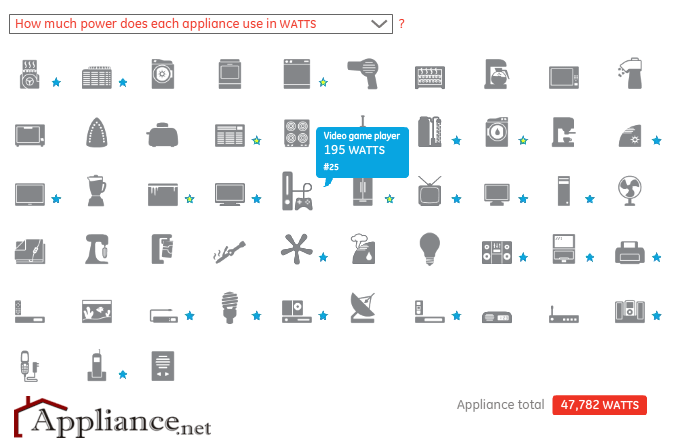
My energy habits are probably similar to many Americans.  If you’re wondering how much energy you’re wasting, or conversely, saving by turning appliances off, check out this energy calculator from GE:

This is a really cool tool that calculates  how much power each appliance consumes in watts or kilowatthours.  Alternatively, you can see how much each appliance costs to use in dollars, and how much it consumes in equivalent gallons of gas.

Some appliances are marked with a blue star indicating that an  EnergyStar model is available or click on the green star to see how much energy (and money) you’ll save with a new appliance.

Filed Under: choosing a Kitchen Appliance, Dishwasher, Dryers, Features, Gas Range, Heating and Cooling, Household, Kitchen, Laundry, Microwave Oven, Multimedia, Office, Oven, Personal Care, Ranges Ovens and Cooktops, Refrigerators and Freezers, Small Appliances, Vacuum Cleaners, Washing Machine Tagged With: appliance energy use, appliance use, energy star appliances, energy use, GE, kilowatthours, using kilowatthours

Recall:Re-announcement of Coby Electronics Portable DVD/CD/MP3 Player – Low Return Rate and Additional Reports of Fires

May 6, 2010 By NightOwl

Name of Product: Rechargeable Batteries sold with Portable DVD/CD/MP3 Players

Units: About 32,600; 13,000 previously recalled in October 2008 and 19,600 in October 2009

Importer: Coby Electronics Corp., of Lake Success, N.Y.

Hazard: The rechargeable batteries can overheat, posing a fire hazard to consumers.

Incidents/Injuries: Coby Electronics has received 32 reports of the battery overheating. Eighteen additional incidents of the battery overheating in the TF-DVD 1020 model, 17 of which resulted in property damage ranging from minor up to $9,650. No additional incidents have been reported for the TF-DVD 8501 model.

Description: The recall involves Coby DVD/CD/MP3 players with product numbers TF-DVD 1020 and TF-DVD 8501. “Coby” is printed on the front cover and the product number is on the bottom of the unit. The serial numbers on the recalled rechargeable batteries are printed on a label on the following batteries:

Product Number Serial Number Description
TF-DVD 1020 DG240043D503000001-1006 Swivel screen
DG240006D503000001-400
DG240039D603000001-3000
DG240111D603000001-2000
DG240143D602000001-3000
DG240106D602000001-2000
DG240106D702000001-2000
DG240183D942000001-100
DG240071DB02000001-1400
DG240115D702000001-2500
TF-DVD 8501 Begin with “HY” 8 ½ inch screen

Sold at: Discount, electronics, music, toy, office supply stores and distributors of electronic products nationwide. The TF-DVD 1020 units were sold from May 2007 through July 2008 for about $168.The TF-DVD 8501 units were sold from January 2007 through September 2009 for between $140 and $275.

Manufactured in: China

Remedy: Consumers should immediately stop using the players with the recalled batteries and contact the firm to arrange for a free replacement battery. After removing the recalled batteries from the unit, consumers can continue to use it with the AC or DC power adapter.

Consumer Contact: For additional information, contact Coby Electronics toll-free at (866) 945-2629 between 8 a.m. and 5 p.m. ET Monday through Friday or visit the firm’s Web site at www.cobyusa.com

Filed Under: Consumer Electronics, Features, Household, Multimedia, Recalls, Safety, Small Appliances Tagged With: Coby DVD Recall, Coby Electronics, Coby Electronics recall, DVD, DVD player recall

Approved Energy Efficient Appliance Rebate Programs

April 28, 2010 By NightOwl

If you are wondering which Department of Energy (DOE) rebates are available in your state, just check out this interactive map.  There is also a simple table listing the individual states along with the total rebate dollars available, websites and phone numbers.

DOE has approved the appliance rebate programs for the states and territories linked or listed on this page as of April 27, 2010. This list and map will be updated as additional program details are available.  This DOE site is the only official DOE-sponsored Web site – beware of other unofficial sites.

Filed Under: choosing a Kitchen Appliance, Dishwasher, Dryers, Features, Gas Range, Heating and Cooling, Household, Kitchen, Laundry, News, Oven, Ranges Ovens and Cooktops, Refrigerators and Freezers, Washing Machine Tagged With: appliance rebate programs, appliances, DOE appliance rebate programs, finding appliance rebate programs, map of appliance rebate programs, rebates, State Appliance Rebates

Appliance Rebates are Here – But Not for Long

April 23, 2010 By NightOwl

The federal appliance rebates are finally here, but if you want yours, you’d better act fast.

According to the Wall Street Journal,  in Florida  the $17.6 million allocated for the program lasted a day and half, as more than 72,000 claims were filed. In Illinois, the second half of its $12.4 million, made available on Friday, April 16th disappeared in 11 hours.

Nationwide, $300 million in rebate money has been allocated by the federal government to 56 states and territories to encourage residents to buy furnaces, clothes washers, refrigerators and other appliances with the government’s Energy Star label. Typically, rebates run about $75 for a clothes washer and several hundred dollars for home heating and cooling systems.

But in an experience reminiscent of last year’s popular “cash for clunkers” program, which paid consumers to trade in gas-guzzling automobiles, interest in the appliance programs has been so been intense that the state programs are often running dry in a matter of days.

For example, Melissa Woodall, a single mother of three in Miami, said she began scanning appliance ads a few weeks ago for a new stove. She noticed an article about the rebates and decided to replace her old, leaky dishwasher and refrigerator.

The day before qualified purchases were allowed, she visited Sears to pick out the appliances. On Friday, she arrived to the store at 6:30 a.m. and found 49 customers in line. Fortunately, the store had given her a printout the night before. All she had to do was pay and arrange delivery, which still took an hour and a half in the crowded store.

And the ordeal was not over, Ms. Woodall said — she still had to get the rebate itself. At 11 a.m., when online signups began, she and her sister went to the state’s rebate site. “The Web site was flooded. It kept crashing,” she said. It took her an hour and 15 minutes to get registered for the rebate.

It was worth it, Ms. Woodall said. She paid about $1,500 for the dishwasher and fridge and will be getting about $500 back.

Each state has structured its own program, sometimes excluding certain appliances like air-conditioners or requiring proof that old appliances were recycled before paying out the cash. The amount of money available varies widely, from more than $35 million in California, where the program was scheduled to start on Thursday in connection with Earth Day, to $100,000 in American Samoa.

The federal government created the appliance rebate program as part of the 2009 stimulus legislation, and retailers say it has increased sales.

The high interest is understandable. The rebate programs come on top of existing discounts on Energy Star appliances, recycling and take-back rebates for old units, and specials provided by individual retailers. In some cases, consumers may qualify for federal or state tax credits, too.

Filed Under: choosing a Kitchen Appliance, Dryers, Features, Household, Kitchen, Laundry, News, Refrigerators and Freezers, Washing Machine Tagged With: appliance rebate program, appliance rebate program California, appliance rebates, Appliance Rebates california, Appliance Rebates Florida, Appliance Rebates Illinois, Appliance Rebates Texas, Federal Appliance Rebates, State appliance rebate program

You Can Use Less Laundry Detergent

April 19, 2010 By NightOwl

Over the next few weeks, Procter & Gamble plans to introduce easier-to-read plastic measuring caps for its liquid detergent brands, including Tide, Gain, Era and Cheer. The new caps will have more-defined measurement lines inside and bigger numbers that are staggered, not stacked, says Dawn French, P&G’s head of laundry research and development for North America.

Why?  Because, according to the Wall Street Journal, Americans use too much detergent per load.  They have come to think that more soap equals cleaner clothes, which is not the case – rather it causes build-up and dingy colors.  Additionally,  more consumers are buying high-efficiency washers which need even less of today’s concentrated detergents.

Packaging, in most cases, hasn’t helped. The molded lines and numbers inside detergent caps are hard to read, especially in a dimly lit laundry room. And even though concentrated detergents have been on the market since at least 2007, many caps still hold more than is needed for an average load.

Method Products Inc. this month launched an ad blitz for a new detergent with a pump dispenser, designed to help curb overdosing. Method found that 53% of people don’t use the recommended amount of detergent per washload, preferring instead to guess or, worse, to simply fill the cap up to the top—a practice that wastes more than half the loads a detergent bottle could wash, Method executives say.

Through much of Europe, detergent premeasured in tablets and sachets has been popular for years. But in the U.S., pre-dosed products have been largely unsuccessful. Consumers usually pick up their laundry habits during adolescence from their mothers, and changing them is hard, says Bob Deutsch, founder of Brain Sells, a marketing consulting firm.

American consumers, it seems, also want more control. Many people have their own laundry “recipe,” and each one believes her unique method leads to superior results, industry executives say. P&G, the world’s leading detergent maker, calls such involved laundry doers “master chemists.”

General Electric Co.’s top-of-the-line Profile frontload washer offers to take on all dosing decisions itself. The SmartDispense feature, adding $600 to the cost of the machine, holds up to six months’ worth of detergent and allocates the right amount for each load, taking the detergent concentration level and the amount of clothes into account.

Proper dosing is the biggest laundry concern among callers to Seventh Generation Inc.’s help line, says Sue Holden, head of the consumer-insights team at the Burlington, Vt., household-product maker. Two years ago, the company started making its detergent bottle cap with translucent plastic partly to make it easier to read. “We’re trying to train people to do something that doesn’t come naturally,” says Ms. Holden. “Growing up, a lot of us just poured it in.”

Seventh Generation’s co-founder, Jeffrey Hollender, wonders why more people haven’t stumbled upon laundry’s big, dirty secret: “You don’t even need soap to wash most loads,” he says.  The agitation of washing machines often does the job on its own.

Filed Under: Features, Household, Laundry, Washing Machine, _ Tips Tagged With: concentrated detergents, Laundry, P&G, Procter & Gamble, Wall Street Journal, Washing Machine

Recall: Lennox Hearth Products Vent-Free Gas Logs and Fireplaces Due to Gas Leak and Fire Hazards

April 7, 2010 By NightOwl

Name of product: Superior VFGL Vent-Free Gas Log Sets and VF Vent-Free Fireplaces

Units: About 5,700

Manufacturer: Lennox Hearth Products, of Nashville, Tenn.

Hazard: The front burners of vent-free gas log set fireplace inserts and the vent-free fireplaces can fail to ignite allowing gas to escape and posing a fire or explosion hazard to consumers.

Incidents/Injuries: Lennox received two reports from installers of the log sets failing to light. No injuries were reported.

Description: The recalled products are Lennox Superior brand VFGL Log Sets and VF4000, VF5000 and VF6000 fireplaces. Log sets are comprised of ceramic-fiber logs with a dual gas burner system and are designed to be placed in a wood-burning fireplace or a ventless firebox enclosure. Fireplaces are comprised of log sets, a ventless firebox enclosure and accessories. Each product has a metal rating plate attached to the grate of the log sets or to the frame of the fireplaces containing the unit’s model number, serial number and other information. The following models are affected by this recall:

Vent-Free Gas Log Set Models

VFGL18 — MSN — 4
VFGL18 — MSP — 4
VFGL24 — MSN — 4
VFGL24 — MSP — 4
VFGL28 — MSN — 4
VFGL28 — MSP — 4
VFGL18 — VSN — 4
VFGL18 — VSP — 4
VFGL24 — VSN — 4
VFGL24 — VSP — 4
VFGL28 — VSN — 4
VFGL28 — VSP — 4

Vent-Free Gas Fireplace Models

VF4000 — CHN — 2
VF4000 — CHP — 2
VF4000 — CMN — 2
VF4000 — CMP — 2
VF5000 — CMN — 2
VF5000 — CMP — 2
VF6000 — CMN — 2
VF6000 — CMP — 2

Included in this recall are units with serial numbers starting with “6408C” through “6408M,” and those starting with “6409.” Units that had repairs made to the burner assembly between March 2008 and December 2009 are also included.

Sold by: Various fireplace and HVAC retailers and installers from March 2008 through December 2009 for approximately $540 to $775 for the log sets and $1,300 to $1,850 for the fireplaces.

Manufactured in: U.S.A.

Remedy: Consumers should immediately stop using the recalled log sets and fireplaces and contact Lennox for information about how to arrange for a free inspection and repair.

Consumer Contact: For additional information, please contact Lennox Hearth Products at (800) 826-8546 between 8 a.m. and 4 p.m. CT Monday through Friday, or visit the firm’s Web site at http://www.lennoxhearthproducts.com


Filed Under: Features, Heating and Cooling, Household, News, Recalls, Safety Tagged With: fireplace recall, gas fireplace recall, gas log recall, Lennox Hearth Products Vent-Free Gas Logs and Fireplaces, Recall Lennox Hearth Products Vent-Free Gas Logs and Fireplaces

Whirlpool Wins $1.78 Million From LG in Patent Case

April 2, 2010 By NightOwl

According to Businessweek.com, Whirlpool Corp., the world’s largest appliance maker, won $1.78 million in patent- infringement damages from Korea’s LG Electronics Inc. in a continuing dispute over refrigerator technology.

After a seven-day trial in federal court in Wilmington, Delaware, the jury of five women and three men also decided that Whirlpool didn’t infringe an LG icemaker patent. “We’re gratified that the jury found that our patent is both valid and infringed,” Scott F. Partridge, one of Whirlpool’s lawyers, said in an interview after the verdict.

LG, of Seoul, sued Benton Harbor, Michigan-based Whirlpool in 2008 alleging infringement of a U.S. patent for an ice dispenser. Whirlpool countersued, claiming LG infringed patents for in-door ice-access and warp-proof refrigerator liners. LG said in a statement it would seek a judicial review of the verdict.

During two days of deliberations, jurors repeatedly examined a row of LG and Whirlpool double-door refrigerators with icemakers lined up in the courtroom, comparing claims of the patents and how the equipment works.

LG had asked the jury to award it more than $1 million in royalties, and Whirlpool originally asked for a minimum of $22.1 million in its suit.

The case was complicated by a U.S. International Trade Commission ruling in Washington last month that LG didn’t violate a Whirlpool patent for ice storage and may still import refrigerators.

In its statement, LG said the jury “was not permitted to hear any evidence concerning the ITC investigation.”

LG is the No. 3 appliance maker behind Whirlpool and Sweden’s Electrolux AB. LG reported more than $7 billion in home appliance sales last year and is aiming to become the world’s largest maker of refrigerators and washing machines by 2012.

LG agreed to modify the design of the ice maker in some of its refrigerators to resolve part of the ITC dispute.

Filed Under: Features, Household, Laundry, News, Refrigerators and Freezers Tagged With: LG, LG appliances, LG icemaker, LG patent, LG refrigerators, whirlpool, whirlpool appliances, whirlpool icemaker, whirlpool patent, whirlpool suing LG

SmellyWasher Will Get the Stink Out

March 23, 2010 By NightOwl

For years, Savage, Minnesota  resident Paul Flynn would go into people’s homes as an appliance repairman to eliminate odors from washing machines.

After seeing the problem over and over again, Flynn came up with a way to fix the problem that didn’t require him to take the machine apart by creating a product called SmellyWasher.

Recalling some concoctions he used to clean submarine parts while in the Navy, Flynn mixed ingredients together to eliminate the smell. About four years ago, he and a few others sat around his kitchen table pouring the mixture into plastic baggies and sending it to customers around the world.

Now SmellyWasher has grown so fast it’s the best-selling cleaning product sold worldwide in Ace Hardware stores.

His hometown Newspaper, The Savage Pacer writes:

Washing machines emit foul odors primarily because of poor washing habits, Flynn said.

Mold and mildew build up in the machine from using too much detergent, fabric softener and inappropriate water temperatures.

“It’s all our fault,” he said. “People don’t like to use less detergent. When they notice a smell, their first reaction is to add more detergent or fabric softener. That’s just exacerbating the problem … It’s up to us to change our washing habits. We can’t change the environment: washing machines are damp and dark. The only thing we can change is the food sources for the mold and germs to grow.”

Laundry loads don’t require more than a tablespoon of detergent, Flynn said. Using more is excessive and the residue builds up in the machine. Then when fabric softener is added during the rinse cycle, it also gets trapped and builds up.

Other “common sense” solutions, like using bleach or leaving the door open, also make the problem worse, he said.

“Bleach and vinegar will get some things out, but it will also leave a base for germs to build off of,” he said. “Leaving the door open increases air flow and makes it worse.”

Front-loading washers are even worse, Flynn said in terms of odor, because they have a larger tub, use less water and people use too much detergent.

SmellyWasher is a citrus-based mix of natural ingredients that removes the smell. It’s can also be used as a booster to maintain the cleanliness of the tub. The 24 ingredients are safe and all natural he said.

The idea for creating a mixture to fix the problem came from an experience Flynn had when he was in the Navy for four years. On one particular filed day, he ran short on cleaning supplies. A petty officer took him to the galley and showed him some combinations of regular items “that would do the job in a pinch,” he said.“I’m proud to say it’s an adaptation of that formula,” Flynn said. “I remembered it working well and relied on that when creating SmellyWasher.”

Filed Under: Features, Household, Laundry, News, Washing Machine Tagged With: cleaning a washing machine, SmellyWasher, Washing Machine, Washing Machine odor

  • « Go to Previous Page
  • Go to page 1
  • Interim pages omitted …
  • Go to page 6
  • Go to page 7
  • Go to page 8
  • Go to page 9
  • Go to page 10
  • Interim pages omitted …
  • Go to page 29
  • Go to Next Page »

Primary Sidebar

[footer_backtotop]

© 2006-2019 Appliance.net · Log in