• Skip to primary navigation
  • Skip to main content
  • Skip to primary sidebar

Appliance. net

Appliance news, reviews, ratings, forums, reports and buyers guides.
Locate repairs and parts. for home and kitchen appliances.

  • About Appliance.Net
    • BestPrice Family
    • Contact
    • Become a Featured Dealer
    • Retailer & Repair Services Advertising
  • Shopping
  • Appliance Forum
  • Manufacturers
    • Manufacturers 800 Numbers
    • Aga
    • Bosch
    • Caldera
    • Dacor – The Life of the Kitchen
    • General Electric – GE
    • Jenn Air
    • Sears – Kenmore
    • Thermadore
  • Sections
    • Features
    • News
    • Recalls
    • Kitchen
      • Dishwasher
      • Ranges Ovens and Cooktops
      • Refrigerators and Freezers
      • Microwave Oven
    • Household
      • Consumer Electronics
      • Heating and Cooling
      • Vacuum Cleaners
    • Laundry
      • Washing Machine
      • Dryers
    • Safety
You are here: Home / Archives for Features

Features

How Food Cooks – Conduction, Convection and Radiation

February 21, 2008 By NightOwl

If you are feeling scientific and have begun to wonder how it is that the microwave or convection oven really cooks your food, or even what good old fashioned heat is doing to your meal, we’ve found your answers.  At drdavescience.com, a PhD candidate with a flair for explaining the scientific tells us how it all works. 

The science of heat

Cooking is the transfer of heat energy from some source to the food. In the kitchen there are three devices that are used to cook food: the stovetop, conventional oven, and microwave oven. Each of these devices are designed around a different method of heat transfer.

The movement of heat is so important that there is a name for it: Thermodynamics. By understanding how heat moves, we can gain insight into our everyday world. It is responsible for the weather, car engines, your refrigerator, cooking, and a host of other things that you may not have even thought about.

Heat is transferred in three basic ways listed below:

Conduction is heat transfer through direct contact. When cooking on the stovetop, the heat from the flame or electric grill is applied directly to the frying pan. This means that only the flat surface of the pan is sufficiently hot enough to cook anything and we must flip and toss around the food to cook it properly. conduction cooking a sandwich

It is important to note that most pans are made of metals, like copper, that conduct heat very efficiently and do not melt on the stovetop.

Convection is heat transfer through a fluid. The fluid can be liquid or gas and in the case of a convection oven, the fluid we care about is air.

An oven is a confined area that gets hot by flames or electric coils. The air inside is warmed to a desired temperature and, as a result, cooks the food from all directions. This method of heat transfer is responsible for pizzas, cakes, and other baked treats!

Keep in mind that ovens heat foods from the outside. The inside slowly heats up with time, and it is not uncommon to see food where the outside looks done, but the inside is uncooked. This is very important when preparing a Thanksgiving turkey, and there are special thermometers that measure the temperature of the food in the center of the turkey to show that it is properly cooked. (editor’s note:  All ovens cook by convection – where the hot interior air does the cooking.  What appliance manufacturers call “convection ovens” have an additional heating element and an extra fan to make the air circulation more efficient and effective, boosting the heat transfer from the air to the food, and thus altering the way the food cooks -faster, dryer etc..)

Radiation is the transfer of heat using electromagnetic radiation. A microwave oven uses very strong radio waves (a form of electromagnetic radiation), which are very weak and not hot. So how does it work? microwave oven

Microwave ovens work by spinning water, fats, sugars and oils inside the food. This causes friction, which then heats the food and cooks it from the inside.

Please do not be confused by the word radiation or electromagnetic radiation. In science, these terms are very general and mean a lot of things. Radiation comes from many sources, some are beneficial and others are harmful. For example, solar radiation from the Sun is responsible for heating the Earth and the light we see is a form of electromagnetic radiation.

As you know, heat is very important in the cooking process. Now you have the basic knowledge of heat transfer.

Filed Under: Cooking, Features, Kitchen, Microwave Oven, Oven, Ranges Ovens and Cooktops Tagged With: conduction, convection, heat transfer, how a microwave works, how food cooks, microwave, radiation cooking

Portable Dishwasher

February 20, 2008 By NightOwl

If you lack the space for a built in dishwasher or need the occasional extra capacity of second dishwasher, a portable might be for you. Danby makes this Model DDW1805W.

This Free-Standing Dishwasher is great for anyone who wants the convenience of a dishwasher but has limited space. The dishwasher can freely be moved around the kitchen to allow for more open space where needed. It has a 8 place setting capacity, a large lower disk rack and silverware basket and has 7 wash programs. The quiet operation of this dishwasher is a must have for anyone who wants a dishwasher in a small space.

You might expect a product this convenient to skimp on other features too, but that´s hardly the case. The Danby Portable 18 Inch Dishwasher features a stainless steel tub for long-lasting durability, convertible dishracks that adjust for regular or glass-only loads, energystar rated superior, super quiet operation and low water consumption.

  • 8 Place Setting Capacity
  • Large Lower Dish Rack and Silverware Basket
  • Dish Rack accommodates plates 11″ in diameter
  • Adjustable Upper Dish Rack
  • 7 Wash Programs
  • Three Tier Spray Wash System
  • Rinse Agent Dispenser
  • Maximum temperature allows for sani-wash option
  • Automatic Detergent Dispenser
  • Low Water Consumption
  • Normal wash uses 3.8 gallons (14.5 L)
  • Quiet Operation (55 dB)
  • Convenient hose storage
  • Built-in Casters for easy movement
  • Water Softening System
  • Stainless Steel Spray Arm & Interior
  • Energy Star
  • 3 Tier Filter
  • 17.7″ wide
  • 27″ deep
  • 36″ tall
  • Sent via truck freight (134 pounds packaged)
  • 18 month manufacturers warranty
  • This sells for around $400.00

    Filed Under: Dishwasher, Features, Kitchen Tagged With: danby, Dishwasher, portable dishwasher, small dishwasher

    Immersion Blenders – Indispensible?

    February 19, 2008 By NightOwl

    Back in July of 2006, I cast my vote for the immersion blender, with my article about my old Braun blender. Well, I’m not alone in my opinion. You can read Marlene Parrish’s thoughts in the Pittsburgh Post -Gazette. She’s even more enamoured of the tool than I am.

    I chose model KHB300OB, in black. With one-touch ignition, multispeeds and powerful performance.

    No, it’s not an ’08 BMW. It’s the latest Kitchen Aid appliance, a new immersion blender. Not for you? Fine. You probably don’t need or want one more thing that plugs into a socket.

    But think a minute. Leaving out the coffee maker and dishwasher, what is your favorite kitchen appliance right now, and why?

    It could be a food processor for all-purpose duties, a hand mixer for cakes and whipped cream, a blender for soups and smoothies, a coffee bean grinder for you know what and so forth. The appliance has earned favorite status because it has multiple uses, is convenient to use and easy to clean and store.

    You might even call it indispensable.

    The immersion blender is the latest appliance on the market to vie for that coveted crown. It does all the tricks my 25-year-old, wearing-out Waring blender does, but does them lots faster and way smarter. It also whips, aerates, emulsifies and purees. Results are immediate, and cleaning is a snap.

    My immersion blender looks like a giant candlestick. The hand-held, ergonomically designed wand comes with multiple bells and whistles. It has a detachable blending attachment, a whisk, a chopper attachment, blending beakers and a chopping beaker.

    There’s only one way to find out if it’s as good as it looks. I decided to put this baby to the tests.

    In the kitchen

    First project: creamy soup. Into my largest pot, I tossed a coarsely chopped potato, two stalks of celery, an apple, a banana, an onion and broth to cover, then simmered until the ingredients were soft. Seasonings and milk were added. Then came the moment of truth. I snapped the blending wand onto the base, plugged in the cord, submerged the business end and pressed the power button. Whoosh, whirr, slurp — done. I had a velvety puree, no lumps and no blade-bitten rubber spatula, either, as often happens in my blender.

    I pressed the dual-ejector buttons, snapped off the attachment, swished it under hot soapy water and started on the mayonnaise.

    Holding the wand at a slight angle (yes, guys, I read the owner’s manual), I moved it slightly up and down within the container as I added a cup of oil to the egg, vinegar and seasonings. Flash, shazam! Done. I tossed two scallions cut into thirds and a half-handful of parsley into it and pulsed again. Smooth, pale green mayo appeared before I could say “Martha Stewart.”

    And so it went for an afternoon.

    • To gauge the efficiency of the nine-speed dial, I made salsa in the chopping container using a pulse action. Had I kept the motor running on a higher speed, the salsa would have morphed into gazpacho. The fat switch is rubberized and the slightest pressure of your fingers turns it on and off. I like that.

    • I harvested my entire basil crop to make superb pesto, using less than the usual amount of olive oil because I had complete control of the power.

    • When I whirled the soup, the 5-foot power cord was an easy reach from the outlet to the stovetop and into the pot.

    • Using the whisk attachment and the beaker bowl, I whipped cream. Next time I’ll try egg whites.

    • Using the chopper attachment and the chopping bowl, I took some nuts down to flour, although I don’t know what I’ll do with it yet. Toss it into cookie dough, I suppose. A couple of leftover slices of breakfast toast became crumbs to brown in olive oil for a pasta topping at supper.

    In the future, I can see the ease of pancake and waffle batter and smooth gravies. Lumpy sauces are past tense.

    Decisions

    A small kitchen has only so much storage. And most people only use what they can see or reach. Where will my new toy live and what, if anything, can it replace?

    It won’t replace my chopping boards and knives. It’s a joy and comfort to slice and chop through a bag of produce. It won’t replace my beat-up, hand-held old Sunbeam mixer either; the thing is older than my children.

    It will not and does not replace my Cuisinart food processor; they are complementary machines. My beloved workhorse processor is for mixing pastry and pizza doughs, shredding cheese and slicing vegetables. Not jobs for the immersion blender.

    But the immersion blender will replace my mini-processor, which has been a loser from the get-go, with a whiny motor, too-little capacity and poor handling. My Waring blender also is going on the garage-sale shelf. It’s been a good friend and companion, but, like other friends, it’s old, overweight and slow, overheating and balking at simple jobs.

    Be warned. There’s a safety factor to contend with. The chopping blade, while well-designed to be covered and protected, is super-sharp. Fingers can find that blade like a moth to a light. I’m putting all the attachments in a plastic box in a kitchen drawer.

    Not that you’d know, but people can get careless under the influence of, um, cooking wine. So let’s borrow the slogan “don’t drink and drive” and change it to “don’t drink and immerse.” And not that you need to be told this either, but never let the kids play with the parts.

    Which model to get? My Kitchen Aid retails for $99.99 and is loaded with attachments. But then I’m of the “you-get-what-you-pay-for” school of thought, and I like Kitchen Aid products. They are the All-Clad of plug-ins. If I were to re-think the purchase, though, I’d buy just the immersion wand. I could do without the whisk attachment and possibly the chopping blade, both of which duplicate jobs done by my hand-held mixer and food processor.

    There is certainly a model to suit your specific needs and wallet. Braun, an excellent company, has two models at $29.99 and $69.99. Cuisinart has one for $49.99. Some have a cord, some are cordless. Others are blender wand only, while some have attachments. Just be sure the one you settle on is sturdy enough to handle the jobs you have in mind.

    Filed Under: Cooking, Features, Kitchen, Reviews, Small Appliances

    How to Buy a Slow Cooker

    February 18, 2008 By NightOwl

    Winter is a great time to enjoy chilis, stews and soups. If you want to arrive home to a comforting meal, one of the easiest ways to do so is by using a slow cooker. Slow Cookers (also known as Crock-pots) work, their name suggests, by maintaining a low, constant heat over many hours. Although they are generally thought of as being used for wet mixtures, slow cookers can also cook a whole chicken or roast.

    If you are looking for a slow cooker, be prepared by reading the tips here before you shop.

    Checklist for buying a slow cooker:

    What size slow cooker do you need?

    Slow cookers are available in 8 ounce to 6 quart sizes. Depending on your intended use, if you’re cooking for a family of four or more you will need at least a 6 quart model, if less that 4 than the 6 quart would do.

    Keep in mind that slow cookers need to be at least half full to properly cook as intended, so if you have a large slow cooker, but are only cooking for a small family, you could prepare a larger quantity of food and then freeze the leftovers.

    Is it user-friendly?

    Choose a slow cooker with user-friendly features like a removable power cord with switch. From time to time you may need to move the slow cooker in your kitchen or even outdoors during a picnic. A long power cord provides you hassle-free mobility with the slow cooker.

    Glass lids and removable pots

    The best slow cookers come with glass lids so you can see through it to check on the progress of the food without opening the lid.

    When you open the lid, the cooking temperature drops so the cooking time will change and may take longer. Most models will have removable pots, but make sure they have stay cool handles to avoid getting burned when lifting them out.

    Most slow cookers have a thick stoneware liner surrounded by a metal exterior. This outer surface can become quite hot. While it may be pricier, you can find models that have added insulation and are layered with temperature absorbing finishes.

    Temperature setting options

    Kitchenaid slow cookersLook for slow cookers with temperature setting options. A slow cooker which only comes with an On/Off switch could not keep your food warm without burning it after it is cooked.

    Most models offer at least 2 heat settings, better yet, some models may have an automatic temperature control that you can set.

    Look for a slow cooker that has a “keep warm” setting because you may not eat immediately as soon as your food is cooked, and you don’t want it to dry out.

    Better yet find a slow cooker model with an electronic temperature sensor because that feature will alert you if there is a drop in the food temperature level.

    Other slow cooker buying tips:

    • Choose a slow cooker that is durable and could be of service to you for the next five to ten years.
    • Digital programmable settings offer cooks maximum flexibility with time and temperature.
    • Choose a slow cooker which is dishwasher friendly and whose parts can be easily removed for easier cleaning.
    • Designer models have sleek shapes, finishes, and a choice solid colors or patterns of floral and plaids. Stainless-steel models are also very popular.
    • Slow cookers are priced from $20 to $250. If you choose a simpler model you will pay less but if you opt for a more elaborate slow cooker with more features, you can expect to pay more.

    The leading distributors of slow cookers in the market today include Rival, Hamilton Beach, Cuisinart, All Clad, West Bend, Farberware, and KitchenAid slow cookers.

    hamilton beach slow cookersWith the right choice, slow cookers can come up with the best-tasting chicken, beef stew, pot roast, roast beef, ribs, vegetarian dishes or any home-made meal you want to eat, but don’t want to stay around and monitor.
    Filed Under: choosing a Kitchen Appliance, Cooking, Features, Kitchen, Small Appliances, _ Tips Tagged With: buying a crock-pot, buying a slow cooker, crock pot, crockpots, slow cooker tips, slow cookers

    Basic Furnace Maintenance Tips

    February 16, 2008 By NightOwl

    We may be halfway through the winter, but it’s never to late to check your furnace for safety and efficiency. Following some basic routine maintenance is one of the easiest ways to save money and hassles with your heating, and will also help with the air quality in your home. You can schedule a check-up with a furnace company, but there are some simple things you can do yourself.

    Be sure to turn off power to your furnace before working on it so that a motor doesn’t start while you’re tinkering. You can usually change a filter without turning off the gas or oil supply, but for all other maintenance be cautious and turn off the fuel supply. Before you do, be sure you know how to relight the pilot light.

    With almost any heating system, replacing the thermostat with a programmable digital thermostat will save energy. These thermostats automatically adjust the temperature of your home to keep you comfortable when you’re there and save energy when you’re not.

    At a very minimum, change the air filter in any forced-air furnace on a monthly basis. A good programmable thermostat will remind you when to change the filter. Some experts recommend inexpensive fiberglass filters; others, midrange filters that trap smaller particles. Furnace performance should not be impacted if filters are changed regularly. Base filter selection on your sensitivity to air-borne particles. Vacuum the blower and accessible areas of the furnace every few months. Even with regular filter changes dust will accumulate on the blades of the blower.

    If you have an older natural gas or propane furnace, oil the motor and blower shafts — they only need a couple of drops of 20-weight oil on an annual basis. Most new models have sealed bearings that don’t need to be oiled.

    Your furnace blower might be powered by a V-belt connected to an electric motor. If the belt is cracking or fraying, it needs to be replaced. Even if the belt looks OK, you might want to check the blower and motor pulleys for alignment; if they’re not aligned the belt will wear out faster (and make more noise). To align it, loosen the screws holding the motor in place, then align the pulleys using a metal carpenter’s square and tighten the screws.

    You can replace the oil filter to keep clean fuel flowing to an oil-burning furnace. Check the owner’s manual to find out how to bleed air out of the fuel line, though it may not be necessary on your model. Regularly checking the fuel lines and connections for leaks is a good idea.

    If you have a hot water system, bleed air out of radiators annually. While the system is on, simply open the bleeder valve on each radiator until water comes out without sputtering. Be prepared to catch the water and be careful — it’s hot! There are different types of bleeder valves on radiators: Some open with a screwdriver; others, with a special key or a knob already in place.

    For all types of furnaces, make sure the outside vents and chimneys are not blocked by snow, leaves, nests, etc. Such blockages can cause carbon monoxide hazards. Flues that leak pose carbon monoxide and fire hazards, so check for cracks or joints that are separating.

    You can read more at motherearthnews.com and then go on down to the basement and do a little preventative maintenance even if it’s just changing the filter.

    Filed Under: Features, Heating and Cooling, Household, Safety, _ Tips Tagged With: furnace, furnace filter, furnace maintenance, furnace maintenance tips, heater, heater filter, heater maintenance

    What to do if Your Freezer Fails

    February 15, 2008 By NightOwl

    Freezing food is a great way to save both time and money.  Many time managers suggest cooking only one or two days a week, making double amounts, and freezing the rest for future meals.  I love to bake and my family can’t always eat all the bread or cookies that I’ve made – enter my free standing freezer in the garage.  For saving money, buying on sale and freezing is a great way to go.  My freezer can sometimes be filled with six to eight half gallons of the kids’ favorite (okay, mine too)  flavors.  But what happens to those savings and time saving meals if the power goes out? 

    Spring storms, for example, sometimes knock out electrical power to entire neighborhoods for days at a time.The appliance itself may develop a problem, or a household pet could accidentally unplug it.  We and motherearthnews.com have some suggestions to help you be sure the food in your freezer stays fresh and safe to eat.

    RULES TO REMEMBER

    The first thing NOT to do when your freezer falls is open the door to check on the food! Little, if any, thawing will take place during the first 12 hours . . . provided the temperature within had been set at or near 0°F. An unopened, fully loaded freezer can actually keep food safe for up to two days without electricity . . . while a partially loaded chest will be effective for up to one day. (The moral is keep your freezer full, even if you have to use plastic gallon jugs filled with water to take up the empty spaces.) Other rules of thumb: The colder the food at the time of the mishap, the longer and better it’ll keep . . . and the larger the freezer capacity, the longer the food will stay frozen.

    So if you’re reasonably certain your electrical power will resume within 24 hours-or if you’ve replugged the freezer and scolded the puppy (in this case, you may have to open the appliance to determine how long ago Fido tripped over that cord)—it’s probably best to leave your frozen edibles alone. But should it appear that the device will be out of service for longer than one day, it’s wise to try to move your goods to a friend’s freezer—or to a rental cold-storage locker—for the duration . . . because even a large, fully loaded freezer just might not be able to recover and refreeze the huge quantities of food it contains before spoilage starts to set in. (If you do move your frozen edibles, remember to “insulate” them well for the journey by wrapping items in newspapers and blankets.)

    If you don’t have any convenient way to move your food, try purchasing some dry ice instead . . . 25 pounds will maintain a ten-cubic-foot freezer for two to three days. (To determine the necessary amount, just multiply the cubic-foot capacity of your appliance by 2.5.)

    You can locate sources of dry ice by consulting the Yellow Pages of your phone directory. Outlets may be listed under ice cream manufacturers and refrigeration suppliers . . . or you might try firms that sell compressed gas. Local dairies, fish markets, or electric utility companies may also be of assistance in locating a source.

    Remember always to wear heavy gloves or use tongs when handling dry ice, to minimize the risk of being “burned” by the substance. And be certain the area around your freezer has adequate ventilation during the loading process . . . since the thawing ice gives off tremendous amounts of carbon dioxide. Place the “cubes” (always on a heavy piece of cardboard) directly over the food, since cold air moves downward . . . and close the door.(If your freezer is only partially full, move all the items close together.)

    MELTDOWN!

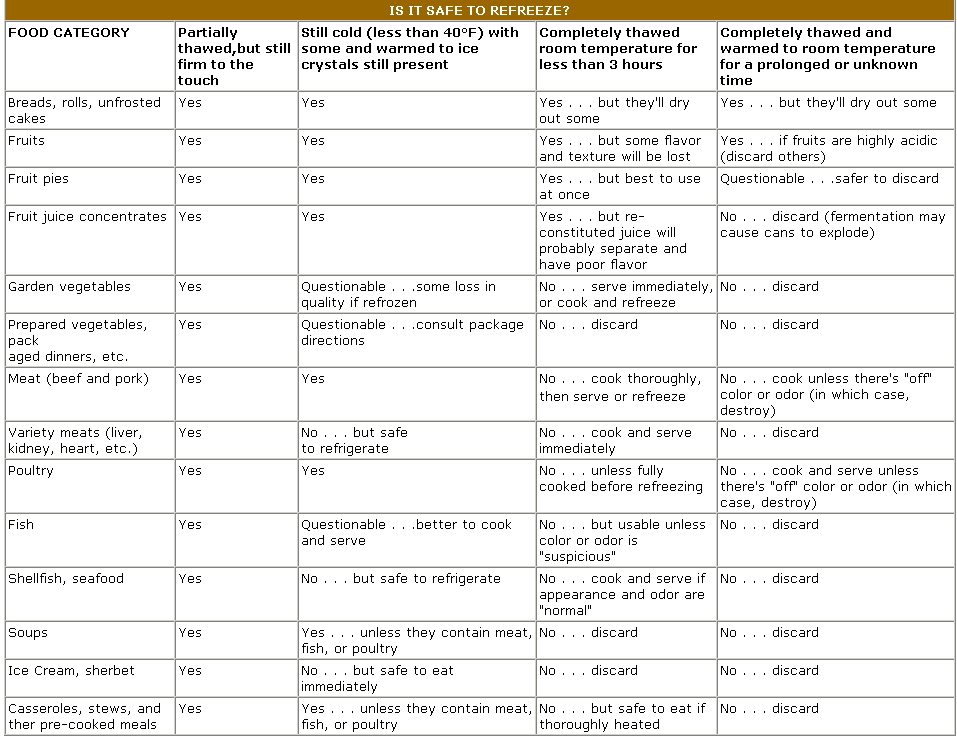
    Let’s suppose the worst has happened. You unsuspectingly open the freezer door one day and discover that all the packages inside are well on their way to being completely defrosted. What do you do? First, check the foods to see if any still contain ice crystals. Those that do are safe to eat, and many of them can be refrozen. Cold foods, even if no ice crystals are present, can also be considered safe but must be cooked before being returned to the freezer. (It’s important to remember that refrozen foods, or frozen cooked foods, need to be used as quickly as possible to guarantee maximum nutritional quality.)

    Never refreeze thawed vegetables (they may contain botulism spores, which would have ample time to grow and reproduce during the time it takes to refreeze) . . . casserole dishes that contain meat, fish, or poultry . . . or melted ice cream. And naturally, always use good judgment and toss out any food that looks or smells even a little suspicious.

    Finally, use the accompanying chart to help determine how to handle specific categories of edibles. Remember, If there’s any doubt, throw it out. No food is worth the risk of poisoning yourself or someone else.

    freezerchart.jpg

    Filed Under: Features, Kitchen, Refrigerators and Freezers, Safety, _ Tips Tagged With: food safety, freezer, freezers, refreezing food

    Kitchen Appliances for Valentine’s Day?

    February 14, 2008 By NightOwl

    Filed Under: Features, Humor, Kitchen, News, Small Appliances

    Questions and Comments About Convection Ovens

    February 12, 2008 By NightOwl

    It seems lately that everyone is interested in convection cooking and that even though manufacturers have brought the technology to the simple toaster oven, many home cooks are still confused about how to use them.  The The Wichita Eagle fields some questions regarding convection oven use and has some simple advice.

    I almost never use the convection option when I bake, because recipes never mention it. When I tried it — shortly after we got the new oven — the suggestion to lower the temperature didn’t work the way they said it would, and I prefer having temperatures I can rely on. What is your opinion of convection cooking? Should I keep trying to figure it out?

    Unlike a traditional oven, a convection oven contains a built-in fan that intensifies the circulation of hot air, which evenly surrounds your food and speeds cooking. It is particularly good for cookies and pastries because the even heat promotes uniform browning and saves you from repositioning baking sheets midway through.

    It’s also great, says cookbook author and frequent Post contributor Tony Rosenfeld, for getting that perfect crisp skin on a roasted chicken. He would know: He cooked hundreds for his book “150 Things to Make With Roast Chicken (And 50 Ways to Roast It).”

    Convection baking is less successful, some say, for wetter foods, such as braises or casseroles, that you want to keep from drying out.

    The degree to which the cooking is sped up depends on the model of oven and what you’re cooking. Recommendations vary, but most guides advise decreasing regular recipe temperatures by about 25 degrees and cooking times by 10 to 25 percent. One alternative is to cook at the prescribed heat but start checking for doneness early.

    The best advice is to follow the instructions for your particular oven and to spend time learning what works and what doesn’t. If you like to follow recipes to a T, use the regular settings.

    Filed Under: Cooking, Features, Kitchen, Ranges Ovens and Cooktops, _ Tips Tagged With: convection, convection baking, convection cooking, convection ovens

    Frigidaire Affinity Washer and Dryer Pair Receives NSF International Certification for Sanitization

    February 11, 2008 By NightOwl

    Frigidaire announced that its Affinity Washer and Dryer pair received the NSF International certification for sanitization.

    The internal heater of the 7000 and 8000 series washers raises water temperature during the cycle, while the stainless steel dryer heats air and clothing, both reaching temperatures high enough that 99.9% of bacteria commonly found on laundry are killed. Plus, the stainless steel interior prevents bacteria transfer load to load.

    NSF International, The Public Health and Safety Company, is a not-for-profit, non-governmental organization, and is a world leader in standards development, product certification, education, and risk-management for public health and safety. With engineers, chemists, toxicologists, and environmental health professionals on staff, The NSF Mark is a leading indicator for sanitization.

    The Frigidaire 6700 series dryer is also NSF certified. After running any wash cycle, the dryers will sanitize clothing when the following cycle combinations are selected: 90 minute timed dry with High/Max Heat, Towels with Max Heat, or Heavy Duty with Max Heat.

    Filed Under: Features, Laundry, News, Washing Machine Tagged With: Frigidaire, frigidaire washer dryer, frigidaire washer dryer 7000 series, frigidaire washer dryer 8000 series, frigidaire washer dryer NSF certification, frigidaire washer dryer pair, frigidaire washer dryer sanitization, NSF, NSF certification

    Fun Fridge Lights

    February 9, 2008 By NightOwl

    Turn your fridge into a canvas for LED art. Any passerby can place and relocate the magnetic LEDs any way they wish to create illuminated pictures and messages.

    It’s great for high traffic kitchens and It’s fun for kids and adults alike.

    You can find complete, step-by-step instuction for this fun project at www.instructables.com

    Personally, I see this as being perfect for a dorm room or rec room fridge, not my new stainless side-by-side, but it would be a great summer project for a talented teen.

    Filed Under: Features, Humor, Refrigerators and Freezers Tagged With: fridge lights, fun with fridge lights, LED fridge lights

    • « Go to Previous Page
    • Go to page 1
    • Interim pages omitted …
    • Go to page 47
    • Go to page 48
    • Go to page 49
    • Go to page 50
    • Go to page 51
    • Interim pages omitted …
    • Go to page 53
    • Go to Next Page »

    Primary Sidebar

    [footer_backtotop]

    © 2006-2019 Appliance.net · Log in