• Skip to primary navigation
  • Skip to main content
  • Skip to primary sidebar

Appliance. net

Appliance news, reviews, ratings, forums, reports and buyers guides.
Locate repairs and parts. for home and kitchen appliances.

  • About Appliance.Net
    • BestPrice Family
    • Contact
    • Become a Featured Dealer
    • Retailer & Repair Services Advertising
  • Shopping
  • Appliance Forum
  • Manufacturers
    • Manufacturers 800 Numbers
    • Aga
    • Bosch
    • Caldera
    • Dacor – The Life of the Kitchen
    • General Electric – GE
    • Jenn Air
    • Sears – Kenmore
    • Thermadore
  • Sections
    • Features
    • News
    • Recalls
    • Kitchen
      • Dishwasher
      • Ranges Ovens and Cooktops
      • Refrigerators and Freezers
      • Microwave Oven
    • Household
      • Consumer Electronics
      • Heating and Cooling
      • Vacuum Cleaners
    • Laundry
      • Washing Machine
      • Dryers
    • Safety
You are here: Home / Archives for _ Tips

_ Tips

Cooking Safely in the Microwave

February 29, 2008 By NightOwl

Microwave ovens can play an important role at mealtime, but special care must be taken when cooking or reheating meat, poultry, fish, and eggs to make sure they are prepared safely. Microwave ovens can cook unevenly and leave “cold spots,” where harmful bacteria can survive. For this reason, it is important to use the following safe microwaving tips to prevent foodborne illness.

Microwave Oven Cooking

    * Arrange food items evenly in a covered dish and add some liquid if needed. Cover the dish with a lid or plastic wrap; loosen or vent the lid or wrap to let steam escape. The moist heat that is created will help destroy harmful bacteria and ensure uniform cooking. Cooking bags also provide safe, even cooking.
    * Do not cook large cuts of meat on high power (100%). Large cuts of meat should be cooked on medium power (50%) for longer periods. This allows heat to reach the center without overcooking outer areas.
    * Stir or rotate food midway through the microwaving time to eliminate cold spots where harmful bacteria can survive, and for more even cooking.
    * When partially cooking food in the microwave oven to finish cooking on the grill or in a conventional oven, it is important to transfer the microwaved food to the other heat source immediately. Never partially cook food and store it for later use.
    * Use a food thermometer or the oven’s temperature probe to verify the food has reached a safe minimum internal temperature. Cooking times may vary because ovens vary in power and efficiency. Always allow standing time, which completes the cooking, before checking the internal temperature with a food thermometer.
    * Cook foods to the following safe minimum internal temperatures:
          o Beef, veal, and lamb steaks, roasts, and chops may be cooked to 145 °F.
          o All cuts of pork to 160 °F.
          o Ground beef, veal and lamb to 160 °F.
          o Egg dishes, casseroles to 160 °F.
          o Leftovers to 165 °F.
          o Stuffed poultry is not recommended. Cook stuffing separately to 165 °F.
          o All poultry should reach a safe minimum internal temperature of 165 °F.
    * Cooking whole, stuffed poultry in a microwave oven is not recommended. The stuffing might not reach the temperature needed to destroy harmful bacteria.

Microwave Defrosting

    * Remove food from packaging before defrosting. Do not use foam trays and because they are not heat stable at high temperatures. Melting or warping may cause harmful chemicals to migrate into food. ( There is some controversy about this.)
    * Cook meat, poultry, egg casseroles, and fish immediately after defrosting in the microwave oven because some areas of the food may begin to cook during the defrosting time. Do not hold partially cooked food to use later.
    * Cover foods with a lid or a microwave-safe plastic wrap to hold in moisture and provide safe, even heating.
    * Heat ready-to-eat foods such as hot dogs, luncheon meats, fully cooked ham, and leftovers until steaming hot.
    * After reheating foods in the microwave oven, allow standing time. Then, use a clean food thermometer to check that food has reached 165 °F.

Containers & Wraps

    * Only use cookware that is specially manufactured for use in the microwave oven. Glass, ceramic containers, and all plastics should be labeled for microwave oven use.
    * Plastic storage containers such as margarine tubs, take-out containers, whipped topping bowls, and other one-time use containers should not be used in microwave ovens. These containers can warp or melt, possibly causing harmful chemicals to migrate into the food.
    * Microwave plastic wraps, wax paper, cooking bags, parchment paper, and white microwave-safe paper towels should be safe to use. Do not let plastic wrap touch foods during microwaving.
    * Never use thin plastic storage bags, brown paper or plastic grocery bags, newspapers, or aluminum foil in the microwave oven.

Filed Under: Cooking, Features, Kitchen, Microwave Oven, Safety, _ Tips Tagged With: cooking safely in the microwave, microwave, microwave safety, safe cooking

Save Money with a Programmable Thermostat

February 29, 2008 By NightOwl

If you are interested in saving energy, the government’s Energy Star program offers their seal of approval on programmable thermostats as well as a variety of household appliances. 

Programmable thermostats automatically adjust your home’s temperature settings, allowing you to save energy while you’re away or sleeping.

They:

  • are more convenient and accurate than manual thermostats and improve your home’s comfort
  • contain no mercury
  • save energy and save money on utility bills — when used properly, about $150/year
  • are better for the environment, since using less energy helps reduce greenhouse gas emissions associated with energy production

Programmable thermostats earn the ENERGY STAR by meeting strict energy efficiency guidelines set by the government. These units save energy by offering 4 convenient, pre-programmed temperature settings — settings that try to anticipate when it’s convenient for you to scale back on heating or cooling.

If you are like many homeowners and work outside the home during the day and have a different schedule on the weekend, a programmable thermostat can offer many benefits, and the return on your investment is usually within 1 year.

On the other hand, if you are home throughout the day, seven days a week, then a programmable thermostat will offer more limited benefits

Through proper use of a programmable thermostat (using the 4 pre-programmed settings) you can save about $150* every year in energy costs.

Rules of Thumb for Proper Use:

  1. Keep the temperature set at its energy savings set-points for long periods of time (at least eight hours), for example, during the day, when no one is at home, and through the night, after bedtime.
  2. All thermostats let you temporarily make an area warmer or cooler, without erasing the pre-set programming. This override is cancelled automatically at the next program period. You use more energy (and end up paying more on energy bills) if you consistently “hold” or over-ride the pre-programmed settings.
  3. Units typically have 2 types of hold features: (a) hold/permanent/vacation; (b) temporary. Avoid using the hold/permanent/vacation feature to manage day to day temperature settings. “Hold” or “vacation” features are best when you’re planning be away for an extended period. Set this feature at a constant, efficient temperature (i.e. several degrees warmer temperature in summer, several degrees cooler during winter), when going away for the weekend or on vacation. You’ll waste energy and money if you leave the “hold” feature at the comfort setting while you’re away.
  4. Cranking your unit up to 90 degrees or down to 40 degrees, for example, will not heat or cool your house any faster. Most thermostats, including ENERGY STAR qualified units, begin to heat or cool at a programmed time, to reach set-point temperatures sometime thereafter. Units with adaptive, “smart,” or “intelligent” recovery features are an exception to this rule — they reach desired temperatures by the set time, since they use formulas that are based on your historical use.
  5. Install your unit on an interior wall, away from heating or cooling vents and other sources of heat or drafts (doorways, windows, skylights, direct sunlight or bright lamps).
  6. Many homes use just one thermostat to control the whole house. If your home has multiple heating or cooling zones, you’ll need a programmed setback thermostat for each zone to maximize comfort, convenience and energy savings throughout the house.
  7. Don’t forget to change the batteries each year. Some units indicate when batteries must be changed.

*The $150 savings assumes a typical, single-family home with an 8 hour daytime setback and a 10 hour nighttime setback of 8°F in winter and 4°F in summer.

Features

ENERGY STAR qualifies these types of units:

7-day models are best if your daily schedule tends to change, say, if children are at home earlier on some days. They give you the most flexibility, and let you set different programs for different days – usually with four possible temperature periods per day.

5+2-day models use the same schedule every weekday, and another for weekends.

5-1-1 models are best if you tend to keep one schedule Monday through Friday, and another schedule on Saturdays and Sundays.

All ENERGY STAR qualified programmable thermostats include:

  • Four default program periods per day, allowing you to save money while you’re away or sleeping
  • +/- 2 degree accuracy to keep the temperature at an even level, keeping you comfortable

ENERGY STAR qualified programmable thermostats typically come with:

  • Digital, backlit displays
  • Touch pad screen programming
  • Voice and/or phone programming
  • Hold/Vacation features
  • Indicators which tell you when its time to change air filters
  • Indicators that signal malfunctioning of heating/cooling systems
  • Adaptive Recovery/ Smart Recovery features – control features that senses the amount of time it will take to reach the next set-point temperature, and reach desired temperatures by the set time

Installation

Programmable thermostats are a low voltage wiring installation (however, you should shut down your electricity during the replacement), and involve anywhere from 2–10 wires, depending on your type of heating and cooling system. The previous attachment points will reconnect your new unit. Read all instructions and proceed carefully.

If the job requires more than just a replacement, call your certified HVAC professional to ensure proper installation, as well as operation of your heating and cooling system. It’s a good idea to upgrade an old manual thermostat to a programmable unit, if you’re replacing a CAC or heating system given that programmable units are far more accurate and will maximize the efficiency of your new system For heat pumps, you may need a special unit to maximize energy savings year-round. Talk to your retailer or HVAC contractor before selecting the unit.

Also, if you’re replacing a conventional thermostat that has a mercury switch, be careful not to break the tube that holds this toxic substance. Contact your local recycling/hazardous materials center, or the manufacturer of your new thermostat, for advice on proper disposal.

Filed Under: Features, Heating and Cooling, Household, _ Tips Tagged With: energy star, energy star Programmable Thermostat, Programmable Thermostat, thermostat

Cooking Safely in the Microwave

February 28, 2008 By NightOwl

Microwave ovens can play an important role at mealtime, but special care must be taken when cooking or reheating meat, poultry, fish, and eggs to make sure they are prepared safely. Microwave ovens can cook unevenly and leave “cold spots,” where harmful bacteria can survive. For this reason, it is important to use the following safe microwaving tips to prevent foodborne illness.

Microwave Oven Cooking

    * Arrange food items evenly in a covered dish and add some liquid if needed. Cover the dish with a lid or plastic wrap; loosen or vent the lid or wrap to let steam escape. The moist heat that is created will help destroy harmful bacteria and ensure uniform cooking. Cooking bags also provide safe, even cooking.
    * Do not cook large cuts of meat on high power (100%). Large cuts of meat should be cooked on medium power (50%) for longer periods. This allows heat to reach the center without overcooking outer areas.
    * Stir or rotate food midway through the microwaving time to eliminate cold spots where harmful bacteria can survive, and for more even cooking.
    * When partially cooking food in the microwave oven to finish cooking on the grill or in a conventional oven, it is important to transfer the microwaved food to the other heat source immediately. Never partially cook food and store it for later use.
    * Use a food thermometer or the oven’s temperature probe to verify the food has reached a safe minimum internal temperature. Cooking times may vary because ovens vary in power and efficiency. Always allow standing time, which completes the cooking, before checking the internal temperature with a food thermometer.
    * Cook foods to the following safe minimum internal temperatures:
          o Beef, veal, and lamb steaks, roasts, and chops may be cooked to 145 °F.
          o All cuts of pork to 160 °F.
          o Ground beef, veal and lamb to 160 °F.
          o Egg dishes, casseroles to 160 °F.
          o Leftovers to 165 °F.
          o Stuffed poultry is not recommended. Cook stuffing separately to 165 °F.
          o All poultry should reach a safe minimum internal temperature of 165 °F.
    * Cooking whole, stuffed poultry in a microwave oven is not recommended. The stuffing might not reach the temperature needed to destroy harmful bacteria.

Microwave Defrosting

    * Remove food from packaging before defrosting. Do not use foam trays and because they are not heat stable at high temperatures. Melting or warping may cause harmful chemicals to migrate into food. ( There is some controversy about this.)
    * Cook meat, poultry, egg casseroles, and fish immediately after defrosting in the microwave oven because some areas of the food may begin to cook during the defrosting time. Do not hold partially cooked food to use later.
    * Cover foods with a lid or a microwave-safe plastic wrap to hold in moisture and provide safe, even heating.
    * Heat ready-to-eat foods such as hot dogs, luncheon meats, fully cooked ham, and leftovers until steaming hot.
    * After reheating foods in the microwave oven, allow standing time. Then, use a clean food thermometer to check that food has reached 165 °F.

Containers & Wraps

    * Only use cookware that is specially manufactured for use in the microwave oven. Glass, ceramic containers, and all plastics should be labeled for microwave oven use.
    * Plastic storage containers such as margarine tubs, take-out containers, whipped topping bowls, and other one-time use containers should not be used in microwave ovens. These containers can warp or melt, possibly causing harmful chemicals to migrate into the food.
    * Microwave plastic wraps, wax paper, cooking bags, parchment paper, and white microwave-safe paper towels should be safe to use. Do not let plastic wrap touch foods during microwaving.
    * Never use thin plastic storage bags, brown paper or plastic grocery bags, newspapers, or aluminum foil in the microwave oven.

Filed Under: Cooking, Features, Kitchen, Microwave Oven, Safety, _ Tips Tagged With: cooking safely in the microwave, microwave, microwave safety, safe cooking

How to Buy a Slow Cooker

February 18, 2008 By NightOwl

Winter is a great time to enjoy chilis, stews and soups. If you want to arrive home to a comforting meal, one of the easiest ways to do so is by using a slow cooker. Slow Cookers (also known as Crock-pots) work, their name suggests, by maintaining a low, constant heat over many hours. Although they are generally thought of as being used for wet mixtures, slow cookers can also cook a whole chicken or roast.

If you are looking for a slow cooker, be prepared by reading the tips here before you shop.

Checklist for buying a slow cooker:

What size slow cooker do you need?

Slow cookers are available in 8 ounce to 6 quart sizes. Depending on your intended use, if you’re cooking for a family of four or more you will need at least a 6 quart model, if less that 4 than the 6 quart would do.

Keep in mind that slow cookers need to be at least half full to properly cook as intended, so if you have a large slow cooker, but are only cooking for a small family, you could prepare a larger quantity of food and then freeze the leftovers.

Is it user-friendly?

Choose a slow cooker with user-friendly features like a removable power cord with switch. From time to time you may need to move the slow cooker in your kitchen or even outdoors during a picnic. A long power cord provides you hassle-free mobility with the slow cooker.

Glass lids and removable pots

The best slow cookers come with glass lids so you can see through it to check on the progress of the food without opening the lid.

When you open the lid, the cooking temperature drops so the cooking time will change and may take longer. Most models will have removable pots, but make sure they have stay cool handles to avoid getting burned when lifting them out.

Most slow cookers have a thick stoneware liner surrounded by a metal exterior. This outer surface can become quite hot. While it may be pricier, you can find models that have added insulation and are layered with temperature absorbing finishes.

Temperature setting options

Kitchenaid slow cookersLook for slow cookers with temperature setting options. A slow cooker which only comes with an On/Off switch could not keep your food warm without burning it after it is cooked.

Most models offer at least 2 heat settings, better yet, some models may have an automatic temperature control that you can set.

Look for a slow cooker that has a “keep warm” setting because you may not eat immediately as soon as your food is cooked, and you don’t want it to dry out.

Better yet find a slow cooker model with an electronic temperature sensor because that feature will alert you if there is a drop in the food temperature level.

Other slow cooker buying tips:

  • Choose a slow cooker that is durable and could be of service to you for the next five to ten years.
  • Digital programmable settings offer cooks maximum flexibility with time and temperature.
  • Choose a slow cooker which is dishwasher friendly and whose parts can be easily removed for easier cleaning.
  • Designer models have sleek shapes, finishes, and a choice solid colors or patterns of floral and plaids. Stainless-steel models are also very popular.
  • Slow cookers are priced from $20 to $250. If you choose a simpler model you will pay less but if you opt for a more elaborate slow cooker with more features, you can expect to pay more.

The leading distributors of slow cookers in the market today include Rival, Hamilton Beach, Cuisinart, All Clad, West Bend, Farberware, and KitchenAid slow cookers.

hamilton beach slow cookersWith the right choice, slow cookers can come up with the best-tasting chicken, beef stew, pot roast, roast beef, ribs, vegetarian dishes or any home-made meal you want to eat, but don’t want to stay around and monitor.
Filed Under: choosing a Kitchen Appliance, Cooking, Features, Kitchen, Small Appliances, _ Tips Tagged With: buying a crock-pot, buying a slow cooker, crock pot, crockpots, slow cooker tips, slow cookers

Basic Furnace Maintenance Tips

February 16, 2008 By NightOwl

We may be halfway through the winter, but it’s never to late to check your furnace for safety and efficiency. Following some basic routine maintenance is one of the easiest ways to save money and hassles with your heating, and will also help with the air quality in your home. You can schedule a check-up with a furnace company, but there are some simple things you can do yourself.

Be sure to turn off power to your furnace before working on it so that a motor doesn’t start while you’re tinkering. You can usually change a filter without turning off the gas or oil supply, but for all other maintenance be cautious and turn off the fuel supply. Before you do, be sure you know how to relight the pilot light.

With almost any heating system, replacing the thermostat with a programmable digital thermostat will save energy. These thermostats automatically adjust the temperature of your home to keep you comfortable when you’re there and save energy when you’re not.

At a very minimum, change the air filter in any forced-air furnace on a monthly basis. A good programmable thermostat will remind you when to change the filter. Some experts recommend inexpensive fiberglass filters; others, midrange filters that trap smaller particles. Furnace performance should not be impacted if filters are changed regularly. Base filter selection on your sensitivity to air-borne particles. Vacuum the blower and accessible areas of the furnace every few months. Even with regular filter changes dust will accumulate on the blades of the blower.

If you have an older natural gas or propane furnace, oil the motor and blower shafts — they only need a couple of drops of 20-weight oil on an annual basis. Most new models have sealed bearings that don’t need to be oiled.

Your furnace blower might be powered by a V-belt connected to an electric motor. If the belt is cracking or fraying, it needs to be replaced. Even if the belt looks OK, you might want to check the blower and motor pulleys for alignment; if they’re not aligned the belt will wear out faster (and make more noise). To align it, loosen the screws holding the motor in place, then align the pulleys using a metal carpenter’s square and tighten the screws.

You can replace the oil filter to keep clean fuel flowing to an oil-burning furnace. Check the owner’s manual to find out how to bleed air out of the fuel line, though it may not be necessary on your model. Regularly checking the fuel lines and connections for leaks is a good idea.

If you have a hot water system, bleed air out of radiators annually. While the system is on, simply open the bleeder valve on each radiator until water comes out without sputtering. Be prepared to catch the water and be careful — it’s hot! There are different types of bleeder valves on radiators: Some open with a screwdriver; others, with a special key or a knob already in place.

For all types of furnaces, make sure the outside vents and chimneys are not blocked by snow, leaves, nests, etc. Such blockages can cause carbon monoxide hazards. Flues that leak pose carbon monoxide and fire hazards, so check for cracks or joints that are separating.

You can read more at motherearthnews.com and then go on down to the basement and do a little preventative maintenance even if it’s just changing the filter.

Filed Under: Features, Heating and Cooling, Household, Safety, _ Tips Tagged With: furnace, furnace filter, furnace maintenance, furnace maintenance tips, heater, heater filter, heater maintenance

What to do if Your Freezer Fails

February 15, 2008 By NightOwl

Freezing food is a great way to save both time and money.  Many time managers suggest cooking only one or two days a week, making double amounts, and freezing the rest for future meals.  I love to bake and my family can’t always eat all the bread or cookies that I’ve made – enter my free standing freezer in the garage.  For saving money, buying on sale and freezing is a great way to go.  My freezer can sometimes be filled with six to eight half gallons of the kids’ favorite (okay, mine too)  flavors.  But what happens to those savings and time saving meals if the power goes out? 

Spring storms, for example, sometimes knock out electrical power to entire neighborhoods for days at a time.The appliance itself may develop a problem, or a household pet could accidentally unplug it.  We and motherearthnews.com have some suggestions to help you be sure the food in your freezer stays fresh and safe to eat.

RULES TO REMEMBER

The first thing NOT to do when your freezer falls is open the door to check on the food! Little, if any, thawing will take place during the first 12 hours . . . provided the temperature within had been set at or near 0°F. An unopened, fully loaded freezer can actually keep food safe for up to two days without electricity . . . while a partially loaded chest will be effective for up to one day. (The moral is keep your freezer full, even if you have to use plastic gallon jugs filled with water to take up the empty spaces.) Other rules of thumb: The colder the food at the time of the mishap, the longer and better it’ll keep . . . and the larger the freezer capacity, the longer the food will stay frozen.

So if you’re reasonably certain your electrical power will resume within 24 hours-or if you’ve replugged the freezer and scolded the puppy (in this case, you may have to open the appliance to determine how long ago Fido tripped over that cord)—it’s probably best to leave your frozen edibles alone. But should it appear that the device will be out of service for longer than one day, it’s wise to try to move your goods to a friend’s freezer—or to a rental cold-storage locker—for the duration . . . because even a large, fully loaded freezer just might not be able to recover and refreeze the huge quantities of food it contains before spoilage starts to set in. (If you do move your frozen edibles, remember to “insulate” them well for the journey by wrapping items in newspapers and blankets.)

If you don’t have any convenient way to move your food, try purchasing some dry ice instead . . . 25 pounds will maintain a ten-cubic-foot freezer for two to three days. (To determine the necessary amount, just multiply the cubic-foot capacity of your appliance by 2.5.)

You can locate sources of dry ice by consulting the Yellow Pages of your phone directory. Outlets may be listed under ice cream manufacturers and refrigeration suppliers . . . or you might try firms that sell compressed gas. Local dairies, fish markets, or electric utility companies may also be of assistance in locating a source.

Remember always to wear heavy gloves or use tongs when handling dry ice, to minimize the risk of being “burned” by the substance. And be certain the area around your freezer has adequate ventilation during the loading process . . . since the thawing ice gives off tremendous amounts of carbon dioxide. Place the “cubes” (always on a heavy piece of cardboard) directly over the food, since cold air moves downward . . . and close the door.(If your freezer is only partially full, move all the items close together.)

MELTDOWN!

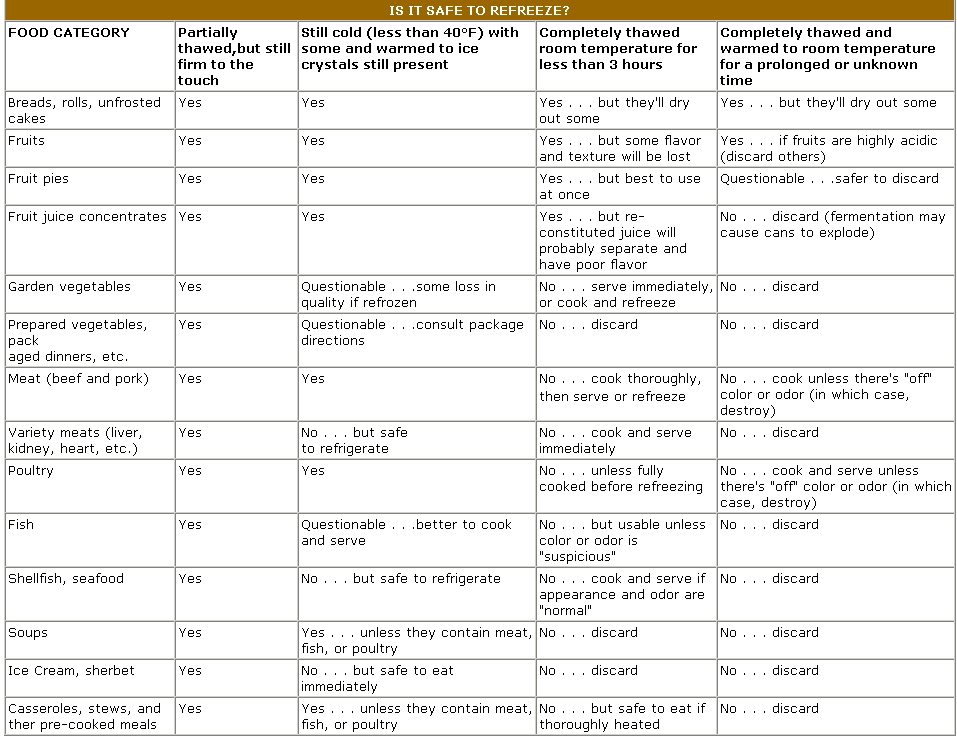
Let’s suppose the worst has happened. You unsuspectingly open the freezer door one day and discover that all the packages inside are well on their way to being completely defrosted. What do you do? First, check the foods to see if any still contain ice crystals. Those that do are safe to eat, and many of them can be refrozen. Cold foods, even if no ice crystals are present, can also be considered safe but must be cooked before being returned to the freezer. (It’s important to remember that refrozen foods, or frozen cooked foods, need to be used as quickly as possible to guarantee maximum nutritional quality.)

Never refreeze thawed vegetables (they may contain botulism spores, which would have ample time to grow and reproduce during the time it takes to refreeze) . . . casserole dishes that contain meat, fish, or poultry . . . or melted ice cream. And naturally, always use good judgment and toss out any food that looks or smells even a little suspicious.

Finally, use the accompanying chart to help determine how to handle specific categories of edibles. Remember, If there’s any doubt, throw it out. No food is worth the risk of poisoning yourself or someone else.

freezerchart.jpg

Filed Under: Features, Kitchen, Refrigerators and Freezers, Safety, _ Tips Tagged With: food safety, freezer, freezers, refreezing food

Questions and Comments About Convection Ovens

February 12, 2008 By NightOwl

It seems lately that everyone is interested in convection cooking and that even though manufacturers have brought the technology to the simple toaster oven, many home cooks are still confused about how to use them.  The The Wichita Eagle fields some questions regarding convection oven use and has some simple advice.

I almost never use the convection option when I bake, because recipes never mention it. When I tried it — shortly after we got the new oven — the suggestion to lower the temperature didn’t work the way they said it would, and I prefer having temperatures I can rely on. What is your opinion of convection cooking? Should I keep trying to figure it out?

Unlike a traditional oven, a convection oven contains a built-in fan that intensifies the circulation of hot air, which evenly surrounds your food and speeds cooking. It is particularly good for cookies and pastries because the even heat promotes uniform browning and saves you from repositioning baking sheets midway through.

It’s also great, says cookbook author and frequent Post contributor Tony Rosenfeld, for getting that perfect crisp skin on a roasted chicken. He would know: He cooked hundreds for his book “150 Things to Make With Roast Chicken (And 50 Ways to Roast It).”

Convection baking is less successful, some say, for wetter foods, such as braises or casseroles, that you want to keep from drying out.

The degree to which the cooking is sped up depends on the model of oven and what you’re cooking. Recommendations vary, but most guides advise decreasing regular recipe temperatures by about 25 degrees and cooking times by 10 to 25 percent. One alternative is to cook at the prescribed heat but start checking for doneness early.

The best advice is to follow the instructions for your particular oven and to spend time learning what works and what doesn’t. If you like to follow recipes to a T, use the regular settings.

Filed Under: Cooking, Features, Kitchen, Ranges Ovens and Cooktops, _ Tips Tagged With: convection, convection baking, convection cooking, convection ovens

How to Move Your Appliances

February 6, 2008 By NightOwl

Moving appliances is a big job.  Before you start, be sure you are aware of the work involved and that you really want to be the one to do it.  Some of us are handy with installations and large unwieldy hulks of metal and some of us aren’t. To decide what type you are, read on and then either go for it yourself, or hire someone to help you out.

The first step in moving an appliance is disconnecting it from its power and water sources.  Some disconnections, such as natural gas lines, should be handled only by qualified technicians.  Even if you decide to hire a mover, preparing for the move is something you can do.  After the appliance is disconnected, has properly disconnected them, make sure your appliance is clean and dry.

Other tips from Better Homes and Gardens include:

If you’re moving the appliances to a new home, on moving day load major appliances into the truck first. This ensures that the center of gravity will be closest to the driver, where it belongs. NOTE: If you don’t have an appliance dolly to do this safely, you can rent one from truck rental companies, hardware stores, and home centers.
Also, check to see if you saved the appliance installation instructions that you’ll need to reinstall the appliance. If not, call a local appliance dealer or the manufacturer for a new copy. You may also be able to find this information on the manufacturer’s web site.
You’ll also want to be prepared to protect the surfaces of appliances when you move them. Even simply moving an appliance in the remodeling process raises the possibility of scratching and denting. Especially when moving appliances from one home to another, be sure to have plenty of blankets and towels to protect the surfaces; also have stretch cords to hold the blankets in place.

The following tips for specific appliances are from Maytag:

Washing Machine

  • Disconnect washer from electrical supply.
  • Shut off the water supply and disconnect inlet hoses from their hot- and cold-water faucets, taking care not to lose the small piece of screening fitted in the end of each inlet hose. Have a bucket handy to catch water remaining in the hoses. Clean screen of sediment.
  • Remove drain hose from the standpipe; empty drain hose of any remaining water.
  • When you call the dealer for cartons, ask for the plastic shipping ring that fits inside the washer lid and holds the washer tub in place.
  • Tape washer lid closed with several pieces of masking tape.


Dryer

  • Disconnect from power source. Move dryer away from the wall and disconnect venting material.
  • If the dryer operates on gas, contact a gas technician to shut off gas and disconnect the gas line in accordance with local codes. On electric models, be sure you take the power cord with you. Tape door shut.
  • Disassemble the venting system and clean it — animals and insects are drawn to the warm air when the appliance is running and may have made a nest in opening.
  • Remove any lint buildup. Be sure not to use any plastic venting or other combustible ductwork in your new home.


Dishwasher

  • Unplug the appliance and close the water shut off valves. Remove the lower access panel below the door to disconnect electric and water lines.
  • Remove the lower access panel below the door to disconnect electrical connections, if you are comfortable doing this; otherwise, contact an appliance service company to do this work.
  • Disconnect the water lines and drain line, keeping a towel and small bucket handy for water spillage.
  • Open doors and unscrew the mounting brackets to free from countertop.
  • Make sure all racks are empty, then latch door securely. Once the appliance is free of the cabinets, you may wish to use masking tape to ensure the door is secure.
  • Bring leveling legs up into the appliance and pull dishwasher slowly from opening. To keep the appliance from damaging floor, tip the dishwasher back slightly, slip a large piece of cardboard under it, and gently slide the appliance out.


Range

  • Have a technician shut off gas and disconnect range from gas line and/or electrical power.
  • Remove broiler pan and racks from oven; on gas range, remove surface grates. Clean storage drawer below.
  • On ranges with standard gas burners, lift the top and secure burners to burner box support rod. On electric ranges, tape coil elements to the top of range.
  • Remove or tape down all knobs. If a knob is stuck, insert a washcloth behind the knob to help dislodge it. Tape the oven door shut.


Refrigerator

  • Turn off the refrigerator according to the instructions, and unplug it. You may have to move it out slightly from the wall to do this.
  • If you have a water dispenser, a plumber may be needed to disconnect it. If you want to attempt doing this yourself, be sure to carefully follow the instructions in your owner’s manual.
  • Empty all contents and clean the inside of the refrigerator, including all bins and racks.
  • Thoroughly clean the outside and back of the appliance.
  • Remove refrigerator handles only if the appliance doesn’t fit through the door of your old or new home.
  • Tape doors shut securely with masking tape or duct tape, and remove toe board.

It’s all pretty straightforward, plan ahead, get your supplies in order and make sure you are physically ready for a day of heavy lifting.

Filed Under: Dishwasher, Features, Gas Range, Oven, Refrigerators and Freezers, Washing Machine, _ Tips Tagged With: how to move applianes, moving a dishwasher, moving a dryer, moving a fridge, moving a refrigerator, moving a washer, moving a washing machine, moving appliances

Bright Lights, Bad Headaches?

February 5, 2008 By NightOwl

This may stretch the appliance theme a bit, but since so many of us are switching to compact fluorescent light bulbs to save energy, I think it is worth sharing. According to Dr. Isadore Rosenfeld at Parade Magazine, new research suggests some dangers:

Flickering bulbs have been reported to precipitate migraines or even seizures, though manufacturers say the new models have been improved. Fluorescent light can also aggravate skin rashes in people with lupus, eczema, dermatitis or porphyria.

Perhaps most important, the bulbs contain mercury.  If one breaks, don’t vacuum the debris- that can release toxic dust into the air.  Leave the room for 15 minutes.  Then, wearing gloves, place the fragments into a plastic bag, seal it and take it to a recycling center.

Filed Under: Household, Office, Parts/Repairs, Safety, _ Tips Tagged With: compact fluorescent, compact fluorescent bulbs, fluorescent bulbs, fluorescent lights

Repairing a Toaster or Toaster Oven

February 4, 2008 By NightOwl

If you haven’t read our article on How Toasters and Toaster Ovens Work, you might want to do that before you start any repairs. If you feel ready to tackle a smallish job like this, then read on…

How to Repair a Toaster

In many homes, toasters malfunction more than any other small appliance. There are two reasons for this. First, toasters are typically built economically to be a throw-away appliance. Replacement models start at $10.

Second, malfunctions are frequently not the fault of the toaster itself but of food particles that interfere with its operation. Excess pieces of bread broken off by carriage movement fall into the base of the toaster and accumulate, obstructing carriage movement, shorting out heating elements, plugging the latch release, and interfering with solenoid operation.

That’s why most pop-up toasters have a large crumb tray and door at the bottom of the toaster. By sliding or unlatching this crumb door you can release food particles trapped in the bottom of the toaster.

For a toaster that is used daily, this should be done once a week. Simply unplug the toaster, hold it over a trash container, and unlatch the door. Once the primary food particles have fallen out, move the toaster around to release other particles that may be trapped at the edges. Periodically clean out the toaster using a can of compressed air, making sure you don’t damage sensitive heating elements or switches.

How to Repair a Toaster Oven

Toaster ovens operate much like toasters. However, a toaster oven is more complex and is typically more expensive to purchase. The higher cost means that repairs are easier to justify. You will probably think twice before tossing a $75 toaster oven into the recycle bin. And because toaster ovens are less compact, they are often easier to work on than pop-up toasters.

Some toaster ovens simply toast bread and related food products horizontally rather than vertically as with pop-up toasters. Other toaster ovens are actually miniature ovens. The differences are identified by the wattage used — broilers require more watts of electrical power to operate — and by the controls. Some toaster ovens allow you to bake and broil foods, offering precise temperature and function control.

Typical toaster oven repairs include servicing the main switch, the thermal fuse, the heating element, and the solenoid.Servicing the Main Switch: The toaster oven’s main switch is an important operating part, one that gets extensive use and is a frequent culprit when things go wrong. In many cases, all that’s required is cleaning the switch. In others, the switch must be replaced. To access and replace the main switch:

Step 1: Remove the side panel and, if necessary, the power cord.

Step 2:Check the contact points for pitting or discoloration. If they are not making good contact, carefully rub them with very fine sandpaper, then clean them with an electrical contact cleaner spray or isopropyl alcohol on the end of a cotton swab. Be careful not to bend the contact leaves out of alignment.

Step 3: If the contacts are fused or the leaves broken, remove and replace the main switch. Main switches are fastened to the chassis with clips, screws, or rivets.Servicing the Thermal Fuse: A thermal fuse protects the toaster oven’s main switch from damage caused by an electrical overload. If the main switch doesn’t work, check the thermal fuse using a continuity tester or multitester. The thermal fuse should show continuity rather than an open circuit. If defective, remove and replace the thermal fuse with one of identical rating. In most models, this means cutting the fuse leads or wires and replacing the fuse unit.Some toaster ovens use a bimetallic thermostat or thermal cutout to protect the adjacent main switch from damage. Inspect the thermal cutout for debris, distortion, or discoloration. Clean debris away with a can of compressed air. As needed, clean the contact points with emery paper.Servicing Heating Elements: A heating element is vital to your toaster oven. It may only be on for a few minutes to toast bread, or, in the case of a baking/broiling unit, it may be on for an hour or more at a time. A heating element is simply a high resistance wire that glows as electricity flows through it. Heating elements, then, are easy to test. Here’s how:Step 1:Determine whether or not there is a clear path for electric current by touching a continuity tester or multitester probe to each end of the element.Step 2: If there is no clear path, remove the heating element. Removing an element may be as easy as unscrewing both ends and any support brackets; however, it may also require that rivets be removed and replaced. Your decision to replace a defective element will then depend on how easy it is to remove as well as the value of the toaster oven.

The two dark rods along the base of this toaster are the heating elements.
©2006 Publications International, Ltd.
The two dark rods along the base of this toaster are the heating elements.

Step 3: Once the heating element has been removed, replace it with one of identical rating and structure. Be very careful not to distort the shape of the new element as it is installed. Element wires are fragile and can be damaged easily. Higher-wattage elements are of thicker wire, much like the element in your conventional oven.

Servicing a Solenoid: The solenoid turns the electric current to the heating elements on and off. If the heating elements stay on longer than they should and burn your food, or if opening the appliance door turns them off, the solenoid may be defective. To test and replace a solenoid:Step 1: Look at the unit for visible damage and smell the area around the solenoid for obvious damage to components.Step 2: Use a continuity tester or multitester to verify your findings.Step 3: Replace the solenoid. In some units, this is easy. Simply unscrew the brackets and remove the unit. If replacing the unit requires cutting or desoldering, take the unit to an appliance-repair shop for service.So, now you are prepared next time your toaster goes on the fritz and you want to impress your schoolager with your knowledge of small appliances. If you would like to learn more, you can visit howstuffworks.com

Filed Under: Features, Kitchen, Parts/Repairs, Small Appliances, _ Tips Tagged With: how to repair a toaster, how to repair a toaster oven, repairing a toaster, repairing a toaster oven, toaster, toaster oven, toaster repair

  • « Go to Previous Page
  • Go to page 1
  • Interim pages omitted …
  • Go to page 6
  • Go to page 7
  • Go to page 8
  • Go to page 9
  • Go to page 10
  • Interim pages omitted …
  • Go to page 12
  • Go to Next Page »

Primary Sidebar

[footer_backtotop]

© 2006-2019 Appliance.net · Log in