• Skip to primary navigation
  • Skip to main content
  • Skip to primary sidebar

Appliance. net

Appliance news, reviews, ratings, forums, reports and buyers guides.
Locate repairs and parts. for home and kitchen appliances.

  • About Appliance.Net
    • BestPrice Family
    • Contact
    • Become a Featured Dealer
    • Retailer & Repair Services Advertising
  • Shopping
  • Appliance Forum
  • Manufacturers
    • Manufacturers 800 Numbers
    • Aga
    • Bosch
    • Caldera
    • Dacor – The Life of the Kitchen
    • General Electric – GE
    • Jenn Air
    • Sears – Kenmore
    • Thermadore
  • Sections
    • Features
    • News
    • Recalls
    • Kitchen
      • Dishwasher
      • Ranges Ovens and Cooktops
      • Refrigerators and Freezers
      • Microwave Oven
    • Household
      • Consumer Electronics
      • Heating and Cooling
      • Vacuum Cleaners
    • Laundry
      • Washing Machine
      • Dryers
    • Safety

Recall: Atico International USA Personal Blenders Due to Laceration Hazard

August 7, 2008 By Appliance

Name of Product: Signature Gourmet™ and Crofton® Personal Blenders

Units: About 124,000

Importers: Atico International USA Inc., of Fort Lauderdale, Fla. (for the Crofton® model) and East West Distributing Co., of Deerfield Ill. (for the Signature Gourmet™ model)

Hazard: While placing the cup on or off the base of the blender, the blender can be inadvertently turned on, activating the blade. This can pose a serious laceration hazard to consumers.

Incidents/Injuries: The firm has received 14 reports of lacerations, including 11 that required medical treatment and stitches.

Description: This recall involves the Signature Gourmet™ (item number W14A3691) and the Crofton® (model number SB-19) personal blenders. The blenders are white and have 3 components parts – a base containing a power button, a blade assembly, and a blending cup. Signature Gourmet™ or Crofton® is printed on the front of the base of the unit. “SB-19” or “W14A3691” is located on a label at the bottom of the unit.

Sold at: The Signature Gourmet™ blenders were sold at Walgreens stores nationwide from July 2006 through March 2008 for about $16. The Crofton® blenders were sold at Aldi stores nationwide from May 2007 through March 2008 for about $13.

Manufactured in: China

Remedy: Consumers should stop using the recalled blenders immediately and call Atico International USA for instructions on returning the product for a full refund.

Consumer Contact: Consumers should call Atico International USA toll-free at (877) 546-4835 between 9 a.m. and 5 p.m. ET Monday through Friday or visit the company’s website at www.aticousa.com
Filed Under: Kitchen, News, Recalls, Safety, Small Appliances Tagged With: atico blender, blender recall, crofton, signature Gourmet blender, signature Gourmet blender recall

Recall: Fire and Burn Hazards Prompt Recall of Gas Grills Sold at Lowe’s Stores

August 7, 2008 By Appliance

Name of Product: Perfect Flame Double Lid Four Burner Gas Grills

Units: About 24,000

Retailer: Lowe’s Home Centers, Inc., of North Wilkesboro, N.C. and Lowe’s HIW, Inc., of Tukwila, Wash.

Manufacturer: Lucas Innovation Inc., of China

Hazard: The cooking chamber of the grill can melt and/or ignite, posing a risk of fires and burn injuries to consumers.

Incidents/Injuries: There have been 175 reports of grill fires and 25 reports of grills melting, some of which resulted in minor property damage. No injuries have been reported.

Description: This recall involves Perfect Flame brand grills, Model GAC3615 four burner LP gas grills. The grill has two lids. “Perfect Flame” is printed on the larger lid. The model number, serial number, and date code are printed on a label on the right side cart frame panel. The following serial numbers and date codes are included in this recall.

Model Number Date Code Serial Number
GAC3615 KU
(July 07)
000001 – 001278
001282 – 001423
KV
(Aug. 07)
001424 – 001849
001855 – 005404
KW
(Sept. 07)
005405 – 006540
006548 – 009671
010299 – 010440
KX
(Oct. 07)
010005 – 010297
010441 – 014305
014322 – 017164
KY
(Nov. 07)
017165 – 020714
020715 – 022856
KZ
(Dec. 07)
022859 – 023284
024301 – 025862

Sold exclusively at: Lowe’s stores nationwide from October 2007 through July 2008 for about $300.

Manufactured in: China

Remedy: Consumers should immediately stop using the recalled grills, disconnect the propane tanks, and return the grills without the propane tanks to any Lowe’s store to receive a full refund.

Consumer Contact: For additional information, contact Lucas Innovation toll-free at (877) 385-8226 between 7 a.m. and 3 p.m. PT Monday through Friday, or visit www.gac3615grillrecall.com

Filed Under: Garage and Garden, News, Recalls, Safety Tagged With: gac3615grillrecall, grill recall, lowes, lowes grill, Lowes grill recall

Recall: DEWALT Cordless Brad Nailers Due to Injury Hazard

August 7, 2008 By Appliance

Name of Product: DEWALT DC608 Cordless Brad Nailers

Units: About 14,000

Manufacturer: DEWALT Industrial Tool Co., of Towson, Md.

Hazard: The nailer can operate when the lock-off (safety) is in the locked position. Also, the nailer can operate when the trigger is not pulled and the contact trip is depressed. The unexpected ejection of a nail poses a serious injury hazard to consumers.

Incidents/Injuries: DeWALT has received two reports of nailers operating when the lock-off (safety) was in the locked position. No injuries have been reported.

Description: This recall involves the DEWALT DC608 18 Volt Cordless 2” 18 Gauge Straight Brad Nailer with date codes 200728 through 200821. “DC608” is located on the right side of the magazine. The date code can be found on the underside of the handle, once the battery pack is removed. Units stamped with an “M” following the date code are not included in this recall.

Sold at: Wholesale distributors and retailers from October 2007 through May 2008 for about $280.

Manufactured in: Mexico

Remedy: Consumers should immediately stop using the nailers and contact DEWALT for the location of the nearest service center to receive a free repair.

Consumer Contact: For additional information, contact DEWALT toll-free at (866) 220-1481 between 8 a.m. and 5 p.m. ET Monday through Friday, or visit the company’s Web site at www.DEWALT.com

Filed Under: Garage and Garden, News, Recalls, Safety Tagged With: Dewalt, Dewalt cordless nailer, Dewalt nailer, Dewalt recall

Keep Your Lawn Mower Running Smoothly

August 6, 2008 By NightOwl

The Outdoor Power Equipment Institute (OPEI) offers their advice on maintaining your lawn tools for a greener yard and a greener world. Proper maintenance will also extend the life of your mower, trimmer or tiller.

  • Change your equipment’s oil seasonally and be sure to recycle the old oil.
  • Replace the spark plug and air filter, and check for proper carburetor adjustment … a properly tuned engine helps burn fuel more efficiently, thereby reducing emissions.
  • Be sure to use replacement parts recommended by the manufacturer.
  • Avoid gasoline spillage when you’re refilling the tank. Also, keep fuel tanks and containers sealed tight, leaving room (approx. 3/4 full) for expansion.
  • Tighten loose nuts, bolts and belts so that your mower runs a little quieter, too.
  • For mowers, sharpen cutting blades and keep decks cleared of all grass clippings to further enhance performance.
  • Replace old worn out equipment with the latest models offering low-emission engines that run 70% cleaner than 1990 models. Electric or rechargeable battery power is also available.

Today’s lawn mowers and power equipment are designed for lower emissions, you can help by practicing proper maintenance.

Filed Under: Features, Garage and Garden, _ Tips Tagged With: lawn mower, OPEI, outdoor power equipment institute, power equipment, power tools, yard tools

More Toaster Silliness

August 4, 2008 By Appliance

One thing I’ve always learned about kitchen appliances is that you should never anthropomorphize them.

They hate that.

Filed Under: Humor, Kitchen, Video Tagged With: anthropomorphization, anthropomorphize, toaster humor, toaster video

International Online Toaster Museum

August 4, 2008 By Appliance

BoingBoing Gadgets reports:

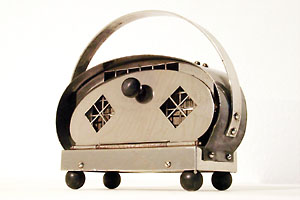
The International Central Service’s Online Toaster Museum shows in nearly infinite nuanced zoological detail just what happens when a piece of technology reaches evolutionary perfection: innovation switches to design. I could spend hours flicking through this collection, trying to decide upon my appliance-void kitchen’s optimal toaster as a reflection of its own inherent soul.

I’m fessing up my inner geek but I think stuff like this is gorgeous.

SIEMENS SCHUCKERT nickel plated toaster

http://www.toastermuseum.com/

Filed Under: Features, Humor, Kitchen Tagged With: guggenheim museum, international online toaster museum, international toaster museum, toaster, toaster museum

KitchenAid Introduces 72″, Counter-depth, French Door Refrigerator

August 1, 2008 By NightOwl

KitchenAid has introduced a new 72-inch counter-depth model that offers extra space on the inside and a built-in look on the outside.  This latest configuration joins a line that includes freestanding, counter-depth and 42-inch built-in French Door refrigerators. 

“Based on our research, we found that the currently available 69-inch model refrigerators don’t fully utilize the 72-inches of available height space found in many of today’s newly constructed homes,” said Debbie O’Connor, Senior Manager of Brand Experience for KitchenAid.  “Our newest French door model offers those who have this space an even better option to choose from in this increasingly popular refrigerator style.  Not only does our latest 72-inch model maximize space with more room inside the refrigerator, it also offers a seamless, built-in look at a gentler price.”   


The French Door Bottom Mount has a narrow door swing, making it easy to maneuver in the kitchen even when multiple cooks are working in the same space.  Its narrow door swing also allows for design flexibility in kitchen designs where a full door swing would be too tight.  Its wide refrigerator shelves have no interior divisions, allowing significantly greater space for wider items, such as cookie sheets, baking pans and serving trays.  In addition, the freezer on the bottom requires less bending, with more frequently accessed refrigerator items located higher and closer at hand.   


Premium features found on the latest KitchenAid® French door model include a single-hand interior water dispenser that is strategically located to prevent interference with usable refrigerator space.  A FreshChill™ Temperature Management System features a thermostat in the refrigerator and an evaporator fan that help regulates temperatures to maintain optimal storage and freshness.


The new 72-inch Counter-depth French Door Bottom Mount refrigerator models will be available in stainless steel, black and white.  Manufacturer’s suggested retail prices will range from $$2,799 to $3,099.   

Filed Under: Features, Kitchen, Refrigerators and Freezers Tagged With: counter depth refrigerator, french door refrigerator, kitchenaid, kitchenaid french door refrigerator, kitchenaid refrigerator

How Your Automatic Ice Maker Makes Ice

July 30, 2008 By NightOwl

A tall glass of iced tea or lemonade seems to symbolize summer, and it seems we are all adding ice to our drinks. I remember those old fashioned metal ice cube trays with a lever that was lifted to release the cubes. Those were followed by plastic trays that we twisted to get to the ice. Now I have noticed that it is nearly impossible to find a new refrigerator without an automatic ice maker built into it. If you’ve ever listened to your freezer making ice and wondered exactly how the system works, howstuffworks.com has the answer for you. We’ll share the gist of for you:

An ice maker works like those plastic trays, but the process of pouring water and extracting cubes is fully automated. A home ice maker is an ice-cube assembly line.

Most ice makers use an electric motor, an electrically operated water valve and an electrical heating unit. To provide power to all these elements, you have to hook the icemaker up to the electrical circuit powering your refrigerator. You also have to hook the icemaker up to the plumbing line in your house, to provide fresh water for the ice cubes. The power line and the water-intake tube both run through a hole in the back of the freezer.

When everything is hooked up, the ice maker begins its cycle. The cycle is usually controlled by a simple electrical circuit and a series of switches.

  • At the beginning of the cycle, a timed switch in the circuit briefly sends current to a solenoid water valve. In most designs, the water valve is actually positioned behind the refrigerator, but it is connected to the central circuit via electrical wires. When the circuit sends current down these wires, the charge moves a solenoid (a type of electromagnet), which opens the valve.
  • The valve is only open for about seven seconds; it lets in just enough water to fill the ice mold. The ice mold is a plastic well, with several connected cavities. Typically, these cavities have a curved, half-circle shape. Each of the cavity walls has a small notch in it so each ice cube will be attached to the cube next to it.
  • Once the mold is filled, the machine waits for the water in the mold to freeze. The cooling unit in the refrigerator does the actual work of freezing the water, not the ice maker itself. The ice maker has a built-in thermostat, which monitors the temperature level of the water in the molds. When the temperature dips to a particular level — say, 9 degrees Fahrenheit (-13 degrees Celsius) — the thermostat closes a switch in the electrical circuit.
  • Closing this switch lets electrical current flow through a heating coil underneath the ice maker. As the coil heats up, it warms the bottom of the ice mold, loosening the ice cubes from the mold surface.
  • The electrical circuit then activates the ice maker’s motor. The motor spins a gear, which rotates another gear attached to a long plastic shaft. The shaft has a series of ejector blades extending out from it. As the blades revolve, they scoop the ice cubes up and out of the mold, pushing them to the front of the ice maker. Since the cubes are connected to one another, they move as a single unit.
  • At the front of the ice maker, there are plastic notches in the housing that match up with the ejector blades. The blades pass through these notches, and the cubes are pushed out to a collection bin underneath the ice maker.
  • The revolving shaft has a notched plastic cam at its base. Just before the cubes are pushed out of the ice maker, the cam catches hold of the shut-off arm, lifting it up. After the cubes are ejected, the arm falls down again. When the arm reaches its lowest resting position, it throws a switch in the circuit, which activates the water valve to begin another cycle. If the arm can’t reach its lowest position, because there are stacked-up ice cubes in the way, the cycle is interrupted. This keeps the ice maker from filling your entire freezer with ice; it will only make more cubes when there is room in the collection bin.

It’s quite a system, and one we should appreciate on a 100 degree day.

Filed Under: Features, Kitchen, Refrigerators and Freezers Tagged With: freezer, ice, ice cubes, ice maker, icemaker, making ice

Laundry Tips From Whirlpool

July 28, 2008 By NightOwl

If you want good advice, go to the experts. I know I’m not alone in my opinion that laundry takes up way too much of my time. Whirlpool, a leading manufacturer of washers and dryers offers their advice on getting your clothes clean with the least amount of hassle.

  • As your laundry accumulates, pre-sort it into designated baskets for lights, darks and whites. This way, a load will be ready to throw in the washer whenever you have a minute to spare.
  • While sorting, don’t forget to close zippers, clasp hooks and check pockets to prevent snags and avoid washing tissues, money, lipstick, etc.
  • Streamline the laundry process by incorporating storage solutions and flat working surfaces into your laundry room. This will keep laundry where it belongs and eliminate the need to treat, sort and fold in other rooms of the house.
  • Wash small loads as needed between laundry days. Today’s high efficiency washing machines use substantially less water and energy than a conventional top-loading washer. Which means you can do small loads when you have time, rather than waiting for the basket to fill up.
  • Don’t overload the washer or dryer. Clothes come out cleaner and less wrinkled when given room to move freely.

Filed Under: Dryers, Features, Laundry, Washing Machine, _ Tips Tagged With: whirlpool, whirlpool appliances, whirlpool laundry, whirlpool washers and dryers

Save Energy and Save Money or Not?

July 25, 2008 By NightOwl

Energy costs are going up and we’re surrounded by warnings of global warming.  What’s a conscien-tious consumer to do?  Buy an energy efficient appliance of course.

From washing machines that use steam instead of hot water, to refrigerators that use low-energy compressors, to low-power computer screens, electronics companies are furiously developing energy-efficient products and heavily promoting lines already on the market that use less electricity than competitors’ brands.

Homemakers are increasingly buying front-load washing machines, which use gravity to move water instead of agitators as in top loaders.

And now, new washers from LG Electronics and Whirlpool offer an option to use steam instead of hot water, cutting water and power use by more than 70 percent compared with some top-load models.

LG expects 4 out of 10 front-load washers it sells in North America to use steam technology by the end of this year, compared with 2 out of 10  currently.

Their biggest appliance plant in South Korea makes mostly front loaders, while recently built plants like one in Russia have stopped manufacturing top loaders altogether.

Among refrigerators, which consume 30 percent of overall power in a typical home, traditional compressors are giving way to linear compressors that use up to 40 percent less power and make less noise.

In the computing industry, power-saving has long been a key priority as bigger and hungrier gadgets challenge battery life.  PC makers from Apple to the Lenovo Group are replacing screens lit by conventional cold cathode fluorescent lamps with light emitting diode (LED) displays.  “LED saves up to 40 percent of the power used in traditional backlights,” said Jeff Kim, an analyst at Hyundai Securities. “Next year they will be commonly found in notebook screens, and will be increasingly used in TV panels from 2010.”

But too often, these energy-efficient products carry a hefty price premium to reflect the cost of developing new technologies, which in turn hampers faster adoption.  For instance, Whirlpool’s washing machines with steam are sold at $1,300 to $1,500, compared with a traditional machine priced at $700.  Still, makers argue that the lifetime savings from green products could amount to the price of the appliance itself.

Sometimes a little incentive helps.

The Japanese electronics retailer Bic Camera is running a campaign in which buyers of eco-friendly products get extra credit points that can be used for future purchases. “That’s a little nudge to help people buy products that are more efficient, even if they are slightly more expensive,” said Naoko Ito, a Bic Camera spokeswoman. “Consumer interest is high.”

Filed Under: choosing a Kitchen Appliance, Consumer Electronics, Features, Kitchen, Laundry, Refrigerators and Freezers Tagged With: energy efficient appliances, energy saving appliances

  • « Go to Previous Page
  • Go to page 1
  • Interim pages omitted …
  • Go to page 45
  • Go to page 46
  • Go to page 47
  • Go to page 48
  • Go to page 49
  • Interim pages omitted …
  • Go to page 83
  • Go to Next Page »

Primary Sidebar

[footer_backtotop]

© 2006-2019 Appliance.net · Log in