• Skip to primary navigation
  • Skip to main content
  • Skip to primary sidebar

Appliance. net

Appliance news, reviews, ratings, forums, reports and buyers guides.
Locate repairs and parts. for home and kitchen appliances.

  • About Appliance.Net
    • BestPrice Family
    • Contact
    • Become a Featured Dealer
    • Retailer & Repair Services Advertising
  • Shopping
  • Appliance Forum
  • Manufacturers
    • Manufacturers 800 Numbers
    • Aga
    • Bosch
    • Caldera
    • Dacor – The Life of the Kitchen
    • General Electric – GE
    • Jenn Air
    • Sears – Kenmore
    • Thermadore
  • Sections
    • Features
    • News
    • Recalls
    • Kitchen
      • Dishwasher
      • Ranges Ovens and Cooktops
      • Refrigerators and Freezers
      • Microwave Oven
    • Household
      • Consumer Electronics
      • Heating and Cooling
      • Vacuum Cleaners
    • Laundry
      • Washing Machine
      • Dryers
    • Safety
You are here: Home / Archives for Laundry

Laundry

Laundry is Moving Up

July 27, 2009 By NightOwl

The next generation of laundry has arrived and the status quo is getting a much-needed makeover. New washer and dryer technologies and innovations in detergents and clothing care save time and energy, making laundry feel like less of a chore.

Everything in its place

Laundry rooms used to be relegated to the basement, but more people are finding space for washers and dryers in convenient areas of the house like upstairs near bedrooms. Experts say installing a “laundry nook” is not only a good investment and can raise the value of your home, but it can make hauling baskets of clothing up and down flights of stairs a thing of the past.

The closer the washer and dryer are to living spaces the more important it is for them to be quiet. “Look for machines with new technologies that reduce vibration for nearly noiseless laundry sessions,” says home design expert Doug Wilson. “If your washer and dryer are out in the open, look for colorful and sleek models that can stand out stylishly on their own. New models are available in a variety of designer finishes such as wild cherry red, Riviera blue and even colors that give the look of stainless steel without the stainless steel price tag.”

Near the laundry area or on the go, make sure to keep the latest stain removal products handy. Treating a stain as soon as it happens can help to ensure your clothing won’t be ruined and prevent the need for multiple washings to remove the stain. Oxygen-based stain removers are gentle, nontoxic and effective on nearly every stain and most types of fabrics. And portable stain-erasing pens and wipes are handy for treating stains no matter where you are.

Get the most out of your wash and save energy

Until now, washers only used one washing motion — tumbling — to clean clothes. Select washers from LG now feature technology that provides a new way to care for your clothes with four new washing motions — rolling, stepping, swinging and scrubbing.Cold care, heavy duty and enhanced hand-wash cycles use a combination of these motions to gently and effectively clean clothes. For example, the cold care cycle uses cold water in combination with these motions to clean clothes as effectively as the normal cycle that uses hot water, but with an energy savings of more than 60 percent.

Look for the ENERGY STAR label on washing machines, and you can cut your water costs by up to 50 percent, according to the U.S. Department of Energy. There are also machines that automatically adjust the water temperature and the amount of water used for each load to prevent excess and waste. Detergent designed for use in cold water helps to save energy by effectively cleaning clothes without hot water.

Another trend in laundry is the use of steam for greater energy and water efficiency. Steam washers and dryers also offer enhanced clothing care options such as short, steam-only cycles that help to reduce wrinkles and remove odors from clothing with using water and detergent (and can help cut down on trips to the dry cleaner in the process, helping to save money in addition to energy).

Stay healthy

With 70 percent of U.S. households affected by asthma or allergies, LG’s SteamWasher with Allergiene cycle gently and effectively reduces allergens, including common triggers — like dust mites and pet dander — on fabrics by more than 95 percent, according to the Asthma and Allergy Foundation of America.

“Now there’s a washing machine that is so effective at reducing common household allergens, the LG SteamWasher, that we are able to certify it ‘asthma and allergy friendly,’” says Mike Tringale, director of external affairs for the Asthma and Allergy Foundation of America.
Filed Under: choosing a Kitchen Appliance, Dryers, Features, Household, Laundry, Washing Machine Tagged With: clothing care, dryer, Laundry, laundry detergent, laundry room, laundry technology, LG, LG dryer, LG washer, LG washer and dryer, LG’s SteamWasher with Allergiene cycle, washer, Washing Machine

Paint Your Appliance Pink Contest

July 20, 2009 By NightOwl

PartSelect.com is pleased to announce the launch of its Paint Your Appliance Pink contest which runs from July 1, 2009 – September 1, 2009. Contestants can enter to win 1 of 3 Pink Prize Packages valued at $369.97 and help PartSelect donate up to $10,000 to Breast Cancer Research.

Breast Cancer is the second most common form of cancer and the second leading cause of death in women. It is so common that 1 in 8 women will be diagnosed with breast cancer during her lifetime.

For each valid contest entry received, PartSelect will donate $25.00 to the Breast Cancer Research Foundation, up to a maximum of $10,000.

The contest is easy to enter. Simply paint a pink ribbon on any major home appliance and send a photo of it to PartSelect. The ribbon can be located anywhere on the appliance and only needs to be big enough to be visible in the photo. A valid entry consists of one pink ribbon painted on one major appliance. Contestants can enter once per appliance.

Each contestant will be entered into 3 monthly draws to win 1 of 3 Pink Prize Packages valued at $369.97. The Pink Prize Packages consist of a Pink KitchenAid Stand Mixer, Pink Stand Mixer Cover, Pink Silicone Spatula, Pink Silicone Heart Pan, Pink Measuring Cups and Spoons Set, and a Cook For The Cure Apron. Draws will take place on August 3, 2009, September 3, 2009, and October 3, 2009.

The official contest webpage and rules can be found at Paint Your Appliance Pink.

Filed Under: contests, Dishwasher, Dryers, Features, Household, Kitchen, Laundry, News, Oven, Ranges Ovens and Cooktops, Refrigerators and Freezers, Small Appliances, Washing Machine Tagged With: appliance contest, cook for the cure, donate to breast cancer reasearch, painted appliances contest, pink appliances, pink ribbon, pink ribbon contest, win pink appliances

Buying a Used Appliance

July 15, 2009 By NightOwl

Washing machines and other hardworking appliances seem to know the worst times to breakdown. With the economy causing most of us to be careful with our spending, replacing a major appliance is not high on anyone’s to-do list. Sometimes your just need a few more months out of the machine before a big move or remodel, but then it happens, the squealing, leaking and motor problems – time for a new unit.

A second-hand washer, dryer or refrigerator can be just what you need. We’ve got some suggestions on where and how you can get what you need.

    Buy used appliances at furniture stores. Most of these stores have a section for used appliances and furniture that people have traded in. Check to see if there is a warranty left or if it is “as is.” Some stores offer their own short return period of thirty to sixty days.

    Check the want ads in your local newspaper for used appliances. If you see an ad for something you want, make an appointment to go inspect the appliance. These will be “as is” so make sure the appliance is fully functional before you buy.

    Go online to online stores that sell used appliances. Make sure to inquire about the return policy and ask if there is a warranty on the appliance.

    Visit flea markets in your area to find used appliances to buy. Most of the time these will be “as is” so make sure you plug it in and find out if it works before you buy.

    Find out about neighborhood garage sales to buy used appliances. These are usually advertised by people putting notices around the neighborhood, stating when and where the sale will be held.

    Search craigslist.org for used appliances in your area. Again,be certainthe appliance is in working order as there will be no warranty.

    Check the Consumer Product Safety Commission (www.CPSC.gov) for any recalls on the appliance you find.

Buying a used appliance can be a smart choice, as with any large purchase, do your research and shop carefully.

Filed Under: choosing a Kitchen Appliance, Dryers, Features, Household, Kitchen, Laundry, _ Tips Tagged With: buying a used appliance, buying a used dryer, buying a used refrigerator, buying a used washing machine, used appliances, used refrigerator, used washing machine

Appliance Installation and Power Needs

July 13, 2009 By NightOwl

Whether you plan to install your new appliance yourself or have a professional do it, be sure your home is ready before delivery. Read these tips on power requirements, placement and more to ensure a successful installation.

Appliance Power Requirements

Check the power requirements of each appliance. To run major appliances and heavy electrical equipment, you need 220-volt current in the house. And unless your clothes dryer runs on gas, it will require a 220-volt outlet to operate, so it’s necessary to upgrade to 220 to handle these and other heavy equipment.

Appliance Installation

When having an appliance installed, be sure it can be removed easily for service. Flexible hook-ups for dishwashers and gas ranges can make repair jobs less labor intensive. Also, leave extra electric cable when installing electric wall ovens and cooktops. This will minimize the time the technician spends on the job and reduce the cost to you.

Here are some tips from appliancemagic.com regarding some specific appliances:

Dishwashers
If your kitchen floor is being tiled, make sure that it is tiled beneath the dishwasher or at least raise its flooring to the same height as the tiles. Once down, there may not be enough clearance to remove the dishwasher for servicing. The only alternative will be to lift the whole countertop off of the cupboards, a needless expense.

Wall Ovens
If you are installing a wall oven below countertop level, be aware that small children could be exposed to a burn hazard. Wall ovens do not have to conform to the same temperature standards that regular ranges do. This is because they are designed to be installed above counter height.

Washing Machines
When installing a washing machine, be sure water shut-offs can be reached easily. Also ensure the water hoses are long enough to remove the appliance when necessary. A floor drain may also be necessary should the water pump or motor fail.

Washing machines are designed to be used on solid flooring, like concrete. If it is being installed on a wooden floor, extra joist bracing may be needed. The mounting of an additional plywood section can also strengthen an existing wooden floor. Severe internal suspension damage can occur if used on unstable flooring.

Refrigerators
Refrigerators with forced air condensers are the only kind that can be built in. Models with regular static condensers will not be able to dissipate the heat if used in this application. This will result in poor cooling efficiency and damage to the compressor. You can tell forced air models by the fan, located in the compressor compartment, used to circulate air through the condenser.

Filed Under: Dishwasher, Features, Gas Range, Household, Kitchen, Laundry, Oven, Ranges Ovens and Cooktops, Refrigerators and Freezers, Washing Machine, _ Tips Tagged With: appliance installation, DIY appliance installation

Appliance Buying Tips to Avoid a Mistake

July 10, 2009 By NightOwl

Here are three great pieces of advice from the Guru – Consumer Reports – that will get you off to a good start when you begin that search for the perfect new appliance. Many consumers commit these errors:


Not checking a brand’s track record.
You can boost your odds of buying a reliable model by choosing a reliable brand from our Brand Repair History for different appliances. You’ll often save money in the bargain because, in general, lower-priced mainstream brands have often been more reliable than upscale brands. Our brand-repair histories are culled from nearly 450,000 respondents reporting on nearly 2.5 million appliances for our Annual Product Reliability Survey conducted by the Consumer Reports National Research Center.

Paying extra for extended warranties.
While they might boost profits for stores, extended warranties generally are a bad deal for you because most products don’t break within the three years most extended warranties cover. And because repairs often cost about the same as the extended warranty, you’re better off chancing it.

Jumping at package deals. Stores typically offer lower prices if you buy a refrigerator with a range and dishwasher from the same brand. But doing so could sacrifice performance, because some appliances work far better than others with the same name. You could also increase your chances of repairs down the road because some brand’s fridges have been far more reliable than its ranges and dishwashers.

Filed Under: choosing a Kitchen Appliance, Features, Household, Kitchen, Laundry, _ Tips Tagged With: appliance purchase, appliance warranties, buying appliances, buying new appliances, mistakes to avoid buying appliances

Read This Before You Buy Your Next Appliance

July 1, 2009 By NightOwl

Purchasing a major appliance is a major decision. To ensure satisfactory return on your investment, comparison shop before each appliance purchase.

The following pointers from The Association of Home Appliance Manufacturers can help ensure your satisfaction with appliance purchases:

• Ask your dealer for specification sheets from several manufacturers who build the types of appliances you plan to purchase. Compare available features, designs and capacities;

• Read the warranty before finalizing your decision. Does the warranty cover the entire product? Only certain parts? Is labor included? How long does the warranty last?

• Ask you dealer for the appliance’s use and care manual and read it carefully before you buy the appliance. The dealer should have available manuals from the floor models. Reading the manuals will help you ask pertinent questions, tell you how the product operates and inform you of any special care the product needs;

• Decide which features you will really use. Consider the possibility of adding features at a later date, such as installing an icemaker in a refrigerator;

• Decide what capacity or size your family requires. For example, when purchasing a room air conditioner, know the dimensions of the room you want to cool and the number of windows, so you can select a model with sufficient cooling capacity;

• Check the space available for the appliance to make sure you select the right size unit and make sure halls and doorways allow clearance for entry and installation;

• Establish the cost of delivery and installation — are they included in the appliance’s price?

• Make sure authorized factory service is readily available in your area for the brand you select;

• Check the product’s design carefully to make sure it meets your needs and accommodates your habits and favorite cookware. Compare the designs of different models and brands;

• Compare price in relation to convenience and service, which will vary by model. Price tends to increase as features are added;

• Avoid overloaded circuits by making sure your house has adequate electrical service for the appliance. Check for adequately grounded, three-hole receptacles.

By doing your homework and being prepared, you can be an appliance buying superhero, avoiding the purchasing pitfalls that trip up ordinary shoppers.

Filed Under: choosing a Kitchen Appliance, Dishwasher, Dryers, Features, Gas Range, Household, Kitchen, Laundry, Oven, Ranges Ovens and Cooktops, Refrigerators and Freezers, _ Tips Tagged With: AHAM, appliance buying guide, appliance buying tips, appliance warranties, buying a new appliance, buying guides, large appliance purchase, major appliance purcahse, warranty tips

Spare Parts After a Washer Repair – A Reader Shares His Story

June 26, 2009 By NightOwl

Recently one of our readers shared a humorous appliance repair story with us. We thought we’d spread the laughter out for a lighthearted weekend chuckle.

It happened a few years back when my neighbor knocked on my door hoping for some help. It seems he had a problem with his washing machine and knew he could count on me due to my vast knowledge of appliance repair (yeah, right). You can now see how this relates to having extra money. Don’t pay a repair man when you can do it yourself with a trusty neighbor’s help.

Actually, he had fixed his problem but was faced with a dilemma all great men are faced with following a repair. What to do with the parts that are left over. Well, he was fortunate, he only had one part left over and was hoping I could help him discover where it went. It was about 6 inches long, was a flattened piece of wire and was in the shape of an arch. Nothing about this thing looked familiar.

We went so far as tearing the machine back down to see where it could be missing and had been at it for about two hours without any luck when his wife returned home and asked what was up. Being a little frustrated and short on patience, my friend explained in man terms that, and I quote, “we are trying to figure out where this d????? piece of wire goes in this d????? washing machine.” She looked at the wire and started laughing. “What”, asked her husband.

“That’s not a part of the washing machine, that’s the under wire out of my bra.”

Money saved, time lost, and another successful d-i-y repair.

If you have your own humorous story you’d like to share, please feel free to post it in the comments section below or send it to stories@appliance.net

Filed Under: Features, Humor, Laundry, Washing Machine Tagged With: DIY washer repair, funny appliance story, spare parts after repair, washing machine repair

Repair or Replace? Be Careful What You Choose

June 24, 2009 By NightOwl

In the not so recent past, if a household appliance was in need of repair, technicians invoked the 50% rule – if a repair cost 50%or more than the cost of a new unit, buy the new one. But these days as the recession deepens, more homeowners and rethinking that advice.

Getting anything repaired, however, can be frustrating. To stay profitable, service companies book multiple appointments on the same day, forcing consumers to sit home and wait for hours. And because it would be impossible for technicians to drive around with every possible replacement part, some repairs require a followup visit that can be subject to the same inconveniences.

Typically manufacturers outsource warranty service to another company, which subcontracts the actual work to a third party. So after contacting the manufacturer, consumers frequently find themselves calling yet another number, and then later, after the service call has been arranged, communicating with a third party — who inevitably seems to have a different idea about when the work will be done and what the warranty covers.

Appliance-repair rage has also driven at least one person, a 42-year-old woman in northern England who says she endured six months of rescheduled appointments and other delays, to hold a repairman hostage until he fixed her washing machine. “I am not proud of what I did,” Tracey Fox told The Daily Telegraph in January, “but it was the only way I was going to get something done.”

After the nightmare comes the bill. Manufacturers intentionally charge a lot for replacement parts as a way of encouraging consumers to buy more products, said Ronald Sawyer, an appliance servicer in Cohoes, N.Y., and a founding member and executive director of the Professional Service Association, an appliance repair industry group. “When manufacturers came up with a machine that retails for $400, that price covers all parts,” he said. “But when it breaks down and you needed a new timer, the timer alone could cost $250. Manufacturers create the technology when they design new machines, they control the manufacturing process, they make the replacement parts, so we’re at the mercy of the manufacturers.”

The complexity of warranties makes matters worse. Years ago, most manufacturers gave warranties of at least two years. Now, however, warranties on most midrange appliances are just one year, say retailers and service providers. Boutique companies like Sub-Zero and Miele typically provide coverage for longer periods.

The best way to avoid the hassle of repair, according to numerous repairmen and Consumer Reports, is to buy the simplest possible appliance. “The more doo-dads, the more stuff you add to an appliance, the more likely it’s going to need a repair,” said Mark Kotkin of Consumer Reports National Research Center. Consumers would also be wise to recognize that the more sophisticated the equipment they purchase, the more complicated — and expensive — the repairs can be.

Still, few products will last as long as those made during the 1960s and 1970s. “The old Maytag washer your grandmother had, she bought that thing and used it for 35, 40 years,” Sawyer said. “It held up like nothing was ever going to go wrong with it. Today, you just don’t get that quality.”

You can read the whole story HERE

Filed Under: Dishwasher, Dryers, Features, Household, Kitchen, Laundry, Parts/Repairs, Ranges Ovens and Cooktops, Refrigerators and Freezers, Washing Machine, _ Tips Tagged With: appliance repair, appliance repair costs, appliance repairman, appliance repairs, repair or replace, repairman, replacing appliances

Win an LG HE Washer and Dryer Pair

June 8, 2009 By NightOwl

The LG True Steam washer dryer pair is the prize available to contestants who enter to win through the LG or Benjamin Moore Paints websites.

From what we can find, the washer includes these Key Features:

* TrueSteam™ Technology
* Ultra Capacity (4.5 cu.ft.)
* TrueBalance™ Anti-Vibration System
* Wash/Rinse Optimizer™
* Trilingual LCD Display
* 1300 RPM Spin Speed
* 9 Washing Programs

Hey, it’s a chance for a free washer and dryer – Go ahead, give it a try.

Filed Under: contests, Dryers, Features, Laundry, Washing Machine Tagged With: appliance contest, LG, LG contest, LG dryer, LG washer, LG washer and dryer

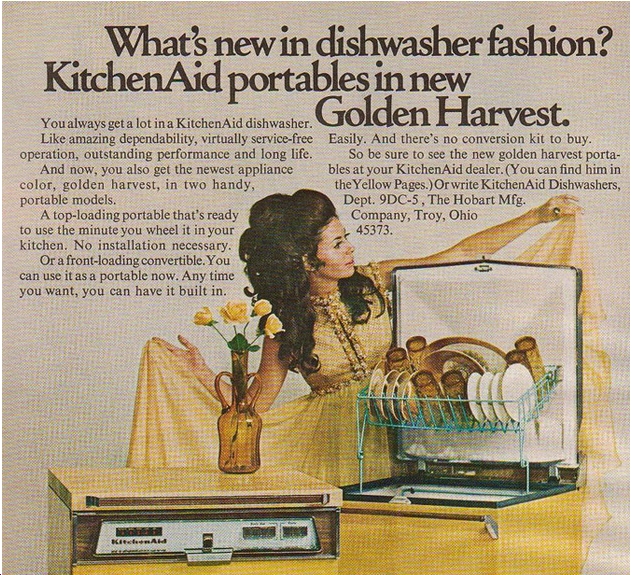
70’s Appliances – Do You Remember Harvest Gold?

June 1, 2009 By NightOwl

Today stainless is still popular in kitchen remodeling, but it is slowly losing its standing to oiled bronze. Thirty years from now we will all look back at these kitchens and fondly remember them the same way we are chuckling at the kitchens of the 1970’s.

Although my mother chose the ever-so-popular Avocado Green appliances, another favorite of the era was Harvest Gold. This ad not only shows the wonder of the modern dishwasher, but also how important it was to dress appropriately for the job. Especially since this was one of the new portable dishwashers that she would be pushing around the kitchen.

Notice the stylish brown tinted glassware? My parents had something similar that I thought was the height of elegance.

Filed Under: Dishwasher, Features, Humor, Kitchen, Laundry, Recalls, Safety, Small Appliances, _ Tips Tagged With: 1970's appliances, 1970's dishwashers, 70's appliances, dishwashers, harvest gold appliances, old dishwashers

  • « Go to Previous Page
  • Go to page 1
  • Interim pages omitted …
  • Go to page 6
  • Go to page 7
  • Go to page 8
  • Go to page 9
  • Go to page 10
  • Interim pages omitted …
  • Go to page 17
  • Go to Next Page »

Primary Sidebar

[footer_backtotop]

© 2006-2019 Appliance.net · Log in