• Skip to primary navigation
  • Skip to main content
  • Skip to primary sidebar

Appliance. net

Appliance news, reviews, ratings, forums, reports and buyers guides.
Locate repairs and parts. for home and kitchen appliances.

  • About Appliance.Net
    • BestPrice Family
    • Contact
    • Become a Featured Dealer
    • Retailer & Repair Services Advertising
  • Shopping
  • Appliance Forum
  • Manufacturers
    • Manufacturers 800 Numbers
    • Aga
    • Bosch
    • Caldera
    • Dacor – The Life of the Kitchen
    • General Electric – GE
    • Jenn Air
    • Sears – Kenmore
    • Thermadore
  • Sections
    • Features
    • News
    • Recalls
    • Kitchen
      • Dishwasher
      • Ranges Ovens and Cooktops
      • Refrigerators and Freezers
      • Microwave Oven
    • Household
      • Consumer Electronics
      • Heating and Cooling
      • Vacuum Cleaners
    • Laundry
      • Washing Machine
      • Dryers
    • Safety
You are here: Home / Archives for Kitchen

Kitchen

How Microwave Ovens Work

November 30, 2007 By NightOwl

We use them almost daily and yet many people have no idea how a microwave oven works.  Here are the basics courtesy of the folks at HowStuffWorks.com:

A microwave oven uses microwaves to heat food. Microwaves are radio waves. In the case of microwave ovens, the commonly used radio wave frequency is roughly 2,500 megahertz (2.5 gigahertz). Radio waves in this frequency range have an interesting property: they are absorbed by water, fats and sugars. When they are absorbed they are converted directly into atomic motion — heat. Microwaves in this frequency range have another interesting property: they are not absorbed by most plastics, glass or ceramics. Metal reflects microwaves, which is why metal pans do not work well in a microwave oven.
You often hear that microwave ovens cook food “From the inside out.” What does that mean? Here’s an explanation to help make sense of microwave cooking.
Let’s say you want to bake a cake in a conventional oven. Normally you would bake a cake at 350 degrees F or so, but let’s say you accidentally set the oven at 600 degrees instead of 350. What is going to happen is that the outside of the cake will burn before the inside even gets warm. In a conventional oven, the heat has to migrate (by conduction) from the outside of the food toward the middle (See How a Thermos Works for a good explanation of conduction and other heat transfer processes). You also have dry, hot air on the outside of the food evaporating moisture. So the outside can be crispy and brown (for example, bread forms a crust) while the inside is moist.

In microwave cooking, the radio waves penetrate the food and excite water and fat molecules pretty much evenly throughout the food. No heat has to migrate toward the interior by conduction. There is heat everywhere all at once because the molecules are all excited together. There are limits, of course. Radio waves penetrate unevenly in thick pieces of food (they don’t make it all the way to the middle), and there are also “hot spots” caused by wave interference, but you get the idea. The whole heating process is different because you are “exciting atoms” rather than “conducting heat.” 

In a microwave oven, the air in the oven is at room temperature, so there is no way to form a crust. That is why microwavable pastries sometimes come with a little sleeve made out of foil and cardboard. You put the food in the sleeve and then microwave it. The sleeve reacts to microwave energy by becoming very hot. This exterior heat lets the crust become crispy as it would in a conventional oven.

Filed Under: Kitchen, Microwave Oven, _ Tips

Brewing the Perfect Cup of Coffee

November 29, 2007 By NightOwl

If you want know how to do something right, ask an expert.  The experts at Krups, the manufacturers of both commercial and home coffeemakers, offer these tips for great brewing:

1. The Coffee Beans Whole beans stay fresh longer
 It is best to buy as soon after roasting as possible. Ideally, you should purchase your coffee fresh every 1 – 2 weeks; and buy only the quantity that you need to last for that period of time.

2. The Grind
 Always grind your beans as close to the brew time as possible.

Do not underestimate the importance of the grind to the taste of your coffee. They type of grind used in a particular machine can alter the taste and flavor of coffee. The general “rule of thumb” is the longer the extraction period (the time water spends in contact with the grounds) the coarser the grind should be. Generally coffee is finely ground for espresso and coarsely ground for a French press machine. Drip coffee machines fall somewhere in the middle. Experiment with the grind and your favorite coffee to get the perfect result. If you have your coffee ground in the store, specify the grind or let them know what type of machine you are using so they can grind accordingly.

3. The Water
 The water you use is VERY important to the quality of your coffee. Its best to use filtered or bottled water. If you are using tap water let it run a few seconds before filling your coffee pot. Be sure to use cold water. Do not used distilled or softened water. Some Krups coffee machines use a unique filtration system that removes traces of chlorine for a better taste and reduces mineral deposits for longer machine life. The ratio of coffee to water is also very important. Use the proper amount of coffee, which is typically 1 to 2 tablespoons of ground coffee for every six ounces of water. This can be adjusted to suit individual taste preferences. Be sure to check the “cup” lines on your brewer to see how they actually measure.

4. Water Temperature During Brewing
 Your coffee machine should obtain a water temperature between 195 – 205 degrees Fahrenheit when brewing. Water temperatures below this temperature will result in flat, weak coffee while water that is too hot will scald the grounds and result in poor tasting coffee.

5. Brewing Time
 The amount of time that the water is in contact with the coffee grounds is another important factor affecting the taste of your coffee. If the taste of your coffee is not optimal, it is possible that it is either over-extracting (the brew time is too short). the type of filter used – gold tone, paper, flat or cone – also effects the contact time. Experiment with the contact time until you can make a cup of coffee that suits your tastes perfectly.

Krups’ Deep Brew Technology, a feature of most Krups coffee machines, eliminates any room for error because it heats water to an ideal temperature, then pulses it through the coffee grounds at precisely timed intervals, resulting in rich, fully flavored coffee.

6. After Coffee Has Been Brewed
 Brewed coffee should be enjoyed immediately. It is recommended to use a pre-heated mug or coffee cup to maintain optimal temperature. If the coffee is not served immediately, it is recommended to pour the coffee into an insulated thermos and serve within 45 minutes. Remember: never reheat your coffee. Thermal coffee machines, such as the Krups Aroma Control Therm, are an ideal way to brew and store coffee while maintaining freshness because it does not require a warming plate which makes coffee bitter over time.

7. Enjoy Your Coffee!
 Take a moment to smell the aroma and taste the flavor. A thoughtfully prepared cup of coffee will make for a much more enjoyable coffee experience.

Filed Under: Cooking, Kitchen, Small Appliances, _ Tips

Bigger, Faster, Better

November 27, 2007 By NightOwl

The basic appliances in our homes are becoming less basic each year. Refrigerators are getting larger with separate temperature zones, dishwashers sanitize dishes and washers clean with less water than you would think possible.

Let’s start with washers. At the Columbus Dispatch , Kevin Kidder writes:

About 30 percent of washers sold are front loaders, which use 65 percent less water and 35 percent less electricity.

The complaint against front loaders used to be that putting clothes into them was a pain.

But manufacturers have added up to 18-inch pedestals on the bottom, elevating the machine and easing the strain on aching backs.

The machines achieve their efficiency through the horizontally oriented tubs, which don’t need to fill to wash clothes. They also spin faster than predecessors, meaning more water is removed from the fabric before it goes into the dryer.

Refrigerators aren’t just larger, they are 45% more efficient than they were in 1990. Another nod to saving resources is filtered water through the fridge. No more buying bottled water.

For those consumers who are concerned about the air in their refrigerator, “Sub-Zero will offer an ‘air-scrubbing system’ to eliminate bacteria and odor in the refrigerator air. The molecules from those odors won’t settle on the foods, altering the flavors.” One really big change in refrigerators is “new refrigerator drawers, which are stand alone units that, as the name would suggest, are shaped like under-the-counter drawers. They are about 2 feet wide, pull out like a drawer and have several cubic feet of storage.”

Moving on to ranges and ovens,

Ovens now commonly have convection fans that reduce cooking times. Many are dual-fuel — electric oven, gas range — combining the best methods of cooking for each. Electric ovens require 220-volt outlets.

Some ovens also have accompanying warming drawers, designed to stay lower than 200 degrees.

Some newer models keep foods moist by injecting steam into the cooking cavern.

Using steam preserves the nutrients in vegetables and is good for other foods that need moisture such as souffles, said Sue Scatterday, commercial sales specialist with Builders Appliance Supply on the Far East Side.
With ranges, an older technology from the 1970s — induction cooking — has been refined and could be the next big trend in stovetop cooking. With induction cooking, magnetic fields heat the iron cooking pot directly; the surface of the range remains cool to the touch.

Gas ranges have evolved, as well. More people want the professional look of industrial burners and stainless steel.

With those higher temperature burners, hoods have become more powerful yet quieter.

“Because we’re seeing so many, we stress that you need the large hoods,” she said. And because newer houses are so airtight, some people actually need “air makeup systems” that allow air to flow into the house so the hood can work properly.

Then we have dishwashers- the newer ones are drying hotter and using 39% less energy than in 1990. Dishwashers are also available in under-the-counter drawer styles, allowing for multiple work stations in kitchen design. I’m personally especially pleased with how quiet the new dishwashers are.

Today’s appliances are performing better, more efficiently, and with less effort than ever.

Filed Under: Cooking, Dishwasher, Gas Range, Kitchen, News, Oven, Refrigerators and Freezers, Washing Machine

Don’t Clean Your Oven Today!

November 21, 2007 By NightOwl

Here’s a very good tip from Appliance411:
as, garberator, microwave, oven, range, stove, refrigerator, automatic and clothes washers or washing machines

Helpful and money saving tips from APPLIANCE411! Oven Cleaning
Clean your oven *well* in advance of a dinner party! It is not usually a good idea to try self-cleaning an oven *immediately* prior to a big dinner. Cleaning a week or more in advance would allow service to be scheduled should a problem arise. They often do… and at the of worst times.

Filed Under: Cooking, Kitchen, Oven, _ Tips

Cook Safely This Holiday Season

November 19, 2007 By NightOwl

With the joy of the holidays comes the joy of delicious food- and someone has to cook it.  If that someone is you, you might want to take a look at the Association of Home Appliances Manufacturers (AHAM)safety page.  There, you can order brochures, read safety tips and learn facts like these:

  • The range-top was involved in nearly 8 of every 10 cooking fires.
  • In nearly 3/4 of the fires reported (73%), the person responsible for the fire was not in the area when the fire started.
  • The other major causes of cooking fires reported were grease, food left on the range, and combustible materials on the range-top.
  • In nearly 2/3 of the fires (64%), people in the residence did not attempt to fight the fire but left the area.
  • Unfortunately, one-half of the people who did try to fight the fire, did it incorrectly, further endangering themselves and their families.
  • A larger percentage of the cooking fires were caused by people in the age range of 19 – 69 than is represented by their percentage of the overall population.
  • One-half of the cooking fires reported were caused by people between the age of 30 – 49.

The age range of 19-69 and 30-49 being overrepresented makes sense to me since that is the age of most family members who are the cooks in the family. So, if you are the family chef, cook carefully and have a delicious holiday.

Filed Under: Cooking, Gas Range, Kitchen, News, Ranges Ovens and Cooktops, _ Tips

Viking Fridge Review

November 18, 2007 By NightOwl

If you are in the market for a new, large refrigerator and you would like to get a custom, built-in look with standard cabinets, this just might be the fridge for you.

Filed Under: Kitchen, Refrigerators and Freezers, Reviews, Video Tagged With: Viking Fridge review

Sharp Introduces New Line of Microwaves

November 18, 2007 By NightOwl

Sharp launched a new line of heavy-duty compact microwave ovens designed to accommodate the limited space designs of busy commercial kitchens. The new line, which includes the 1200-watt R-CD1200M, 1800-watt R-CD1800M, and 2200-watt R-CD2200M, is redesigned to have a small footprint and a 0.7-cubic-foot cooking cavity. New TwinTouch dual controls make the microwaves ideal for crowded kitchens, allowing users to easily operate the oven no matter where it is located.

The new models feature dual control panels, one along the top of the unit and another on the bottom edge along the door. In many kitchens, the microwave is placed on a high shelf, which makes accessing the standard control panel challenging. In those situations, users can opt to use the more readily accessible bottom-mounted controls, which eliminates reaching up to the top of the microwave.

Models R-CD1200M, R-CD1800M, and R-CD2200M will be available in early 2008.

Filed Under: Cooking, Kitchen, Microwave Oven, Small Appliances

Induction Cooking is Hot- and Cool

November 16, 2007 By NightOwl

Induction cooking has been around for a while, but it seems that in North America it is just beginning to assert itself.  I’ve recently learned more about how the technology works from some helpful sites. 

At choice.com.au they offer a clear explanation about the magnetic fields:

Each ‘element’ (an induction coil) generates a magnetic field that induces heat in steel cookware placed on top of it. In essence, the pot becomes the element that cooks the food, so the cooktop surface doesn’t get as hot as other cooktops. Induction cooktops have the same instant control as gas and are the fastest of all cooktop types to heat and cook food — for example, they take about half the time of conventional electric cooktops to boil water.

They go on to explain that induction cooktops are smooth surfaces that are extremely easy to keep clean.

Because the heat is contained by the vessel, the cooking surface doesn’t get hot.  This picture shows that induction cooking is hot and cool.

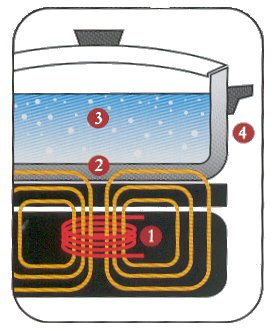
Another site, theinductionsite.com, has very thorough explanations of induction cooking and even includes some simple drawings like this one below with clearly labeled descriptions.

diagram of induction process

How Induction Cooking Works:

  1. The element’s electronics power a coil that produces a high-frequency electromagnetic field.
  2. The field penetrates the metal of the ferrous (magnetic-material) cooking vessel and sets up a circulating electric current, which generates heat.
  3. The heat generated in the cooking vessel is transferred to the vessel’s contents.
  4. Nothing outside the vessel is affected by the field–as soon as the vessel is removed from the element, or the element turned off, heat generation stops.

(Image courtesy of Induction Cooking World)
As mentioned in point two in the diagram, pots and pans must be made of a ferrous, or magnetic metal.  One way to check if your current pans are ferrous is to see if a magnet will stick to them.  If your pans do not have a ferrous metal base, you will need to consider the cost of some new cookware along with the generally steep cost of these cooktops. (I found them online for $1,800-$5,000.) There are some induction ranges in the works that can use other metals, but they’re not available yet.

I had concerns about the magnetic fields generated by the coil, and discovered that they are not completely unfounded. People with pacemakers should take precautions near the range and might want to check with their doctors before getting one. Theinductionsite has a whole page dedicated to the controversy surrounding radiation from electromagnetic waves.

There seem to be plenty of both pros and cons to induction cooking- lower energy use saves money, but the cooktop is expensive and may require new cookware.  Food cooks more quickly, but new techniques must be learned.  The safety of the burner going off automatically if there is no pot on it, but the pots slide easily and could get unintentionally bumped so the food won’t cook.  If you are shopping for a new range there is a lot to consider about induction cooking and the choice will be a personal one.

Filed Under: Cooking, Kitchen, News, Ranges Ovens and Cooktops, Reviews, _ Tips

These are a Few of My Favorite Things

November 14, 2007 By NightOwl

I have some appliances that are my go-to tools for making life easier- my immersion blender, bread machine and toaster oven are a few.  At appliancepulse.com  they’ve come up with a list of what they consider the eight counter-top appliances people can’t do without.

They are:

  1. coffee machine
  2. microwave
  3. toaster oven/toaster
  4. blender
  5. food processor
  6. stand mixer
  7. rice cooker
  8. juicer

I’ll stand by numbers 2-5, but my coffeemaker can stand idle for weeks at a time, I haven’t used my juicer in about 8 years (Don’t ask me, I don’t know why I keep it.)  and I don’t own and see no need to own a rice steamer. 

Everyone’s cooking style is different and families’ needs change.  Things we can’t seem to do without -the juicer- become clutter in the closet and some  appliances that seemed impossible forty or fifty years ago are standard in the most basic kitchens today – the microwave.

What are you using daily at your house?  We’d love to hear from you.

Filed Under: Cooking, Kitchen, Small Appliances

Downsizing? Some Choice Advice for Baby-Boomers

November 13, 2007 By NightOwl

As the population ages, many people choose to move to smaller homes or condos for ease of maintenance.  Some Baby-Boomers are purchasing smaller, second homes that can become retirement homes in the future. 

Marriette Mifflin at about.com advises:

Take a serious look at your appliances, large and small, and consider their age, general condition, capacity, performance, and how likely you are to use them in the future. Consider the impact of moving certain appliances. Older refrigerators or freezers may not survive a physical relocation and would be best replaced for the new home.

Replacing older appliances for more efficient ones will save you energy dollars and the outlay to purchase now, will hopefully provide you with many years of trouble-free use. Replacing later on a limited budget may be more difficult.

We all have our favorite appliances and housewares, but most of us have items that we actually like, but seldom use for whatever reason. And, we often store appliances that aren’t working quite right, for disposal at some undetermined time – well now is the time. When you’re faced with moving, re-evaluating and de-cluttering is a must.

A second or retirement home may be smaller than the family home you’ve spent many years in new appliances should be evaluated accordingly.

Do you really need a high capacity washer and dryer, or would a compact set be sufficient? What size of refrigerator is adequate? Maximize counter space by choosing space-saving appliances and limiting counter presence by importance, and storing the rest.
Consider handling and ease of operation. Choose a vacuum that you can easily lift and maneuver, or consider an upright that may be easier to handle. When buying a new laundry set, the optional pedestal drawers do add to the cost, but may greatly increase the ease of transferring clothes and reducing back strain. An upright freezer may be more accessible for you than a chest model.

It is worth the investment of some careful planning now– it could pay off with some serious savings financially and emotionally, in the future.

Filed Under: Dishwasher, Gas Range, Household, Kitchen, Laundry, Oven, Ranges Ovens and Cooktops, Refrigerators and Freezers, Small Appliances, Vacuum Cleaners, Washing Machine, _ Tips

  • « Go to Previous Page
  • Go to page 1
  • Interim pages omitted …
  • Go to page 33
  • Go to page 34
  • Go to page 35
  • Go to page 36
  • Go to page 37
  • Interim pages omitted …
  • Go to page 41
  • Go to Next Page »

Primary Sidebar

[footer_backtotop]

© 2006-2019 Appliance.net · Log in